
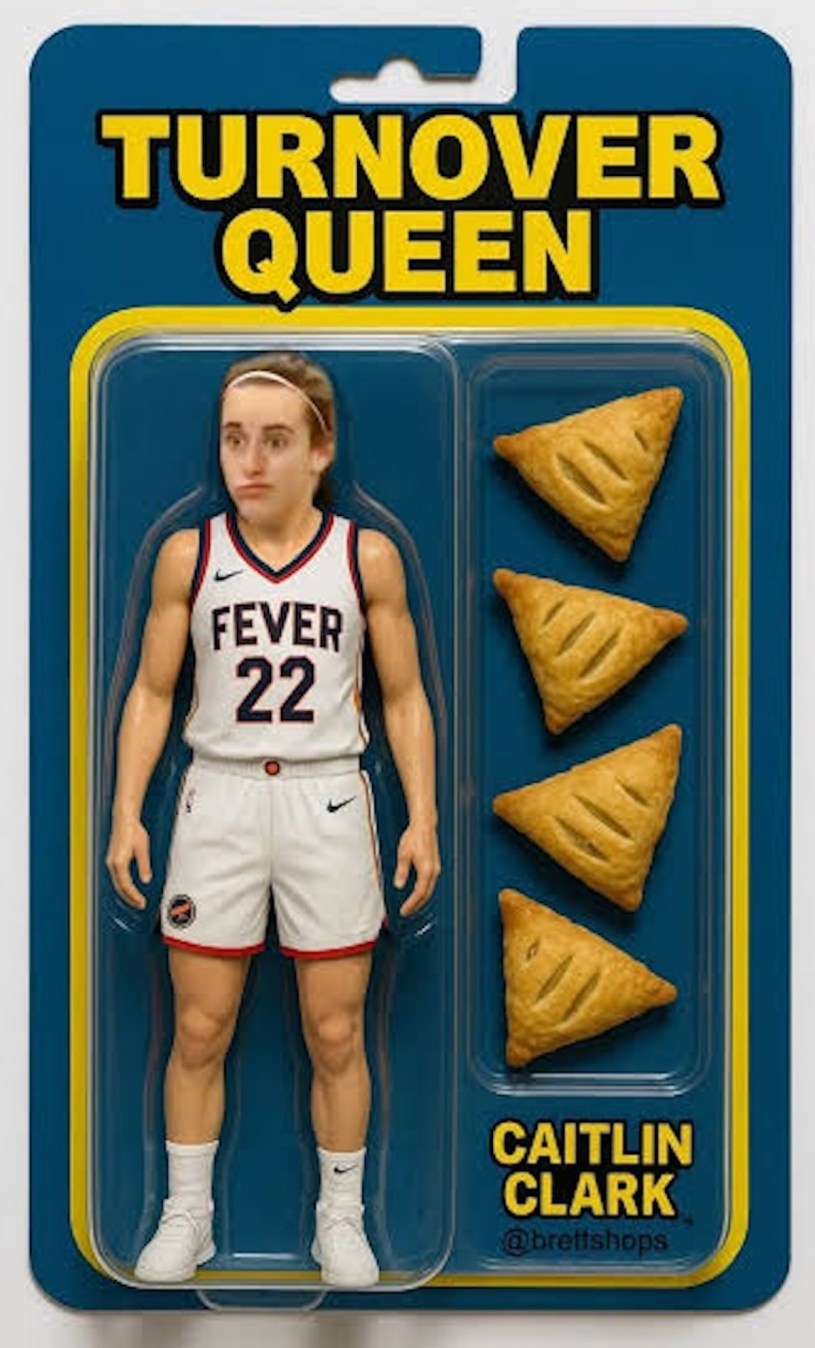
With less than a week left in the regular season now, we take this time on WNBA Tuesday to look at the statistics of Caitlin Clark, for the first time in awhile. Not much has changed, as the Indiana Fever are in fifth place and probably will open the playoffs Sunday on the road. Part of the reason is Clark herself and her gaping flaws that manifest themselves clearly when one looks at the data beyond the counting statistics (scoring, etc.). As we have noted since her college days, she is not well rounded.
First, the obvious notion based on the social-media meme above: Clark is a turnover machine. She has committed 33 more turnovers than any other player in the league, and even in context for her sky-high usage rate, this is not a good thing. Every time she loses the ball, it stop her team from scoring while handing a scoring opportunity to the opposition. It is like a fumble or an interception in football, and we all know those are not good. In basketball, most turnovers happen in scoring position.
Let that sink in.
For her career, she has committed 466 turnovers in just 91 games for a rate of 5.1 lost balls per contest. She coughed it up 223 times, an NBA record, as a rookie in 2024, so she’s improved a little bit there in the past few seasons, but Clark is still the Turnover Queen. That hurts all her sabermetric valuations, really, as she is only seventh on her own team in Offensive Rating, a math projection of points produced per 100 possessions. Obviously, she produces no points every time she coughs it up.
Second, her shooting percentages are somewhat dismal for someone taking any amount of shots, let alone the volume of heaves she proffers up every game. Again, she is seventh on her own team in Effective Field Goal percentage (eFG), and she’d been even lower if she wasn’t so good from the free-throw line (84.8 percent). Still, her 54.3% eFG mark is middling on her own team, because she makes only 36.8% of her team-high 7.9 three-point attempts per game. Yet this is her best pro mark.
She is a career 34.4-percent shot from downtown, and what hurts her team is that her backcourt parter Kelsey Mitchell makes 45.6% of her three balls, while shooting one less per game. So even if Clark took just one less “logo 3” per game and gave that shot attempt to Mitchell instead, the Fever would score more points—and probably have an extra win or two, depending on the opponent and the closeness of the score. When you’re seventh on your own team in overall shot efficiency, that’s not good.
Third, Clark’s defense is even worse, and while Indiana is not known for its defense due to its high number of shots taken, Clark stands ninth on her own team in Defensive Rating. She doesn’t rebound particularly well, and she’s eighth on her own team in steal percentage. Because she is on the floor so much, the counting stats need to have context, and that’s what sabermetric analysis provides: valuation for each minute spent on the floor in every facet of the game, not just the scoring.
And where does Clark land on her own team there, in terms of Win Shares per Minute Played? Currently, she is third on her own team, behind Mitchell and front court star Aliyah Boston. Thus, Clark is literally the third-most valuable player on the Indiana roster, even though some mediots want to promote the idea she’s a league-wide MVP candidate. That is pure hogwash, as any fool can score a lot of points if they take enough shot (remember the Kobe v. Curry analysis). Thus, little has changed.
Clark is still very overrated no matter how many points she scores, because the turnover rates and poor shot percentage from three-point, magnified by her high usage rate, prevent her team from scoring more, in actuality, and her defense is somewhat of a joke, enabling the opposition to score even more points off her inadequacies. We will remind everyone she is still young, as this is just her third season in the WNBA. But her two better teammates were All Stars before Clark joined the team. So …
They remain the better players, and they’re not automatically “better” now for playing with Clark. In fact, the statistical trends demonstrate that Boston is “worse” now because of Clark, as the younger player takes away opportunities from the more-efficient front court player and hurts the team’s overall success. Blame the Fever coaches for that, as they clearly feel pressure to let Clark shoot, shoot, shoot … even though that costs the team a lot of points every game. And the defensive issues are bad.
So forget the points scored and watch the bad passes, the ill-advised missed shots, and the poor defense—then you’re seeing the complete player, unfortunately.

