
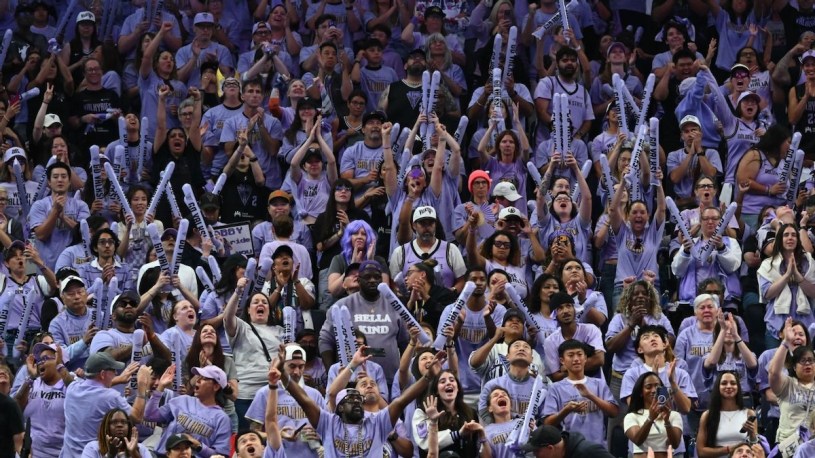
It’s time for the Sunday Surmising column again, as the WNBA playoffs came to a close last night in San Francisco at Ballhalla (also known as the Chase Center). The Golden State Valkyries made some history for North American professional sports, becoming the first true expansion team to win a league championship in its second season of existence. As proud members of the franchise’s Founders Club, we have covered this team with our WNBA Tuesday pieces for the duration of its short journey to now.
But we were wrong about these playoffs, that’s for sure. Remember when we picked Las Vegas and Minnesota to be in these Finals? We do. Back in late September, we predicted both the Atlanta Dream and the Valkyries would get bounced in the semifinals, as well. Oops. And even when the championship matchup was finalized in early October, we did pick the Valkyries to win … in five games. Doh! We were wrong there, too, although we did emphasize home-court advantage as a huge element here.
We were right about that: Atlanta outscored Golden State by four points per game overall in the seven-game series, but once again, clueless basketball fans should be reminded that s/he who scores the most points does not always win. Yes, that’s a riddle of sorts, but counting stats are for simpletons. The Valkyries won this series in ugly fashion, grinding out four wins while mostly getting blown out in three losses. Both teams were rather evenly matched, and we simply overestimated the Golden State momentum.
So be it.
A quick glance at some key sabermetrics for the championship round shows us these mathematical truths: again, the Dream scored more points, but the Valkyries played superior defense. Atlanta shot the ball better, percentage wise, but Golden State protected the ball better and committed fewer turnovers. Both squads were equally adept at offensive rebounding, with the Dream coming out a little bit ahead on the defensive glass duty. Atlanta got to the free-throw line a lot more than the Valkyries did, too. What to think?
It’s the defensive edge that stands out most, as Golden State forced more turnovers and blocked more shots— compensating for the scoring deficit and shooting woes, as the Valkyries took 30 more shots from the floor overall. That doesn’t matter when you lose big, but when the games are tight, those extra possessions matter a lot. This is what the Caitlin Clark crowd does not understand: turning the ball over is very, very bad. It costs your team points, and it gives more scoring opportunities to the other team. Ouch!
The Valkyries have a system, and they have their specific players to run that system. It’s not pretty; it’s downright painful to watch most nights, in truth. But it’s a selfless system, really, regardless of how many points Finals MVP Gabby Williams scored. If it wasn’t going to be Williams, it would have been someone else. That’s the reality: in the regular season, Williams actually was just sixth on the team in sabermetric value overall (2.9 Win Shares) and even worse in sabermetric value per minute played (ninth).
Yet in the postseason, she was the one who stepped up just enough (1.8 WS) to be the top dog of the moment; don’t let the mediot hyperbole fool you. She was outstanding on defense during the regular season yet barely above average on offense, similar to most Golden State players this year. Only five Valkyries earned 1.0 Offensive Win Shares during the regular season, and Willams was not one of them. In the playoffs, across 13 games, four different Golden State players were sharing the offensive load, though.
In order, Williams, Kayla Thornton, Tiffany Hayes, and Kiah Stokes carried the offensive load, with minimal differences between them all, collectively. But get this: in the regular season, only Hayes and Thornton finished in the team’s top five for Offensive Win Shares. Veronica Burton, Janelle Salaün, and Kaitlyn Chen all but disappeared offensively in the postseason, allowing Williams and Stokes to step up in their places. This is what we discussed all season: the roster depth provided it all.
Sometimes, that’s the way it goes: we aren’t saying Williams doesn’t deserve glory and credit, but she’s not the reason the Valkyries won 32 games and earned the No. 2 seed. Yet once the playoffs started, she certainly became one of the primary reasons Golden State is hoisting the trophy and will raise a banner to the rafters of the Chase Center alongside those of the Golden State Warriors. It really was a team effort: Williams, Stokes, Hayes, and Thornton just happened to be the ones who took charge in the playoffs.
Ironically, Chen and Salaün did next to nothing in the postseason, but they were key reasons why the team won 32 games. See how this works? The advanced analytics do not lie, folks. Furthermore, Williams and Stokes each topped the Valkyries in Defensive Win Shares for the postseason, and they deserve so much of that collective credit for stifling—just enough—the Dallas Wings, the Aces, and the Dream. Burton, Hayes, and Keila Charles also get huge credit for their very-good defensive efforts in this success.
Charles was a solid role player in the regular season who got a lot more playing time in the postseason based on matchups and performance. She posted 2.7 WS to finish right behind Williams on the roster in terms of overall sabermetric value, despite her rotational status. She went from 20.2 minutes per game in the regular season to 23.7 mpg in the playoffs—and truly made her presence felt in the Golden State championship run. She is one of the unsung heroes of this overall team-based accomplishment.
Again, studying the sabermetrics is a really fun thing to do, as it does reveal a lot more than the talking heads and mediots on television or online will offer you. That being said, we are still in a bit of disbelief that this collection of misfits—as the Moneyball film called the 2002 Oakland Athletics roster—was able to achieve so much in spite of conventional wisdom and moderately good expectations. In truth, with the Warriors/Valkyries roots in Oakland, this may be the ultimate win for “moneyball” math/theories.

