
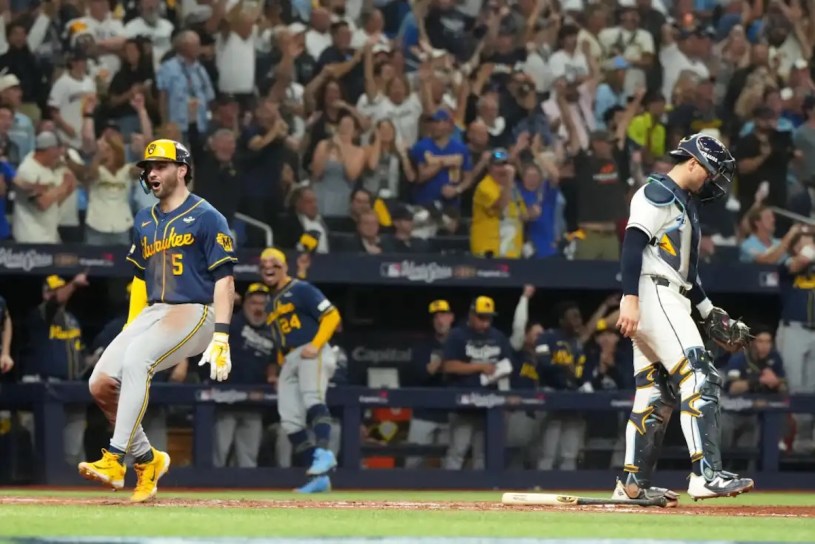
On MLB Monday, we’ve been pointing out the past realities for World Series winners for years now: overwhelmingly so, the MLB champions have come from large TV markets, and they’ve enjoyed large payrolls. Those crazy trends—only one winning team from each of those classifications, respectively, since the 1994 labor strife that canceled the final two months of the season and the playoffs—were both broken with the Milwaukee Brewers winning the 2026 World Series. The odds of this happening were tiny.
And yet it happened. The Brewers, perhaps like the Oklahoma City Thunder winning the NBA title in 2025, were the best regular-season team in the sport, but we’ve seen many teams fitting this profile not win the Series, and some of those teams were also from small markets with small payrolls. So why Milwaukee now? Why this year? That’s what we want to deconstruct with both a little bit of math and a little pinch of wonder. As the wise Carl Sagan often posited, it’s very good to be both bewildered and skeptical.
First, we must disclose we do find it a little fishy that of all the teams in the last three decades-plus since the Bud Selig Commissioner Coup in 1992 to buck these near-concrete trends, it’s Selig’s old team to do it. That in itself stinks since the man himself did everything to keep small-market, small-payroll teams from winning while he was commissioner, and his policies have continued basically unchanged since he left the MLB office. How Milwaukee even got a new stadium this century is also suspect.
Second, we’ve seen this theory now in reliable and unreliable places: “Baseball owners are trying to prove that small payrolls can win just before the CBA expires.” This wades a little bit too far into conspiracy circles for us, yet we see the timing being right on multiple levels for a team like the Brewers to win (see below). For any miraculous event to occur, it’s never just one thing happening; it’s a combination of several things happening in just the right causal order to affect a rare-incident happening, truly.
Lastly, before our mathematical deconstruction commences, it always takes a little bit of luck to win the World Series, and the Brewers certainly got a lot of that (see below). Like the old cliché about golf’s U.S. Open, you don’t win the Fall Classic—it wins you. Perhaps that was just the pendulum swinging around, as Milwaukee had not won a baseball championship since the 1957 season, and even then, it was another franchise doing it. The Brewers certainly had experienced their own bad luck over the years.
Alright; with those caveats out of the way, on with the deconstruction!
Sabermetric Realities
The Brewers were the top sabermetric team in the major leagues this year, so they had that going for them. Yet they were also the top-rated sabermetric team last year, too, so that shows how much that matters. The New York Yankees tied last season’s Milwaukee club for that honor, while the Los Angeles Dodgers took the “sabermetric” crown in 2024. See our point? Yes, we follow the math, but often enough, the math established over 162 games isn’t enough to “guarantee” October success in the end.
As we all know, the best teams don’t always win the title, but sometimes they do, no matter what the sport. That’s why they play the games, right? Still, what the math shows here is that on the sabermetric level, the Brewers’ postseason success this year was not a fluke. The Chicago Cubs losing to the San Diego Padres in the National League Wild-Card Series last month was a fluke, and upsets happen when it’s a short series; any single moment can change the momentum in any sporting event and render math moot.
The pendulum swings, of course, and the longer the matchup goes, perhaps that evens out anomalies so that regression to the mean can occur. In a short series, there often is not enough “time” for that to happen, and so upsets happen. The Brewers were able to avoid the upset bug for a variety of reasons this October, the primary one being their sabermetric performance as established over 162 games in the regular season ended up overriding any short-term anomalies they faced against their three playoff opponents.
Luck Factor
Some of the above does come down to luck. Take the NL Division Series between Milwaukee and San Diego: in Game One, the Padres got dealt some serious bad luck in the form of a probable, game-winning home run in the ninth inning being negated by stadium design and “intriguing” ground rules. This was one of the most ridiculous things we’ve ever seen in five decades of watching MLB. There’s no surety that San Diego would have won the game eventually, of course, but that is as lucky as it gets.
Now, in Game Two, the Padres had the best closer in the sport (Mason Miller) on the mound to finish off a win on the road. Miller’s regular-season numbers were quite impressive: 1.67 ERA, 0.900 WHIP, an NL-best 38 saves, and 129 strikeouts in just 70 innings. Sure, he blows a save here and there, but this was as close to automatic as you can get. So what happens? Miller blows the save, and the Brewers win both games at home to start this series when they very easily could/should have lost them both. Luck!
Turns out Miller’s wife was probably in labor, and he knew it when he took the mound; his mind was completely elsewhere, sadly. And if that’s the kind of good fortune the Brewers needed to win, so be it. They took advantage; there were other “lucky” moments ahead for Milwaukee, but these first two games of October for the team pretty much showed that something was brewing (pun intended) for their fate. Sometimes, everything just falls your way in improbable and unpredictable fashion, and history is made.
Miscellaneous Data
The numerous fan complaints about the Dodgers’ success certainly had to have some impact here, because the Brewers’ 4-0 sweep of Los Angeles in the NL Championship Series was not about the math. The Dodgers were barely behind Milwaukee in the sabermetric rankings, to the tune of just 0.1 runs per game—which is basically nothing. But last year, we saw solid mathematical underdog L.A. sweep the Brewers in the NLCS, and this year, the opposite happened. Whether anomalous or lucky, it is what it is.
The fatigue for the Dodgers, mentally and physically, was real, too. Like discussed multiple times with the Golden State Warriors playing in five consecutive NBA Finals from 2015-2019, going deep into the postseason takes its toll—not only directly but in the repeated lack of recovery time when the season is over. Eventually, you’re just doing to collapse. This is why so few teams have ever won three straight World Series, and it’s only happened once since the advent of free agency in the mid-1970s: exhaustion.
In fact, no National League team since before the end of World War II has even won three consecutive pennants; that’s how hard it is to do what the Dodgers were attempting to do. L.A. had also become the new “Evil Empire” of the sport, much like the Yankees had become in the mid-to-late 1990s. Fans were tired of New York winning all the time then, too, and even those Yankees fell short on the precipice of winning another World Series, twice even (2001, 2003). All good things must come to an end, alas, right?
Onward and Upward
We can’t lie: we hated watching the Brewers win because Colorado, Detroit, Oakland, and Seattle—among other deserving teams in supportive cities—couldn’t win a Series in the last three decades-plus. This was a perfect storm, and once the CBA drama settles in the near future, we don’t expect to see this kind of scenario unfold again. That is neither “bad” or “good” … it just is what it is. We also hate that the man who ruined baseball for the masses got to see his “family team” rise victorious under his greedy policies.
Oh well. Hope springs eternal in baseball again now for every other small-market, small-payroll team in places like Pittsburgh, et al. Or will it?!

