
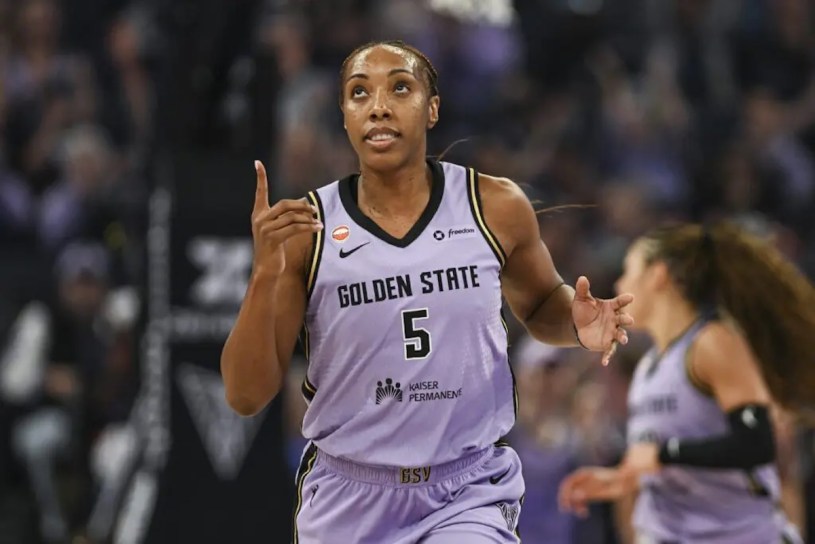
The Golden State Valkyries failed to win their tenth consecutive game last night, in uncharacteristic fashion, blowing a seven-point lead with three minutes left at home and losing by eight points. The team went into a hard funk, getting outscored 17-2 by the middling Washington Mystics over the final stretch of regulation. There were bad turnovers, missed free throws, and poor shot selection as the Valkyries went to an unusual group on the floor featuring two point guards: Veronica Burton and Kaitlyn Chen.
Today on WNBA Tuesday, we want to examine the roster decisions that the team made in the offseason before the current campaign began. Golden State is 19-8 right now, in third place by percentage points, which is an improvement over their first season of play last year, which still resulted in a playoff spot, the first time a WNBA expansion team had qualified for the postseason. Clearly, the team’s front office knows what it’s doing, as does the coaching staff led by Natalie Nakase. Yet still?
We have questions … two, specifically: the personnel decisions to keep Chen over former first-round pick Carla Leite, now playing for the expansion Portland Fire, and the situation where the team retained Kayla Thornton and let Monique Billings go, as she now suits up for the Indiana Fever. Looking at these two choices and how they’re panning out is important, especially as Chen takes on a bigger role this season which her previous play certainly did not warrant, even in light of her alleged breakout.
A Tale of Two Guards
Last year, Leite was an age-21 rookie from France, the ninth overall pick in the 2024 Draft by the Dallas Wings, who let her go in the 2025 expansion draft. She is two years younger than Chen, also a rookie as the 30th overall pick in the 2025 Draft. In 2025, Leite was the better player, posting 0.051 Win Shares per 40 Minutes Played, while Chen actually brought negative value to the Valkyries, to the tune of minus-0.015 WS/40. With the age factor and talent potential mixed in, it was odd that Leite was discarded.
On paper, it makes no sense—other than the social uproar when the team released Chen last year before the season started. Chen is popular with a certain segment of the Valkyries fan base, even though her actual play was a detriment to the team, overall. The same could not be said for Leite, and perhaps there were some financial considerations, too. Most likely, the coaching staff wanted a certain kind of player, and they felt Leite was not going to fit a mold, while they could work with Chen to get what they needed.
Leite is starting for a mediocre team now in Portland, scoring 15.5 points per game and dishing out 5.8 assists per outing. She does commit a lot of turnovers, but the roster around her isn’t stellar. Meanwhile, Chen has somehow increased her shooting percentage from 38.0 percent last year to a crazy 57.5 percent this year, despite playing only four more minutes per game on average. That means she probably spent 10,000 hours in the gym offseason taking shot after shot after shot. But that is not a normal increase.
She’s only averaging 7.7 points and 1.9 assists in her increased playing time this year as the primary backup ball handler to Burton, but her overall WS mark (1.6) is higher than Leite’s number (1.4)—yet that mostly has to do with the fact Chen is surrounded by better players on a much-better team despite getting less playing time. Nothing in Chen’s statistical profile suggests she can maintain her shooting percentage through the end of the season, going suddenly from being a schmuck to being Steph Curry-ish.
Again, we think this came down to what the staff thought they could do with Chen to what they felt Leite couldn’t do in their system. Chen’s improvement was crazy unlikely in any prognostication modeling, sabermetrically speaking, and her defense is still terrible: she ranks tenth on the Valkyries in both Defensive Win Shares and Defensive Rating, and the team’s rotation only goes ten deep. Thus, she is the worst defender on the floor any time she plays, and that is a problem. Last night showed another issue …
Chen had a costly turnover and missed two free throws down the stretch when Golden State desperately needed points. She scored a career-best 20 points last night after scoring just two points on Saturday against the Mystics, but what lingers is the fact she was on the floor in crunch time, and she showed a lot of inexperience while making huge mistakes. Again, her shooting improvements are real although likely to regress to the mean by the end of the year, and her defense is a huge liability—as was Leite’s last year.
The Overrated Forward Issue
Thornton somehow made the All-Star team last year despite being tenth on the Valkyries roster in WS/40. Burton should have been the team’s representative to the exhibition match last summer, but that’s water under the bridge. Billings was the better player last year, too, out-valuing Thornton 0.145 WS/40 to 0.105 WS/40. Billings is also three years younger than Thornton, so perhaps the team’s front office should have done everything to keep the more-youthful, superior contributor. But they did not, and now? Ugly.
Billings rates as the third-best player on the Fever, currently, at 0.165 WS/40, ahead of the overrated Caitlin Clark (0.139). Meanwhile, Thornton is eighth on Golden State’s roster in the same sabermetric category (0.121). Considering the age difference, as well, we can assume Thornton will fade as the season goes on, while Billings will stay relatively strong throughout the entire schedule. Both players have the same 2.1 WS mark, overall, but Thornton is also playing almost five more minutes per game.
Even with the Valkyries’ ten-deep rotation, Thornton is getting too much playing time, and that too will take its toll on her aging body. She is in her age-33 season, and she had a major injury last year. Both players have some talent around them, and Billings arguably has more talent around her, in terms of Aliyah Boston and Kelsey Mitchell being among the league’s top players. The Golden State roster lacks that same star power, but the Valkyries’ strength comes in its depth—and Thornton is still overplayed.
Maybe, again, this was either a financial decision or a “system” analysis for the Golden State brass and coaches, but on paper, Billings made a lot more sense to retain instead. And even if it was a financial thing, smart teams find their way around such barriers in professional basketball, so that’s a garbage rationale. The Valkyries definitely would be a better team right now with Billings instead of Thornton, and this is a mistake—among many—the front office has made, despite the shiny overall record.
Conclusion
There’s no way, again, the Golden State personnel analysis ever could have predicted a 20-point improvement in Chen’s overall shooting percentage, so to let Leite go was mostly about realizing they had Burton installed already as the starter, and that Leite would be wasted on the bench as a backup. Still, one would think they could have found some trade value for her as a former Top 10 pick. Instead, they kept a “popular” player with a low-ceiling talent level and hoped she could work her can off in the winter.
The Valkyries have blown their regular drafts two straight years, with next to nothing to show for their first rounders in 2025 and 2026. Teams sometimes find diamonds in the rough and develop them, for sure, and the Golden State front office must have the same perceptions as the Warriors do in the NBA personnel evaluation process. Chen may have been cheaper, as well, as noted above, allowing the team to sign Gabby Williams in the offseason, etc. But again, there’s no way they knew this was going to be.
Chen still has a lot of work to do on her defense, too, and that is the calling card of the Valkyries—which is why they may have blown that lead last night with Chen on the floor when she usually is riding the pine. She may fit an offensive scheme, but she’s a huge liability in the defensive game plan. Meanwhile, Billings is defensively inferior to Thornton, so there’s that to counter that decision, too, but it’s odd how the team could make these two decisions in conjunction. Again, it is working on the surface … now.
But two major things should happen in the second half of the season: Thornton’s age should impact her availability and productivity over the final 18 games of the season, and Chen’s return to something resembling normalcy on offense should happen as well, based on statistical probability. You can only dodge the math for so long, and you can’t hide a bad defender, either, in the game of basketball—at least not for too long. It will be interesting to see if the team can keep this winning percentage intact now.

