
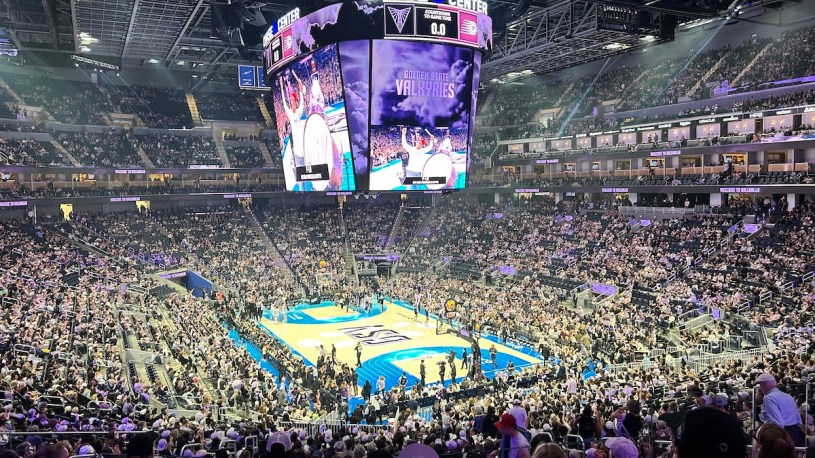
The Golden State Valkyries righted their Ballhalla ship on Sunday, defeating the visiting Toronto Tempo in an another uneven offensive performance. Today on WNBA Tuesday, we want to explore the defensive side of the Valkyries’ success, as that seems to be the talking point for the media as they ignore the ugly offensive realities (yes, pun intended). While Golden State shoots a league-worst 42.1 percent from the floor, they stay competitive via their three-point barrage and the defense, in theory.
The Valkyires are fifth in the 15-team league for steals and seventh for blocks, so they’re not extraordinary there at all. However, they do hold the opponents to a league-low 62.7 shot attempts per game, and the Golden State defense allows just 42.6 percent of those shots to go in the basket, which is second best in the WNBA. Thus, without excessive steals or blocks, they do smother the opponents enough to limit quality shots. Oddly, though, the team is just tenth in defensive rebounding.
And here’s the biggest kicker: only two regulars on the roster have Defensive Rating marks under 100, which represents “average” defensive impact. Center Kiah Stokes (97 DRtg in 22.6 minutes per game) and forward Laeticia Amihere (99, 11.6) aren’t on the floor enough to have that big of an impact, really. Even F Gabby Williams, who is known for her defense, has a 102 DRtg mark, so she’s not carrying a lot of water herself. Although no one in the rotation has worse than a 109 DRtg.
Still, how are the Valkyries doing it? Limiting the shots is one thing, and that defensive effect is the result of the stagnant offense that often takes up most of the shot clock before launching a low-percentage three. The Valkyries also are dead last in the league for two-point shot percentage, so it can be argued effectively that they’re also not taking high-quality two pointers, either, although anecdotal eyewitness testimony from us will mention they miss more layups than we ever thought possible.
In terms of defensive value, the sabermetric measurements reveal a lot, too, about the team’s total defensive effort: six players have at least 1.0 Defensive Win Shares (DWS) currently, and that’s a starting lineup’s worth of quality defense. Stokes (1.9 DWS), guard Veronica Burton (1.7), Williams (1.6), F Kayla Thornton (1.4), F Janelle Salaün (1.3), and G/F Kaila Charles (1.2) should be the go-to players for game-ending defensive pushes, for sure. And then there are the others … Yeah.
Players in the rotation who should not be on the floor in crunch time for their defense? F Cecilia Zandalasini (0.9), G Tiffany Hayes (0.7), and G Kaitlyn Chen (0.6). They’re not big liabilities, but they’re the bottom dogs here. With Amihere (0.8), it’s hard to tell, since her MPG is the lowest of the those in the regular rotation. For example, Chen plays three-plus minutes more per game and has 0.2 DWS less, so a lot of DWS value can be impacted by time on the court; hence, the DRtg measure works.
In terms of DRtg, the least-effective defender in the regular rotation is Chen (109), and she’s significantly weaker than Hayes (106), the second “worst” defensive player. Salaün (105), Burton (104), Thornton (104), and Zandalasini (104) come next, with Charles (103) slotting in just below Williams. Thus, devising a lineup that balances just enough offense with effective defense, especially down the stretch when the game is close, becomes very complicated in terms of myriad combinations and matchups.
This is why Head Coach Natalie Nakase and her staff deserve a lot of credit for keeping this team so competitive. They have a system that is working, somehow, despite odd roster management. The best players for that delicate balance of offensive and defensive ability are few on this team, so the substitutions must be smart and strategic. Really, only Burton and Salaün can play both ends of the court effectively enough, in truth. They are the only players above 2.0 OWS and 1.0 DWS right now.
Amihere, Chen, and Zandalasini are the three players below 1.0 in both OWS and DWS, and in fact, Zandalasini is posting negative offensive value, sadly, despite bringing one of the best pure shooting motions to the equation (certainly an issue to explore in full on its own later this season). Hayes brings more offense than defense, while Stokes, Williams, Thornton, and Charles bring more defense than offense. Those are all the puzzle pieces Nakase and her staff have to work with right now.
Finally, in terms of WS/40, the “first five”—one of the dumbest terms we’ve heard in the last 35 years of covering sports, by the way—should be comprised of Salaün (.201), Burton (.199), Hayes (.165), and Stokes (.145), maybe always. The fifth spot can go to whichever player Nakase and staff think will be effectively, depending on the opponent and subsequent matchup needs. Zandalasini is the one player in the ten-deep rotation who should not be playing as much as she is (18.0 mpg) right now.
Of course, this is all mathematical analysis, and again, we trust Nakase to know what she’s doing with what she has to work with on this roster. The results speak for themselves; however, this is just good data-based knowledge to keep in your back pocket as a viewer. The Valkyries play great defense without really having any great defensive players, so it’s a team effort, in the end, and that’s what this franchise has done: build a winner without a truly dominant player, outside of Burton and Salaün.
Those two are very good players, but they’re not great players. Perhaps the GSV plan is to avoid rostering those right now?

