
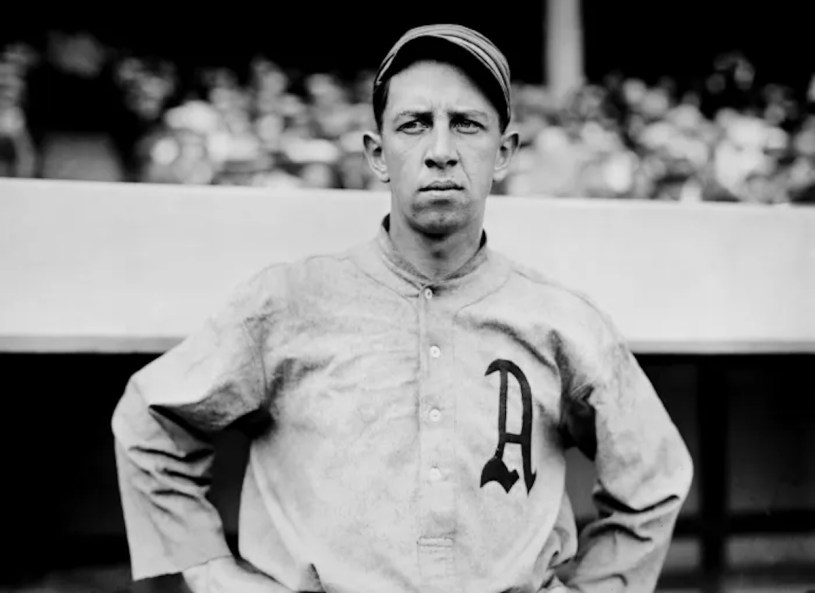
We’ve mentioned this before, but sometimes we have a plan for what we want to write on for MLB Monday, in advance (like an editorial calendar!), and then there are days like today when we have no idea what will come out of our fingers, onto the keyboard, and into cyberspace. Alas, we spun the wheel of chance and came up with … drumroll, please … Eddie Collins, the Hall of Fame second baseman. We ended up here for what can only be described as the randomness of our ADHD brain(s). Follow the trail …
Over the weekend, we went and saw The Odyssey, a new Christopher Nolan film based on the Homer epic. The cyclops (Polyphemus) was motion-capture acted by Bill Irwin, who happened to portray Collins in the 1980s film, Eight Men Out. Therefore, here we are. Collins had a 25-year MLB career, won six World Series, and even earned the AL MVP in 1914. Alas, we did not give him that nod, but we gave him the hardware in 1909, 1910, and 1913. He had an amazing career, clearly, and long!
He notably went to college at Columbia University and broke into the majors at age 19 during the 1906 season with the Philadelphia Athletics, as he played a combined 20 games with the club in 1906-1907. His first regular playing time came in 1908 when he saw action at second, shortstop, and all three outfielder positions for a total of 102 games and 330 ABs. Collins earned 1.4 WAR that season, and by 1909, he was entrenched as the starting second sacker for the A’s, all the way through to the 1914 season.
Overall, his Philly sabermetric value was incredible in those six years as a starter: 53.3 WAR. Let that sink in for a moment, and we will point out that he topped the majors in runs scored three straight years (1912-1914) while also leading MLB overall in stolen bases once, too (81 SBs in 1910). The Athletics won four AL pennants in five years (1910–1911, 1913–1914), but after winning the World Series three times, they lost it in 1914, and Manager/Owner Connie Mack sold Collins to another team.
The Chicago White Sox were the new beneficiary of Collins’ talent; he spent 12 seasons on the South Side playing for Charles Comiskey, totaling 66.7 WAR in the process. While he posted 9.1 WAR with the Pale Hose in 1915, his production would drop a little bit in his time with Chicago—although clearly not much. He led the AL in steals three times while with the White Sox (1919, 1923, 1924), and Collins was a key member of the 1917 World Series champs and the infamous Black Sox of 1919, a honest one.
He certainly did not partake in the gambling scandal, and Collins stayed in Chicago through the 1926 season. At age 39, he still managed to contribute 4.3 WAR to his team. His final 143 games in the major leagues came across the 1927-1930 seasons back in Philadelphia with the A’s, to the tune of just 2.2 WAR total—most of that coming in the 1927 season alone when he hit .336 in 95 games at age 40. He won two more rings with the Athletics in 1929 and 1930, although he did not play in either postseason Series.
Overall, he hit .333 in his career with 741 stolen bases and a still-record 512 sacrifice hits, too. His .853 OPS translates into a 142 OPS+, and he walked three times more (1,499) than he struck out (467). He didn’t have power, but his defense was more than adequate (career 8.1 dWAR). In fact, he topped all players in dWAR once, too (2.8 dWAR in 1910). All these numbers seem a little unreal today, of course, although Collins only managed to hit 47 home runs and post a .429 SLG for his long career without power.
In fact, his SLG barely outdoes his OBP (.424), but he brought value in places other than the long-ball department, clearly. The career 123.7 WAR mark, overall? Ranks second all time among second basemen, and he did win that official MVP award to go along with the six World series titles. The archival records show he only made around $275,000 for his entire MLB tenure, but he did have that Columbia degree. It served him well in front-office gigs: the A’s (1931-1932) and the Boston Red Sox (1933-1947).
Truth be told, it was Collins who helped the Red Sox restore some luster in the 1930s and 1940s with the signings of Ted Williams and other great players that won the 1946 AL pennant. His Boston teams never won a World Series, but they are part of the franchise legendarium. In our minds, we see the Bill Irwin version of Collins on the stand in the courtroom with his teammates on trial, outsmarting the attorney questioning him. In reality, it could be said Collins outsmarted everyone else, too. Oh, and this:
Collins hit .328 in 34 World Series games across his long career, with a .795 OPS. We did not give him our fictional WS MVP nod in 1910 when he hit .429 with a 1.097 OPS, nor in 1913 when he hit .421 with a 1.082 OPS, neither. Likewise, he hit .409 with a .913 OPS in the 1917 Fall Classic without us picking him for the trophy. This shows how good he was, of course, in most pressure moments, yet it also reveals he certainly played on some very talented teams. His WAR marks speak the most for his value, really.

