
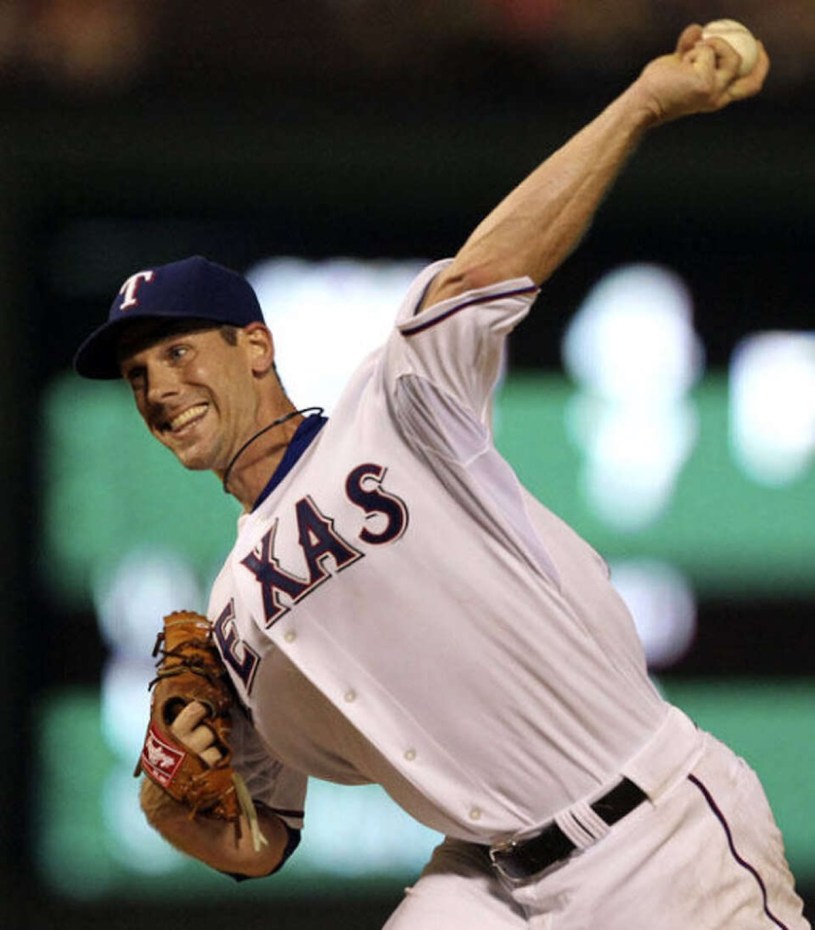
One of the things we enjoy about Friday Funday is the randomness of it, in terms of just exploring an MLB player’s career statistical profile, analyzing it, and drawing conclusions from the data inferences. It’s something that brings us joy and eventually will form the foundation of some published books. Today we look at southpaw Clifton Phifer Lee, a player who was average for his first six years in the majors—and then suddenly became one of the most dominant pitchers in the game for the next six years.
Baseball is a funny sport, isn’t it? “Why, yes, indeed, it is.”
With a career WAR mark (43.2) that ranks him 121st overall in baseball history, Lee is not Cooperstown material. Yet consider that from 2008-2013, he compiled 36.8 WAR while pitching for four different teams as perhaps the hottest commodity in the sport. Those peak seasons netted him four All-Star nods, one Cy Young vote win, and a whole lot of street cred when it came to boosting a team’s fortunes in pursuit of the postseason. A 2.52 ERA across 82 October innings doesn’t tell the whole story, either (read on).
But let’s start at the beginning: Lee was drafted three times, starting in 1997 out of high school (eighth round), by the Florida Marlins. He was selected a second time the following year in the 20th round by the Baltimore Orioles after spending one year at Meridian Community College (MS). Finally, the Montréal Expos grabbed him in the fourth round of the 2000 draft after he had transferred to the University of Arkansas. Alas, he never pitched for Les Expos, as he was traded to the Cleveland Indians in 2002.
You may remember that trade for the names exchanged: Montréal sent Brandon Phillips, Grady Sizemore, Lee Stevens, and Lee to the Tribe for Bartolo Colón and Tim Drew on June 27, 2002, in a blockbuster deal that should have set up Cleveland for many seasons ahead. Alas, that did not happen as planned. We have explored Sizemore’s career here before, and maybe someday we’ll discuss Colón (one of our least-favorite frauds). Heck, the trade and its aftermath alone would be an analytical article unto itself.
Lee made his MLB debut for the Indians in 2002 at age 23, and even though he only pitched a combined 62 2/3 innings in 2002-2003 together, he was pretty good: a 3.30 ERA with 50 strikeouts. His control was problematic (28 walks), but by 2004, the Cleveland front office assumed he was ready to make the leap into full-time action; however, they were very wrong. While he posted a 14-8 record, his ERA (5.43) and WHIP (1.503) were atrocious. It is surprising he got 33 starts overall, across 179 IP.
In fact, he earned more WAR in 2002 across 10 1/3 IP (0.6) or in 2003 across 52 1/3 IP (0.5) than he did in 2004 (0.3), despite winning all those games and pitching all those innings—which is crazy. Still, he would be in his age-26 season heading into 2005, so the Tribe stuck with him, and his continued development paid off with his best season yet: 2.5 WAR, 18 victories, a 3.79 ERA, and a 1.218 WHIP in 202 IP. His strikeout rate dropped a lot, but so did his walk rate as he led the league in winning percentage.
When Lee followed that effort up with 2.0 WAR mark in 2006, though, the signs of regression were there at age 27: a 4.40 ERA, a 1.405 WHIP, and increases in his hits-allowed and walk rates. He was an enigma at this point, and Cleveland really wasn’t sure what to do with him, as he entered his prime seasons. However, an abdominal muscle injury in spring training ended up hindering Lee’s entire 2007 season, one where the team made it all the way to the American League Championship Series, only to lose ugly.
He spent time in the minors, was demoted to the bullpen, and didn’t pitch in the postseason at all—which we have to think might have made a difference if he did, since the stint in the minors seemed to have fixed what ailed him, based on the six-season peak to come just ahead. Lee’s 2007 numbers—a 6.29 ERA and a 1.521 WHIP in 97 1/3 IP for minus-0.8 WAR—put him in the odd space of nowhere land, really, in terms of Cleveland’s rotation plans for the next campaign (his age-29 season with a $4M price tag, too).
In the 48 minor-league innings Lee tossed in mid-2007, he struck out 61 batters. That stat stands out now as a sign of something different in his game, and that carried over to 2008 as he literally stunned the baseball world on his way to winning the AL Cy Young vote (which we did not agree with, incidentally). His stat line is nuts, in contrast to what he’d produced hitherto: a 22-3 record, a 2.54 ERA, and a 1.110 WHIP. He also topped the majors in wins, winning percentage, and walk rate, crazily enough.
Lee led his AL peers in WAR (6.8), ERA, shutouts (2), and fewest home runs allowed per 9 IP, too. It was a stunning turnaround, one not really seen since the days of Sandy Koufax. Their career arcs are somewhat similar in many ways, in truth; that’s an article for another day, too. Heading toward his contract walk year in 2010 at age 31, Lee couldn’t have hoped for anything better than this metamorphosis. He would make $15M total in the two years before free agency, and he was still (mostly) young. Bingo!
As a small-market team, Cleveland was not going to be able to hold on to its star lefty. When he got off to a 7-9 start through his first 22 starts in 2009, albeit still to the tune of 4.3 WAR based on a 3.14 ERA and other stats, the Tribe front office maximized its capital by trading Lee to the defending World Series champion Philadelphia Phillies. There, he added 1.1 WAR to his season total for a respectable 5.4 WAR effort, although his combined numbers (14-13, 3.22, 1.243) paled in comparison to his Cy Young stats.
Still, the gamble paid off for the Phillies, as Lee went 4-0 in the playoffs, even though the team could not defend its title in the Fall Classic against the New York Yankees. But the star southpaw established that he could handle the playoff pressure, even though Philadelphia ended up trading him in the offseason to the Seattle Mariners. We will never understand this move, really, as the Phillies came up short of the World Series in 2010, too, despite the fact they could have had a crazy-dominant rotation with Lee.
Alas, the Mariners gave up next to nothing for Lee, oddly enough, and perhaps it was their plan all along to flip him, too, because they did after he made just 13 starts for Seattle (8-3, 2.34, 0.945, 3.5 WAR)—sending him to in-division rival Texas for a handful of players. Down the stretch with the Rangers, Lee did not pitch extremely well, but he managed to add another 1.6 WAR to the cause, finishing the full season with 5.1 WAR, a 12-9 record, a 3.18 ERA, and an MLB-best 1.003 WHIP. We gave him our Cy.
Now this is where the narrative gets even nuttier, and sadly, too: Lee won two games in the AL Division Series against Tampa Bay, giving up just two runs in 16 IP. Then, he tossed eight shutout innings in his only ALCS start, against the Yankees. So, in 24 IP through two rounds of the playoffs, he gave up just two runs. Heading into the World Series against the poor-hitting San Francisco Giants—a team that was eighth in the NL for OPS that season (2010)—it seemed a no brainer that Lee would dominate the Series.
Alas, PEDs are real, unfortunately, and the mediocre Giants somehow managed to score nine runs in 11 2/3 IP off Lee in his two World Series starts. Coming into this matchup, Lee had been 7-0 in the postseason with a 1.26 ERA in October baseball. Let that sink in as nothing screams “cheating” more than that reality, in truth, how he was able to shut down the top two sabermetric teams in the sport, with ease, before somehow losing to a team that had barely made the NL postseason despite its sad PED predilections.
Either way, it was a fluke, and Lee finally hit free agency with all the momentum he could have asked for, before signing with … the Phillies, who had traded him away for some reason the prior winter. They clearly saw the error of their ways, and he secured a six-year deal that would net him $120M by the time it expired, even though he only managed to pitch another four seasons in the majors. Philadelphia sure got its money’s worth, though, for at least the first three seasons of the contract, as evidenced below:
- 2011 (age 32): 17-8, 2.40 ERA, 1.027 WHIP, 6 SOs, 8.5 WAR (career high), All Star
- 2012: 6-9, 3.16 ERA, 1.114 WHIP, 4.4 WAR
- 2013: 14-8, 2.87 ERA, 1.010 WHIP, 6.6 WAR, All Star
Lee topped MLB in fewest walks per 9 IP in both 2012 and 2013, as well. Oddly, in those three years, Lee made just one postseason start, an ugly loss to eventual World Series champion St. Louis, where the Cardinals managed to get 12 hits off him in six innings, despite striking out nine times in the process. That Phillies team had three SPs in the top handful for the National League, yet somehow did not get out of the first round of the playoffs, much like many of the Atlanta Braves teams of the past.
By 2014, at age 35, Father Time came calling for Lee, and he “struggled” to a 4-5 record and a 3.65 ERA in his final 81 1/3 MLB innings, due to injury. He would miss the 2015 season entirely as a result, and then the Phillies bought out the final year (2016) of his big contract at half price—a cool $12.5M, still. While the Philadelphia organization didn’t win as much as it wanted to do while Lee was under contract, they did get a lot of good use out of his left arm: 21.3 WAR across parts of five seasons in total … not bad.
He was a late bloomer, but once he blossomed, there were few that were better in baseball. Our hats are off to you, Clifton Phifer.

