
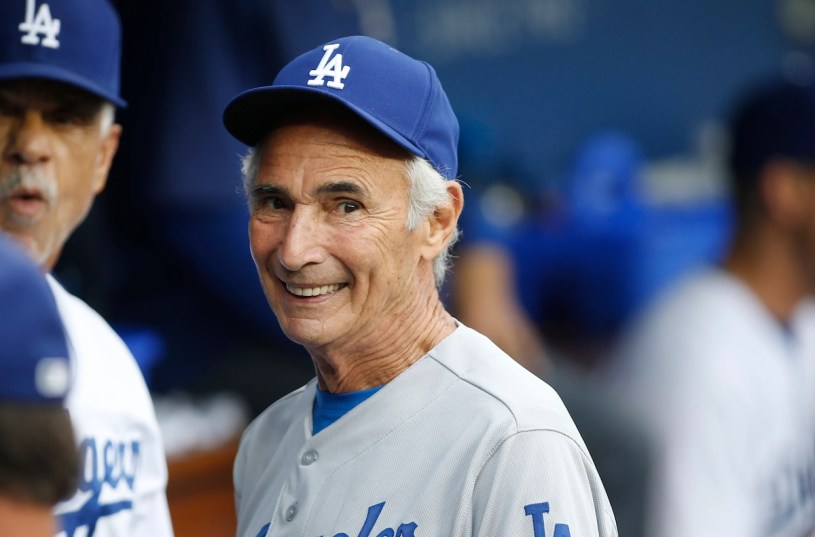
A few weeks ago on Friday Funday, we looked at the career of Cliff Lee, where the first six years were middling and then the next six years were dominant. That analysis made us think of the most infamous example of the career demarcation line: Sandy Koufax. The Dodger franchise legend’s career spanned from 1955 in Brooklyn to 1966 in Los Angeles, where the first six years were meh (6.8 WAR) and the last six years were ungodly (46.3 WAR). There’s a lot to unpack here, so let’s get started right away.
Koufax is in Cooperstown, despite the modest career WAR mark (53.1), which ranks him a mere 97th on the all-time list of the best starting pitchers. Yet he won three pitching Triple Crowns in a four-year span (1963-1966), in addition to winning five straight ERA titles (1962-1966) and three National League Cy Young votes in the same four-year span as the Triple Crowns (1963-1966). How does a player transform seemingly overnight from being somewhat middling to establishing himself as the most dominant?
Well, in Koufax’s case, part of it seemed to be weight loss. Seriously. Also, as the stories go, “He economized effort, retained velocity, and gained better control of both his pitches and himself. In other words, he went from thrower to pitcher.” We have to take the word of the man himself, of course, and that word was simple: dedication. Entering his age-25 season frustrated with his career hitherto (36-40, 4.10 ERA), Koufax had to make a decision if he was done with the sport or whether he could be “better” …
Here’s the statistical breakdown on his two career phases, for a data appetizer:
- 1955-1960: 36-40, 4.10 ERA, 1.428 WHIP, 6.8 WAR, 691 2/3 IP
- 1961-1966: 129-47, 2.19 ERA, 0.970 WHIP, 46.3 WAR, 1632 2/3 IP
That is some level of dedication—and focus. However, let’s go back to the beginning, in Brooklyn, during the 1955 season when the Dodgers would go on to win their first-ever World Series (finally). Koufax was a teenager still when he made his MLB debut, pitching in 12 games and posting a 3.02 ERA. Yet he walked almost the same number of batters as he struck out, leaving his WHIP way too high for anyone’s liking (1.464). He made the World Series roster; however, Koufax did not appear in his first Fall Classic.
In 1956 at age 20, he took a step backward, seeing his ERA (4.91) and WHIP (1.619) rise—while posting negative WAR (minus-0.3) for the only time in his career. Koufax also surrendered a career-worst 10.1 hits per 9 IP while once again walking basically the same amount of hitters as he struck out. In 1957, he righted the ship a wee bit (3.88 ERA, 1.284 WHIP) across 104 1/3 innings. He also posted the first winning record of his career (5-4), barely. That would be Koufax’s last season in his Brooklyn hometown.
In fact, he was the last Brooklyn Dodgers pitcher of record, throwing the final inning of the 1957 campaign. With the move to Los Angeles in 1958, the Dodgers pitchers did not benefit from the strange dimensions of the Los Angeles Memorial Coliseum. In fact, it was just the opposite, really, and Koufax was no exception: he saw his ERA jump to 4.48 and his WHIP rise to 1.494 due to a MLB-worst 17 wild pitches and other setbacks in his statistical profile. But he did win 11 games after appearing in 40 contests.
At age 23 in 1959, Koufax was a part of a second World Series championship, even though his numbers still were rather ugly: a 4.05 ERA and a 1.487 WHIP. Yet his versatility served the team well, as he had both a complete-game shutout and two saves during the regular season. And while he lost a potential title-clinching start in Game 5 of the Fall Classic, he did so by only giving up a single run against the Chicago White Sox in that matchup. In retrospect, perhaps this was a small sign of great things ahead.
In 1960, Koufax topped majors in a positive statistical area for the first time ever: Ks per 9 IP. He would top either the NL or MLB for this category six times in his final seven seasons, actually (see below). Yet he also posted a losing record (8-13) to go along with a 3.91 ERA and 1.331 WHIP. The mixed-bag performance is what caused Koufax to consider leaving the sport to pursue business ventures instead. The offseason between 1960 and 1961 offered much change for him, both mentally and physically.
The results speak for themselves (note that the Dodgers moved into their new pitcher-friendly stadium in 1962, as well):
- 1961: 18-13, 3.52 ERA, 1.205 WHIP, 5.7 WAR
- 1962: 14-7, 2.54, 1.036, 4.4
- 1963: 25-5, 1.88, 0.875, 10.7 (Cy Young vote win, WS MVP vote win)
- 1964: 19-5, 1.74, 0.928, 7.3
- 1965: 26-8, 2.04, 0.855, 8.1 (Cy Young vote win, WS MVP vote win)
- 1966: 27-9, 1.73, 0.985, 10.3 (Cy Young vote win)
Koufax walked away from the sport after his age-30 season due to chronic pain and threat of permanent disability; he’d thrown 658 2/3 IP in the 1965-1966 regular seasons combined, in addition to the 48 IP thrown in three World Series during the time period above. His arm was … tired, as we politely phrase it. Maybe he could have continued, but he had agency and used it to preserve what he wanted to save in his own life—the more power to him. Besides, there wasn’t a lot left to prove at that point in his career.
Here are some more amazing facts from his statistical profile: five straight ERA titles (1962-1966); 54 complete games in 1965-1966 combined; three times leading the league in shutouts (1963, 1965-1966); four strikeout titles (1961, 1963, 1965-1966); four straight WHIP crowns (1962-1965); five straight seasons topping the league in fewest hits allowed per 9 IP (1961-1965); six-time strikeout rate king (1960-1962, 1964-1966); and three-time BB/K ratio titles (1961, 1963, 1965). The “black ink” is amazing, yo.
Not sure what else we can state here, really: Koufax walked away atop his game in his prime for smart reasons, and he’s turning 91 in December this year. With lifetime ERA (2.76) and ERA+ (131) marks that seem incredible through a historical lens, it’s odd to think Koufax is an all-time leader in exactly zero categories—mostly because his first six seasons were so rough and his career so short overall. Twelve seasons may not seem that brief, really, but the first six years hindered his career statistics, significantly.
Yet circling back around to our piece on Lee two weeks ago, we do see a lot of similarities between the two southpaws, despite Koufax’s superiority. These career demarcation lines often have documented reasons, both legitimate and not-so-legitimate. We have no reasons to see either Koufax or Lee doing anything illicit or unethical. They improved the old-fashioned way, and there’s something to be said for that kind of human evolution of the highest order. We wish more athletes today could be so honest, truly.
 Daily McPlay: (mostly) Historical Sports Analysis with TENACITY & VERVE