
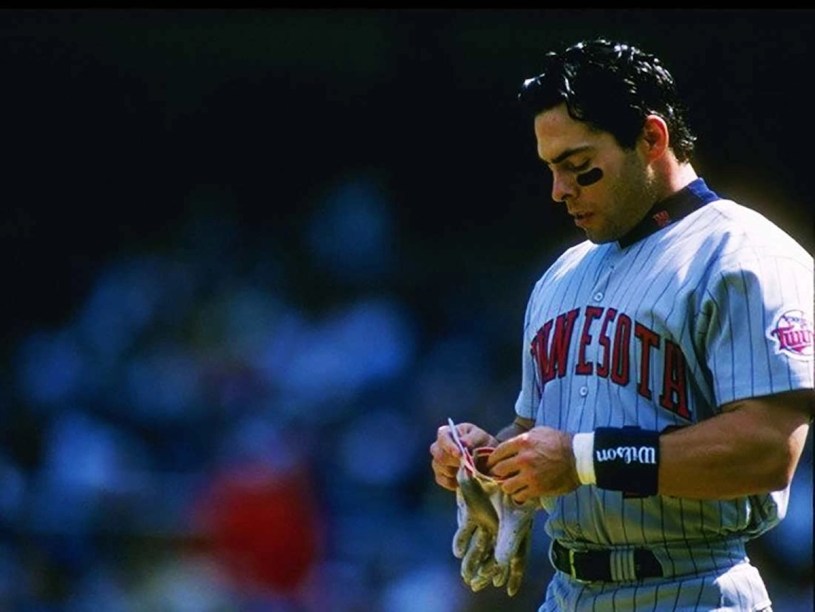
Not everyone likes Mondays, which we are sure we’ve noted before, but … we do! MLB Monday is one of our favorite pastimes, so here we go again. This time around it’s a career retrospective on left fielder Marty Cordova, who won the American League Rookie of the Year vote in 1995 when he posted 3.3 WAR. We did not agree with that award in our award-revisionist miniseries, and we’re still surprised today to look back and think that he beat out our pick for that piece of hardware.
Alas, it’s time to forget and forgive.
Still, his career WAR mark (7.7) shows that Cordova was a flash in the pan, of sorts, as his eventual nine-year MLB career did not amount to much. Originally, he was drafted in the eighth round of the 1987 Draft by the San Diego Padres, but he decided to go to college instead. He then was drafted in 1989 by the Minnesota Twins in the tenth round, costing himself some money in the process, we suspect. Perhaps that was a sign, though, that Cordova was not meant for greatness—and we mean no offense.
He did not break into the majors until age 25, which is another sign, really, of a low ceiling: guys who take that long to reach the show really aren’t destined to be superstars. It’s the rare late bloomer who ends up having a long, productive career in professional baseball’s highest level. Nonetheless, Cordova won the AL ROTY vote when he hit 24 home runs and posted an .839 OPS for the Twinkies. He did strike out 111 times while walking just 52 times, though, which was another red flag.
Cordova’s second season wasn’t a big disappointment, even if there was a bit of a drop off in production (2.6 WAR). He actually hit .309, raised his OPS to .849, and cut back on his Ks at the plate to under 100. He also drove in a career-best 111 runs. He only hit 16 HRs, but that’s not what hurt his value: it was a decline in the field from 0.6 dWAR as a rookie to minus-0.7 dWAR in his age-26 campaign. Yet the Minnesota organization probably felt comfortable at the time with his offensive stuff.
Alas, the bottom fell out hard in 1997, as Cordova dropped down to a .739 OPS in just 103 games after playing a combined 282 contests in his first two years. The defensive metrics just got worse, too, as his value declined there as well (minus-0.9 dWAR). That old Metrodome turf was not well perceived by fans and players alike, and it took its toll on Cordova’s career and ability to field his position competently. Therefore, at age 27, when he should have been entering his peak seasons … yeah.
It just got uglier for him in 1998: a minus-1.0 WAR value as his OPS went down to .709, and his defensive performance doubled in its decline (negative-1.8 dWAR). Cordova played in 119 games, and with sabermetric marks like that, he only did his team damage, unfortunately. Interestingly enough, he made $2M for this “effort” and then got a salary increase to $3M for the 1999 season, which seems absolutely ridiculous at this point. Producing negative value and getting a raise? Sign us up!
The Twins’ “faith”—or whatever you want to call it—in Cordova was rewarded, though, with a bounce-back season in 1999, in his age-29 campaign. Playing in 124 games, his OPS returned to good levels (.828) even though his defensive value remained well below average (minus-1.0 dWAR). Combined, his overall WAR (0.9) really wasn’t enough to justify that salary, and at the end of the 1999 season, he was granted free agency, looking at 2000 as an age-30 free agent with a dubious record.
The Boston Red Sox took a chance and signed him in January 2000, although they ended up releasing him in March 2000 before the regular season started. In came the Toronto Blue Jays quickly, willing to gamble $500K on Cordova’s potential. Unfortunately, he had his worst season ever, playing in just 62 games and still burying himself with minus-1.3 WAR overall. That’s a lot of negative value in so few games: a .657 OPS and minus-1.1 dWAR will do that for anyone, of course. Ouch!
At the end of that disastrous season, Cordova was once again a free agent, and next up? The Cleveland Indians signed him to a one-year, $500K deal for 2001, his age-31 season. Clearly, this was a low-risk situation for the Tribe, gambling on an aging former “phenom” … and the Cleveland front office got lucky! In just 122 games, Cordova posted 2.6 WAR thanks to a career-high .855 OPS as not playing on turf for half the season did him well defensively (just minus-0.1 dWAR). This needs analysis.
It is entirely possible that this was an honest “recovery” for him, based on the change of scenery. However, the era is one of suspicion, and Cordova did spend a few months with the Red Sox organization, too, perhaps “seeing” what others were doing. Either way, we have no firm reason to suspect anything, even if it seems strangely fortuitous for him. Yet, the Tribe didn’t choose to re-sign Cordova, and that says a lot to us, too. Why not? Cost? Maybe. Trust? Maybe. Didn’t want to gamble twice?
Probably.
But one MLB organization was willing to pony up a lot of money for an age-32 Cordova comeback before the 2002 campaign, evidently: the Baltimore Orioles. They signed him to a three-year, $9M deal, and it was a disaster for them: 140 games total (none in 2004), a decent-enough .761 OPS, yet with a negative-1.1 dWAR. Clearly, the 2001 season was an aberration of some sorts, but it got Cordova one last huge payday in a career where he made a total of $16.5M: more than half that came at the end.
That fits a pattern discussed here before about PED use: the lure of one last huge payoff. Cordova’s elbow injuries derailed his time with the Orioles, and that type of injury is consistent with some sort of PED use, too. However, again, there does not seem to be any hard evidence to suggest it. Perhaps it was a coincidence, although with the presence of the Red Sox on his MLB tenure, who knows? Either way, he did sign a final contract with the Tampa Bay Devil Rays for 2005, retiring before playing.
And that is the career of Cordova: a .274 hitter with 122 HRs and 540 RBI in 952 games. He never made an All-Star team, didn’t lead the AL or the majors in any categories of note, and never won a Gold Glove. He stole 57 bases in 93 attempts, so he was not fleet of foot on the base paths. With more than twice as many strikeouts (730) as walks (329), he was an undiscerning free swinger. Cordova made a lot of money off his career .792 OPS and 104 OPS+ marks, and he should be thankful for that.
Oh, and his lone postseason? Came with Cleveland in 2001, when he hit .250 with a .500 OPS in four games. Overall, a very nondescript career which still afforded him some wealth beyond the comprehension of most people reading this piece. Hmmm.

