
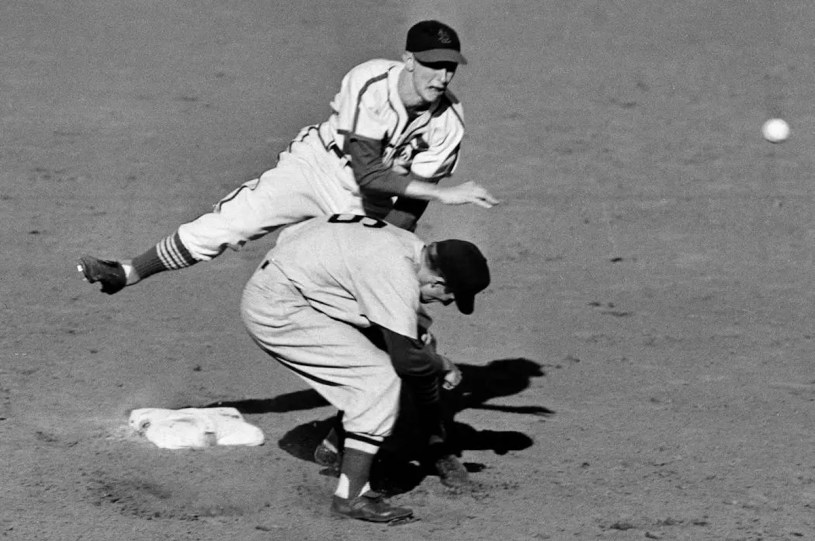
It is time for another Friday Funday column, and today we go back in time: Hall of Famer Red Schoendienst. He played 19 seasons in the majors from 1945-1963, beginning as a left fielder and mostly playing second base throughout his career, and he later managed as well, across 14 different years between 1964 and 1990. He was voted into Cooperstown by the Veterans Committee in 1989, despite only compiling a middling 44.8 WAR and rarely standing out statistically among his peers at all.
So much to unpack here, so let’s start with the playing career: he debuted with the St. Louis Cardinals in April 1945, before World War II was officially over, as an age-22 left fielder. He appeared in 137 games and posted only 1.1 WAR total, which is not very impressive at all. He did lead the National League in stolen bases (26), but his .648 OPS was terrible—equating to just a 78 OPS+ mark—and his defense was slightly above average (0.2 dWAR). He was a weak-hitting contact swinger, really, who hit one homer.
But the Cards like him enough to move him to second base in 1946, where he would start regularly for the franchise over the next 11 campaigns. He posted 2.7 WAR in his second season, barely improving his OPS (.665) while posting 1.2 dWAR … thus showing his true value to the team. St. Louis famously upset the Boston Red Sox in the 1946 World Series, even though Schoendienst delivered just a .500 OPS in seven games. His one RBI in the Fall Classic did come in a one-run, Game 7 victory.
Still, it is silly to see him earning MVP votes for that campaign, while also earning the first of 10 All-Star nods as well. His defense was good, but it’s wasn’t standout great. His bat was a joke; he also only stole 12 bases against nine failed steal attempts. However, his solidification of a weakness in the St. Louis infield must have driven his perceived value quite high, as it surely does not make sense today at all. The Cardinals only won three more games in 1946 than the prior year, so … thus began his legend, eh?
We want to take this moment, too, to address why Schoendienst was not in the military by the spring of 1945: it’s quite an interesting story. He joined the New Deal’s Civilian Conservation Corps at age 16 in 1939 after dropping out of high school, and he suffered an eye injury. This forced him to become a switch hitter, interestingly enough, and then later he was drafted by the U.S. Army during his 1944 minor-league season. However, the eye injury, combined with some other trauma, led to his discharge.
Back to Schoendienst’s career on the diamond now: in 1947, he topped the NL in plate appearances and at-bats while posting his lowest OPS mark yet (.636). His defense remained good, but his overall WAR earned for the season dropped to just 0.7 at age 24. He did bring extra value to the St. Louis organization by playing other positions briefly when necessary, but it’s still hard to fathom how keeping his bat in the lineup for all those ABs didn’t hurt the team in some noticeable way. But it was a different era and time.
His no-hit, good-glove profile made him popular with teammates and fans alike, really. And from 1948-1955, Schoendienst made eight straight NL All-Star teams while improving at the plate a lot and excelling in the field even more. In those eight years, he compiled 30.4 WAR, peaking with a 6.7-WAR effort at age 30 in 1953. He finished fourth in the MVP vote that year while posting a career-best .907 OPS and delivering 1.1 dWAR still, too. This was clearly his apex, and it’s a nice one to admire from afar, too.
Yet the offensive output was an anomaly, as he never posted another .800-plus OPS in any other season of his career. Perhaps he was drinking some special water; we may never know, but the season stands out like a sore thumb in his statistical profile. In 1956, for whatever reason, the Cardinals traded Schoendienst to the New York Giants in a multi-player exchange, despite the fact he was hitting .314 through the first 40 games. He finished the year with a .302 average but only a 97 OPS+ mark in an odd stat fluke.
The next year, at age 34, he again was hitting well with the Giants when they flipped him to the Milwaukee Braves for three players. By the end of the season, he had topped the majors with 200 hits, made the NL All-Star team for the final time, and posted 5.7 WAR overall for his second-best campaign ever. To top it all off, Schoendienst won his second World Series, as the Braves came out on top of the New York Yankees in a seven-game matchup, even though he himself posted just a .611 OPS for the series.
It signaled the end of his productive career, however, as in 1958, at age 35 now, he regressed to just 1.7 WAR, a .641 OPS, and a 77 OPS+ mark. His defense kept him in the lineup, as the Braves once again won the NL pennant, but this time they lost the World Series in seven games to the Yankees. But that wasn’t Schoendienst’s fault, as he hit .300 with an .810 OPS despite not driving in a run or stealing a base. He scored five times in the seven games, but his MLB career was all but over at that point nonetheless.
Due to tuberculosis, he played just 73 total games in 1959-1960 with Milwaukee, before being released at age 37. Fortunately, he was able to return to the Cardinals and take on the roll of a pinch hitter for three more years (1961-1963). He thrived in the role, hitting .295 in 176 games across 292 plate appearances to finish his career overall with a .289 batting average, a .724 OPS, and a 94 OPS+ mark. He only stole 89 bases for his MLB lifetime, though, while getting caught a whopping 60 times in the process.
It’s a unique hitting profile, with 606 walks and only 346 strikeouts. He did manage 84 HRs overall, but his .378 SLG is pretty weak, even for the time period and his positional expectations. Alas, Schoendienst was a “smart” player, and this naturally led to a managerial opportunity with his favorite organization, the Cardinals. Taking over after St. Louis’ 1964 World Series victory over the Yankees, he managed the team for 12 straight seasons, winning two NL pennants back to back in 1967 and 1968 along the way.
Even though the award didn’t exist at the time, we gave him our NL Manager of the Year nod three times (1967, 1968, 1974), putting him in select company. He later managed the Cardinals briefly on an interim basis in both 1980 and 1990. His overall .522 winning percentage as a manager is pretty solid, to go along with the 1967 World Series title. It took a superhuman effort from Detroit Tigers starting pitcher Mickey Lolich in the ’68 Fall Classic to deny him another one. Schoendienst was a good manager.
Maybe he deserved the Hall of Fame for the combined contributions as a player and as a manager. The pure statistical profile for a second baseman places him 37th overall now at the position in the sport’s history. Obviously, a lot of guys have passed him since he retired in 1963. So perhaps he should have gotten in on the vote originally? Schoendienst spent 15 years on the Cooperstown ballot from 1969-1983, never earning more than 42.6 percent of the vote (1980)—but never coming close to dropping off it.
We’re fine with him being in the Hall, even if his bat was “lesser than” overall; he had some excellent years and might have won some Gold Gloves if they had existed earlier in his career. Schoendienst was a team player, a valued contributor to some championship teams, and a good manager who was loyal to his primary organization that gave him the good life. He made a little over $550,000 for his whole career as a player, which is weird to think about now, but he certainly earned a lot more good will.

