
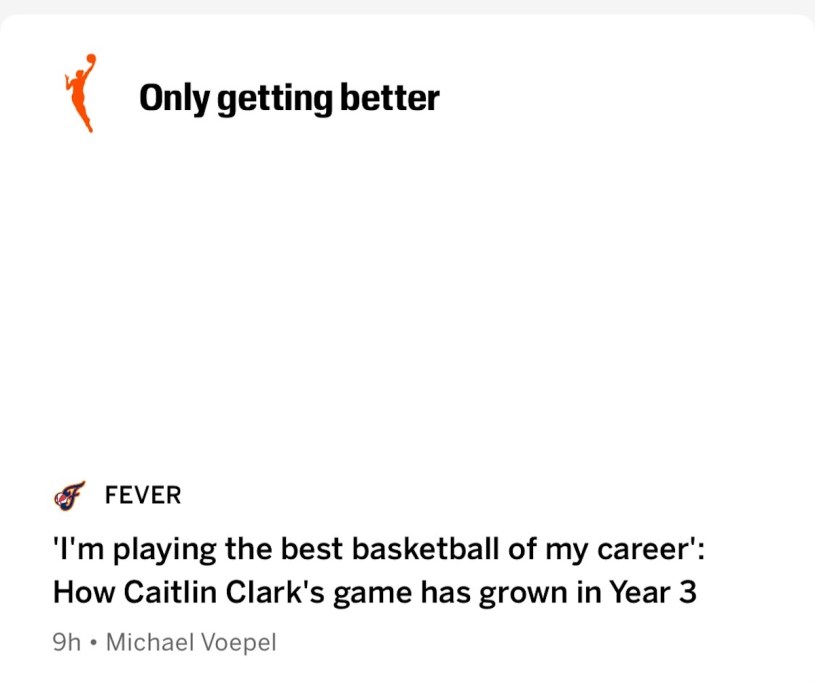
The morning after the Indiana Fever choked away a potential home victory against the WNBA defending champion Las Vegas Aces, thanks to more terrible shooting and ball handling from their alleged star Caitlin Clark, ESPN ran a puff piece entitled, “Only Getting Better” … and the timing was so bad, the network didn’t even include a picture with its headline (see above). The article also appeared with a quote from Clark as the subtitle: “I’m playing the best basketball of my career.” The joke was clear.
Today on Saturday Smugness, we want to break down how badly Clark blundered, again, in Thursday night’s loss to the Aces, while continuing to criticize ESPN and other media outlets for their dishonest coverage of this individual—something that has been going on for years now. Let’s start with the game against Las Vegas, where the Fever were up by 20 points in the second quarter before letting the defending champs back into the game and even giving them a solid chance to win in the fourth period.
The game was tied at 72-72 with 52 seconds left, when the Fever scored two points on a basket by Aliyah Boston and one on a free throw by Kelsey Mitchell to take a three-point lead with just 10 seconds left. Three seconds later, Clark was fouled and went to the line to shoot two free throws and potentially put the game away with her team already up by three points. She missed them both, and reigning league MVP A’ja Wilson grabbed the rebound with four seconds left. Yes, Vegas had a crack of daylight now.
[Note the juxtaposition here of an alleged MVP candidate and an actual MVP winner, four times now. Thank you. Read on!]
Clark had a brutal shooting night overall, making just seven of 20 shots from the floor, including a mere 2-for-10 from three-point range, her alleged specialty. But to miss those FTs in that situation is unforgivable, really. And when the Aces hit a three pointer at the buzzer to tie the game, it was all headed to overtime. In the extra session, Clark went 1-for-3, yet her hometown Fever still built a one-point lead into the final seconds, thanks to Mitchell’s seven points. Then came an even bigger blunder for Indiana …
With the lead and the ball, the clock wound down from 28 seconds to six seconds left when Clark tried to make a pass over Wilson, who was guarding her. This is a center covering a guard, by the way, which in theory should give the guard the ability to dribble around the bigger, taller player. But instead, Clark tried to make a pass with the shot clock winding down, and the ball went right into Wilson’s hands, knocking it high in the air. With a four-inch height advantage (at least), Wilson snagged the ball, easily.
Clark went down to the ground in a heap, as Wilson pushed the ball up the court for her team to take a potential game-winning shot. And the same Aces player who hit the game-tying three at the end of regulation—Chelsea Gray—then hit the winning three at the buzzer to secure the victory, snatching it away from Clark and the Fever. This was a similar disaster to the one Clark experienced against the Golden State Valkyries earlier this season, melting down in crunch time against a good opponent. Ouch.
She had a whopping eight turnovers in this game, which is astounding, and the last one directly cost her team the win. She missed those free throws, which directly cost her team a victory. Clark will hit an occasional three pointer that looks great on a highlight reel, but all the shots she misses create opportunities for the other team to score—and the Fever surrender the fourth-most points in the league. She can make some great passes, as evidenced by her eight assists in this game, but all that is undone by the ugly facts.
Thus, the timing of ESPN’s article was amusing, and to post it without a photo revealed a half-hearted attempt by the site’s editors to push a false narrative that was even more hollow than it was when planned out beforehand. We feel bad for the ESPN writers who are forced to spew this disinformation in an attempt to make money for the organization off uninformed fans, but then again, we do not. They sacrificed their journalistic integrity a long time ago, although that’s a story for later. Right now? Clark stinks.
And yes, that is extreme. Let’s rephrase: she stinks in comparison to the claims being made, for she is not an MVP candidate as discussed previously. She is a good player, generally speaking, surrounded by better players in Boston and Mitchell—and that’s been the case since Clark entered the league as the No. 1 overall pick in 2024, only to join a team that already had two All Stars on it. Those teammates have played better than Clark for three straight seasons now, although the average fan would never know that.
Since Clark joined the team, Boston has posted 15.3 Win Shares; Mitchell has earned 13.7 Win Shares; and Clark has amassed just 6.6 Win Shares. Yes, she was hurt a good portion of the 2025 season, but that also reveals a lot of her weaknesses: she’s not a strong enough player to endure the pounding in this league, and before anyone cries “foul” over that, we remind you we coached college women’s basketball in the 1990s, and we got hurt scrimmaging against the team in practice. Women play sports hard, yo.
In terms of Win Shares per Minute Played? Boston has been dominant in her four WNBA seasons (.224). Mitchell has put up .191 and .223 marks the last two seasons (2025-2026), respectivaley, and Clark? Her career .120 rate looks pretty pathetic in comparison. I’s not even just volume here; it’s quality of time spent on the court; Clark does not provide it in comparison to her two significantly better teammates. These advanced analytics are available everywhere on the Internet, so why does the media lie?
Well, again, the first issue is the fans do not understand “Moneyball” as it relates to basketball statistics. The media should address that issue, but doing so weakens the narratives they try to sell the bandwagon every day. So, why don’t fans themselves learn the data crunching that NBA and WNBA front offices use to evaluate player performance? Good question. Nothing is stopping them from growing their expertise as fans in the stands, other than finding information that doesn’t fit their feelings. Therein lies the rub.
Follow the money. Do your own research. Never stop learning.
For the year now, Clark is hitting just 44.1 percent of her shots, which ranks seventh on her own team. She is making just 34.1 percent of her three-point attempts, which is sixth on her own team. She averages two more turnovers a game than any of her teammates. She is fourth on her own team in value per minute played. League-wide, she is eighth in Player Efficiency Rating (mostly thanks to her great assist rate), but she’s not in the Top 20 for Win Shares or Offensive Rating—the latter being her thing.
She tops the league in turnovers (again), and her meltdowns are many. She certainly is still young with a lot of potential growth in front of her, and maybe someday she becomes the “superstar” the media claims she is right now. But that’s the thing: she is not that player right now, not even close. As our high school PE teacher told us, potential and 25 cents will get you a cup of coffee. So when she’s the third-best player on her team and definitively has been since she entered the league, all the MVP talk? Garbage.

