
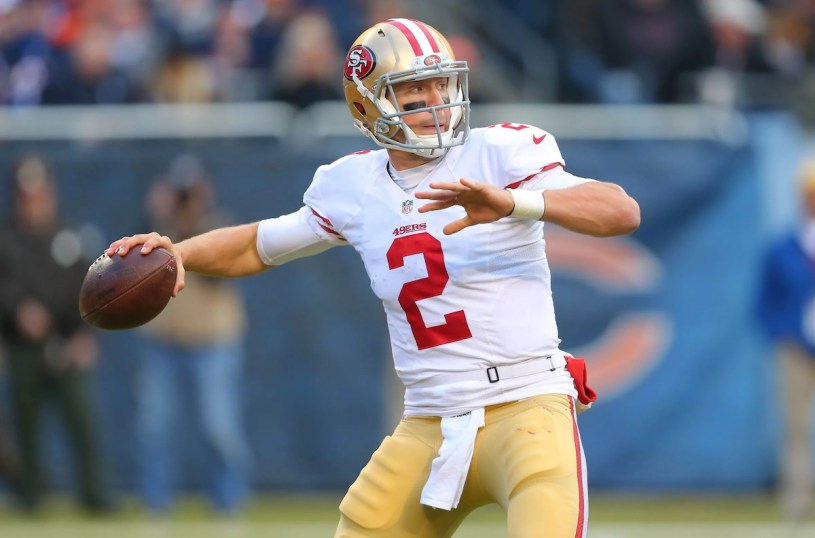
Friday Funday always provides us an opportunity to look at an interesting player from the past (or even the present, perhaps) in any sport. We tend to focus on baseball, but today? We’re talking NFL football and former pro quarterback Blaine Gabbert. Maybe you remember the tenth overall pick in the 2011 Draft; maybe you do not. Either way, he had a really goofy career in the NFL, all things considered. In looking back through his college career, too, we think he’s lucky he ever set foot in the NFL, really.
Gabbert was a two-year starter at Missouri in 2009 and 2010, after tossing just 13 passes a freshman in 2008. The Tigers went 18-8 overall in his starts, when they were still in the Big XII Conference, and they lost two bowl games with Gabbert at the helm. He wasn’t a standout player at all, not even statistically, really, only leading just his conference in a few minor categories during his first season as a starter (2009), like yards per attempt (8.1). He peaked that year with a college QB rating of just 140.5, as well.
The two biggest indicators for college quarterback success in the NFL is a combination of completion percentage and number of starts, based on historical data analysis. Gabbert’s 60.9-percent completion percentage is uninspiring, while his 26 starts are roughly average. So, what was it that got him into the Top 10 on Draft Day? We honestly have no idea: his best “award” in college was being second-team, all conference in 2010 when his QB rating dropped to 127.0, down from the aforementioned 2009 peak.
The Jacksonville Jaguars traded up six spots to pick him, too, and that may explain why the Jags franchise was amid a nine-season playoff drought at the time (2008-2016). Needless to say, his tenure in Jacksonville was a disaster: he went just 4-10 as a rookie starter, posting a horrible 65.4 QB rating in the process, and it was downhill from there, as ineffectiveness and injuries limited his playing time in 2012 and 2013. Gabbert won just once in final 13 starts with the team over those two seasons, proving to be a bust.
Why the San Francisco 49ers sent the Jags a sixth rounder in exchange for Gabbert before the 2014 season is a mystery, but then again, Jim Harbaugh—then the S.F. head coach still, in decline—always has had an undeserved reputation as a “QB guru” so he must have convinced someone in the 49ers front office of something foolish. Needless to say, he barely played as San Francisco went 8-8 and missed the playoffs after three straight seasons of reaching the NFC Championship Game from 2011-2013. Hmmm.
That certainly wasn’t Gabbert’s fault, as he played in just one game and tossed just seven passes. Yet it demonstrated that even on a non-playoff team, he had no ability to crack the starting lineup at age 25. Harbaugh then bailed on the team he ran into the ground by leaving for the University of Michigan after the 2014 season, and Gabbert saw an uptick in playing time for the 49ers, although it was mostly due to circumstantial reasons under incompetent Head Coach Jim Tomsula. Gabbert even got eight starts in 2015.
For a 5-11 team overall, his 3-5 record as a starter actually looks decent, and his 86.2 QB rating was decent. However, it all went downhill again in 2016 for San Francisco and Gabbert, as Tomsula was fired, and Chip Kelly took over for that season. The 49ers cratered to just two wins, and Gabbert’s QB rating returned to his rookie-season level (68.4) across six games, five of them starts. He did manage to win one of the five starts, but his overall numbers were not good. At this point, he had a 9-31 record in the NFL.
Now, the best team he played on in those first six seasons was the 2014 49ers, who still only won eight games. So, Gabbert wasn’t surrounded by a lot of talent, but QBs in the NFL have a responsibility most of the time to make the players around them better, and he certainly wasn’t capable of that trick. His career certainly was at a crossroads, and he got a fortunate reprieve when the Arizona Cardinals came calling, as their head coach at the time—Bruce Arians—was one of the best in the business. So, then …
Gabbert had a chance to learn from a master, really, although his playing time didn’t necessarily reflect that. At age 28, we imagine he absorbed as much as he could from the experience of playing for Arians and behind two veteran QBs: Carson Palmer and Drew Stanton. There wasn’t a drastic improvement in his statistical output, as he went 2-3 as a starter when injuries hit the QB corps in Arizona, and his QB rating (71.9) barely rose from its garbage level the season before in San Francisco. Still? Progress.
And growth behind the scenes, too.
That being said, Arians left the desert after 2017, retiring unexpectedly, and Gabbert was once again without a team or a contract. We suspect someone whispered in the ear of then Tennessee Titans Head Coach Mike Vrabel, because the Titans signed Gabbert to be the primary backup to young starter Marcus Mariota—the second Heisman Trophy winner Gabbert would backup in consecutive seasons, after Palmer the year before with the Cardinals. These were prime chances to learn from some good QBs, too.
Mariota was often hurt, so Gabbert ended up playing eight games overall, including three starts in which he posted a 2-1 record to help the team finish with a 9-7 mark. It was the first time Gabbert played for a winning team in his career, so maybe things were looking up for him finally after his age-29 season. Nope: his 74.9 QB rating with the Titans was still mediocre, and he once again found himself unemployed after the end of another long NFL campaign. Enter Arians once again, Gabbert’s NFL patron saint, yo.
The grizzled coach had been coaxed out of retirement to guide the Tampa Bay Buccaneers, and he wanted Gabbert. This is the most ringing endorsement we could ever make for Gabbert’s talent: Arians was an excellent coach, and the fact he saw something in Gabbert that the statistical profile did not reveal says a lot more than we could ever say from the press box, the sidelines, or the TV couch. Alas, the now age-30 QB missed almost the entire 2019 season with a shoulder injury, not making an single appearance.
Lucky for him, the Bucs upgraded their starting QB from Jameis Winston in 2019 to cheatin’ Tom Brady in 2020. But in Winston, Gabbert got another chance to “learn” from a former Heisman winner, and despite Brady’s proclivity for dishonesty, he still had a brilliant football IQ, so Gabbert struck gold again in being able to work with both Arians and Brady at the same time. Yet, due to Brady’s unethical and (possibly illegal) association with Alex Guerrero, there was basically no playing time to be had.
In four seasons with Tampa Bay (2019-2022), Gabbert played in just 11 games total and threw just 35 passes combined. But in his limited play, his QB rating was 111.5 for this time with the Bucs, and he was part of a Super Bowl-winning roster in 2020, too. Sometimes we’ve joked there is no better gig in the NFL than a backup quarterback role, assuming the starter doesn’t get hurt. And that’s what Gabbert got here: a lot of money, a championship ring, and little-to-no actual action on the field of play—a perfect job.
Arians left the Bucs after the 2021 season, and then Brady retired after the 2022 season. The Bucs weren’t going to hand the starting job to an age-34 QB who had thrown a total of just 35 regular-season passes over the previous four seasons. Once again, Gabbert was out of a job, and it would have made all the sense in the world for him to just retire. What else did he have to prove? He’d won a ring, made some good money, and still had his health intact, for the most part. Yet one last time, he was saved by fate.
The Kansas City Chiefs needed a cheap and serviceable backup for Patrick Mahomes, and they signed Gabbert for that role in 2023. He got to work with Andy Reid, another known coaching genius, while backing up one of the best QBs in NFL history. Gabbert made it into two games, starting only the season finale while Mahomes rested, and Gabbert got the win despite completing just 50 percent of his attempts, not throwing a touchdown, and giving away an interception to the other team. His QB rating? 31.2!
That is not a typo.
For the whole year, he threw three INTs and no TDs among his 35 total attempts. Yet, when the dust settled after the playoffs, Gabbert had another Super Bowl ring on his fingers, thanks to Mahomes & Co. beating his old team, the 49ers. There would be no more hurrahs for him, however, as this was his final NFL season, and he rode off into the sunset as maybe the luckiest backup QB in the history of the sport. A look at his final career statistical line is just flat-out embarrassing for a No. 10 overall draft pick:
- 14-35 record
- 71.7 QB rating
- 51 TDs, 50 INTs
- 56.3 completion percentage
- 19 AV (Approximate Value, akin to baseball’s WAR, basketball’s WS, and hockey’s PS, in sabermetric “Moneyball” terms)
The 19 AV across a 13-season career for a quarterback drafted in the Top 10 is official “bust” territory. NFL single-season leaders in Approximate Value almost always post 20-plus AV in one year. Gabbert couldn’t even come up with that in 13 years, aggregate. Now, no one has ever stated that Gabbert was anything other than a bust, of course, so we’re not making any controversial declaration; we just have found his NFL journey to be a fascinating one, a fortunate one, and a very surprising one, all things said.
And as we’re often stating in our MLB pieces on random players from the past, a lot of fans out there would take this career, easy.

