
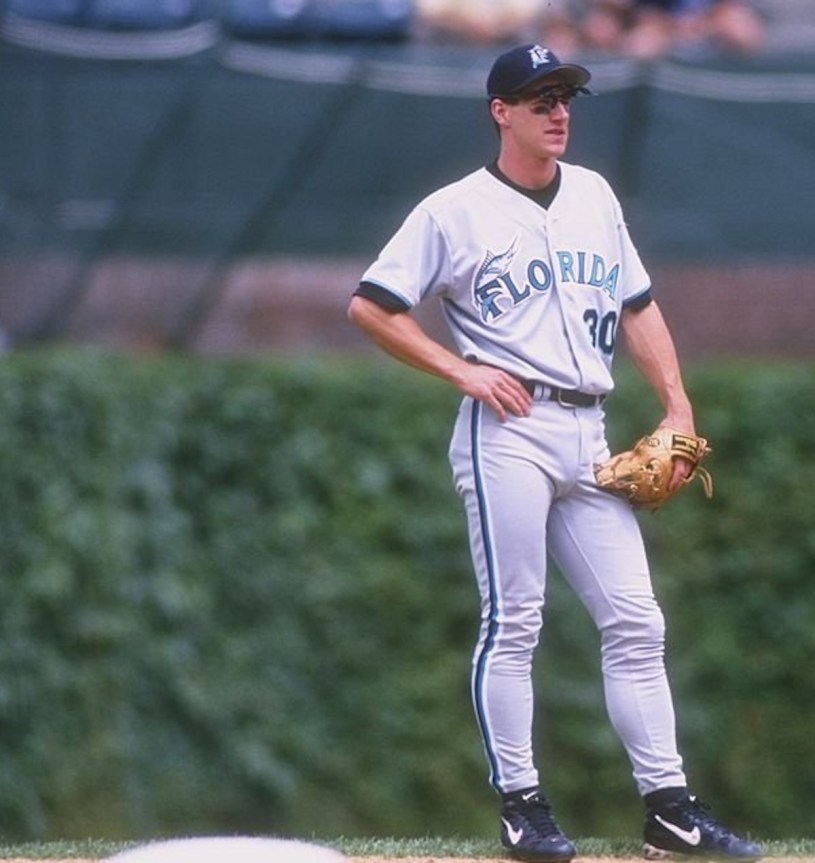
Welcome back to MLB Monday as we move into the middle of August—and the home stretch for professional baseball’s pennant races. We won’t look at those today in this space, but we do proffer up something “fun” … at least in our minds. Longtime middle infielder/utility player Craig Counsell had a rather fortunate career for someone who just wasn’t that great of a player. However, from 1995 to 2001, he played for three of the new expansion franchises in MLB and somehow managed to win two World Series.
Yeah, it sort of stretches the imagination a little to even perceive how he pulled this off, but that’s why we’re here. He may be the current manager of the Chicago Cubs, and that tracks, considering his “cerebral” talents that kept him employed in the majors until age 40 in 2011. As a player, he earned just 22.4 WAR in 15-plus seasons, and that includes 18.8 dWAR, for the record. His .686 OPS and 79 OPS+ marks didn’t keep him in the show for all those years, that’s for sure: this is his statistically based profile story.
And what a story it is …
Drafted by the soon-to-be-expansion Colorado Rockies in the 11th round of the 1992 draft out of Notre Dame, Counsell made his MLB debut late in the 1995 regular season, a campaign that would see the Rox make the postseason as a wild-card team playing its first season at Coors Field after competing in 1993-1994 at Mile High Stadium (the old one, built for the Denver Broncos). he got into three games in late September, made two plate appearances, drew a walk, and didn’t get a hit. This was his age-24 year.
The following season saw him play just 25 uninspiring games at Triple-A Colorado Springs, without getting back to the majors. Then, in 1997 at the age of 26, he played just one game for the Rockies without making a plate appearance before being traded to the Florida Marlins—the 1993 expansion brethren of the Rox—in late July for no one noteworthy. It was the break Counsell needed as he made it into 51 games in the final two-plus months of the season as the Marlins oddly qualified for the postseason.
His rookie numbers? Not too bad, as he hit .299 with a .773 OPS while earning 0.4 dWAR at second base. But it was the postseason that announced his presence to the world as the Marlins beat the San Francisco Giants, the Atlanta Braves, and the Cleveland Indians to win the most unlikely World Series championship of our lifetimes, that’s for sure. He had become the starting second baseman, and he was in the middle of all three matchup victories, while scoring the winning run in Game 7 of the Series.
Yeah, no one had that on their bingo card in Spring 1997, that’s for sure.
You can read all these qualitative narratives elsewhere, but in this quantitative analysis, Counsell hit .293 in 15 postseason games against superior competition, drove in five runs, and walked 10 times. He was the personification of The Little Engine that Could, really. It would be a hard act to follow as he entered his prime years in 1998 at age 27, but he responded decently enough with 2.0 WAR that year, playing in 107 games for the defending champions who had infamously stripped their roster after winning it all.
It’s odd to us that a playoff hero couldn’t earn a regular starting role on a 54-win team, but that’s what happened. Counsell hit only .251 despite walking 51 times, and when he got off to a very bad start in 1999, batting just .151 through the first 37 games, even the lowly Marlins couldn’t take it. They traded him to the Los Angeles Dodgers for the infamous “player to be named later” just to get him off their roster. Strange highs and strange lows; that’s how baseball’s love goes (and yes, we owe $1 to Depeche Mode).
With the Dodgers, Counsell got into 50 games, mostly as a defensive replacement, but he managed to hit .259 with L.A., albeit with no power or speed. His .626 OPS wasn’t impressive, obviously, and in the middle of Spring Training 2000, the Dodgers released him. The reality was that other than those bright moments in the brief month of October 1997, Counsell just wasn’t an MLB-worthy player at age 29. With 674 ABs under his belt, he had hit just .254 with minimal power. His defense was his ticket.
And that is what led the 1998-expansion Arizona Diamondbacks to sign him a week after L.A. released him. The D’backs had surprisingly won the National League West in their second season, and the front office clearly felt that Counsell could add something to their roster. Still not a starter, he played in Arizona for four seasons at all four infield positions, getting into 409 games in those four seasons (2000-2003), while hitting .273 and compiling 4.5 dWAR as a valuable defensive piece of the pie.
Oh, and then there was the 2001 postseason … yeah, you remember it.
Counsell hit only .213 overall with a .611 OPS, yet eight of his 13 postseason hits came in a five-game NL Championship Series victory over the Braves, and he was voted the NLCS MVP. In the World Series against the three-time defending champion New York Yankees, he only had two hits in the seven-game Fall Classic, but one of them came in Game 7. And then there was this key AB in the bottom of the ninth in that game: Counsell got hit by a pitch from Mariano Rivera with two outs to load the bases …
And the rest is history there.
What are the odds that this kind of player would feature so prominently in two World Series titles, for two expansion teams, in a five-year period, without doing much of anything in between? We can’t even calculate that nonsense. Counsell was in his age-30 season when the D’backs upset those Yankees, and yet he had two rings already would continue playing through to the 2011 season. What could he possibly do to top the first act(s) of his career? Well, after a middling 2003 season at age 32, he got traded.
Counsell had earned just 0.3 WAR in 2003 with Arizona, so the team moved him—and his $3.1M salary—to the Milwaukee Brewers in December 2003 as part of a multiplayer deal featuring no one of note. There, he was the starting shortstop at age 33, posting 1.0 WAR, 1.0 dWAR, and a .645 OPS in 140 games. That wasn’t enough production to justify his salary, of course, and the Brewers let him walk into free agency. Lo and behold, the Diamondbacks came calling for some reason and brought him back.
Mind you, he was now an age-34 middle infielder with a solid glove and a terrible bat who had managed just 1.3 WAR combined in the prior two seasons. Arizona didn’t give him a lot of money—just over $3M for two years—so it wasn’t like the D’backs were expecting a lot. They just missed his defense, right? Well, they got a lot more than that in 2005: a career-best 5.5 WAR at age 34, which is pretty unbelievable looking back now, and if the Arizona manager had been someone other than Bob Melvin, we’d balk.
Still, this season represented a demarcation line of sorts in Counsell’s long career: from 1995-2004, he managed to post 8.6 WAR total. And from 2005-2011 in the second part of his career, he earned 13.9 WAR at ages when he should have been in steep decline and falling apart physically, especially with his defensive play. Maybe we should balk at this, because it’s kind of fishy, in truth. Was there someone on that 2005 Arizona roster who “helped” Counsell discover a Fountain of Youth? Actually, yes, factually so.
Luis Gonzalez, he of Mitchell Report fame.
Gonzo himself had experienced an unreal turnaround at age 31 in Arizona back during the 2001 season, and perhaps this time back with the team, Counsell’s locker was closer to Gonzalez’s locker. We don’t know for sure, but what Counsell experienced here was very unnatural based on historical data and trends we’ve analyzed and discussed here endlessly in the last handful of years. Whatever the case, Counsell’s 5.5 WAR topped the Arizona roster, and his 3.5 dWAR should have won him a Gold Glove, too.
What could he do for an encore at age 35 in 2006?!
Well, only about half as much, as his OPS dropped from .726 to .674, and his dWAR dropped from 3.5 to 2.7—all adding up to just 2.6 total WAR. He had lost his second-base starting role from the prior year and got most of his playing time at shortstop, yet it was still the second-most productive season of his career, in terms of sabermetric value. Yet the Diamondbacks were done with Counsell, for whatever reason. They chose not to offer him a new deal, and he ended up signing with the Milwaukee organization.
It was there he would spend the final five seasons of his long career, making just over $10M more and contributing a total of 5.8 WAR to the Brewers cause from 2007-2011. This included two Octobers, 2008 and 2011, where Counsell hit just .083 in 10 games combined. He was never a true starter again at this point of his career, but he even played left field for the first time ever in his final season at age 40. Counsell was certainly a gamer, and no one can deny that. He brought a lot of intangibles to the team equation.
He did have one final “good” seasons at age 38, too, in 2009, when he posted 2.5 WAR, his third-best season ever. Playing in 130 games, he hit .285 with a .766 OPS with 1.0 dWAR. In fact, his defense never really slipped, as he posted at least 1.0 dWAR in all five of these tail-end seasons with Milwaukee. His bat, which was never very good, just ended up fading to the point that even his defense wasn’t enough to extend his career. But hey, he won two rings and earned at least $21M over his career, which isn’t bad.
Especially for a guy with his physical talents. Counsell certainly got the most out of his career, and he has parlayed that into a successful managerial career now, too, guiding the Brewers for nine seasons (2015-2023) and five playoff appearances (2018-2021, 2023). Now in his second act in the dugout leading the Cubs, he is in his third season, with one postseason berth already on his permanent record. However, his player career path stands out to us more, due to the expansion oddness and the late-age surge.
His career .255 BA came with just 42 home runs and 103 stolen bases, which spread out over his long career, amount to only four HRs and 10 SBs for every 162 games played—and he oddly never topped 150 games in a single year. What stands out is the fortuitous World Series victories, the career dWAR mark, and the strange demarcation line of “improvement” at an illogical age for a baseball player. After all this, we’re not sure what to think, but it’s always important to examine a player’s career very carefully.
Counsell ranks as the 106th-best second baseman in history, which seems kind of high. As far as we can tell, he never received a Cooperstown vote once eligible. His nickname—”Chicken”—doesn’t do much for us, either, except suggest a lot of inappropriate jokes. His batting stance was well known for its oddness, although it should have been better known for its ineffectiveness: even with his random October heroics, he was just a .229 hitter in the playoffs across 41 playoff games, with a .625 OPS. Go figure.
[Editorial Note: as the headline suggests, we didn’t set out to write this piece with our ultimate conclusion in mind at all. It’s just where the data and evidence led us, from our initial curiosity point of Counsell’s expansion journey. This is the scientific method.]

