
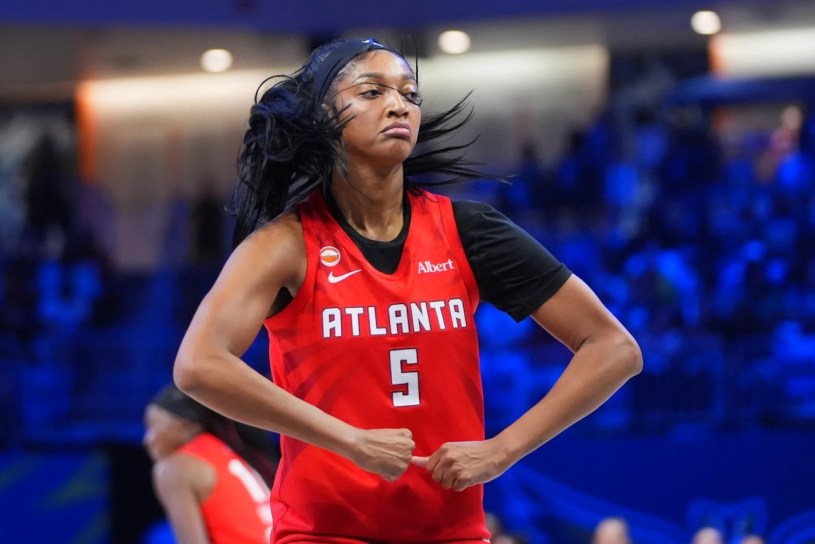
If there is a more polarizing player in the WNBA today than Indiana Fever guard Caitlin Clark, then it’s Atlanta Dream forward Angel Reese. The two rivals famously had it out in the 2023 NCAA Championship Game, won by Reese’s LSU Tigers, and they entered the women’s professional league in the same year (2024). Today on WNBA Tuesday, we’re going to look at the sabermetric realities of Reese’s games, as many people also claim she is overrated based on the “mebound” counting statistics. So, off we go!
We know Clark is overrated by many people who do not understand the modern advanced mathematical analytics of sport, but the reality is that Reese is definitely in the same category: overall in her career, Reese has posted just 0.129 Win Shares per Minute Played, while Clark is at 0.127 Win Shares per Minute Played. While too many people who should know better tout Clark as an MVP candidate, few say the same about Reese. Neither individual is the best player on their current rosters, either, which is big.
Let’s stick to Reese here, though, and go back to the beginning when she was drafted by the Chicago Sky, a team that didn’t have a lot of talent on it. In those first two seasons combined, Reese earned 4.6 WS on a team that won just 23 games total. This year, she has posted 4.0 WS for a franchise that is 25-13 with six games left to play in the regular season. Reese’s mark for value per minute has jumped as well to a career-best 0.166 this campaign, showing that anyone looks better with quality teammates around them.
However, like Clark, the Dream forward is not even close to being the best player on her team: this year, Reese ranks fourth on the Atlanta roster for total Win Shares; sixth for WS per Minute Played; third in Defensive Rating (101); and seventh in Offensive Rating (106). Never known for her offensive shooting, she also ranks 11th on her own team in Effective Field Goal Percentage (eFG: 44.6%). Reese is scoring a career-best 16.1 points per game, but she’s also taking a career-high 13.1 shot attempts per game.
See how that works? The more any player shoots, the more they will score—which is why scoring itself is the most replaceable “skill” for any player in the sport. It’s the shooting efficiency that matters a lot more than how many points one scores. Again, Reese’s game isn’t about scoring or shooting percentages; it’s more famously about rebounding. She tops the WNBA right now in total rebounds and rebounds per game (12.4), which interestingly enough is lower than her 2024 and 2025 marks (13.1 and 12.6).
The biggest critique of Reese, outside of her poor shooting skills, is the “mebounds” phenomenon, where she misses so many close-to-the-basket attempts, gets her own rebound, and pads her counting statistics that way. She has corralled a whopping 55 more offensive rebounds than any other player in the WNBA this year, and with her overall shooting percentage so low (43.7%) for a front-court player, it is not just anecdotal evidence here to support those criticisms. This is a very real statistical anomaly.
In her 2024 rookie campaign, Reese shot an even-worse 39.1 percent from the floor—while leading the league in offensive rebounds by 60 boards overall. Generally, the worse her shot making is, the more offensive glass she’s going to be cleaning. This only looks “good” on the counting stats for total rebounds or rebounds per game; it devastates her advanced analytics and sabermetric value overall … as it should! Thus, when sports mediot headlines scream about Reese’s counting stats, there’s the rub.
And like Clark, one of the most maddening things from these mathematical perspectives is the high usage rate for Reese: 25.4 percent, which is second the Dream. It’s almost as if the coaching staffs in Indianapolis and Atlanta feel “pressure” to use these “stars” more often than they should, considering the lesser value they bring to the team’s success, sabermetrically and in a common-sense way. Reese takes too many shots for someone with such poor shooting ability, and she should pass the ball more.
Her assist rate peaked in 2025 at 21.7 percent, and this year it’s dropped down to 14.3 percent with the Dream, when she has plenty of better teammates to pass the ball to on the court. High usage rates, poor shooting percentages, and a lowered assist rate all add up to the middling sabermetric value she is bringing per minute on the court. Reese is still fourth in the WNBA for defensive rebounds, and that’s her strength: cleaning defensive glass, perhaps bringing the ball up the court, and finding the open teammate.
Whether she starts focusing on those strengths, working on her weaknesses, or just staying the same player she is, Reese will remain polarizing for many off-the-court reasons—which we will not discuss here. It’s a shame, though, that people don’t see her for the basketball player she is rather than for what they’re being told she is by the sports mediots with a vested financial motive.

