
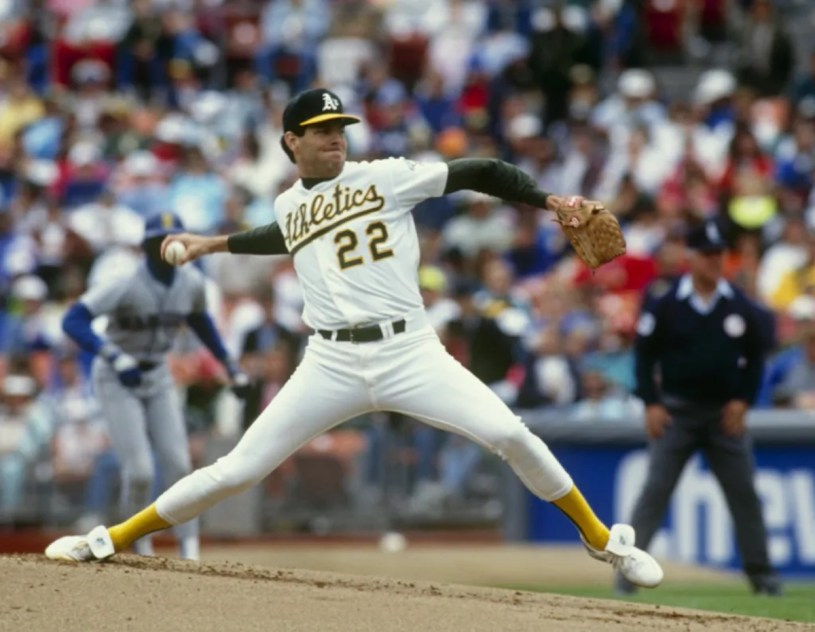
We’re back with the last Friday Funday of the month, and this time, it’s all about longtime MLB starting pitcher Scott Sanderson. Why him? Well, he danced across our radar earlier this month when we did our analytical piece on the 1990 season series between the New York Yankees and the Oakland Athletics, and we couldn’t get him off our minds. ADHD works that way sometimes, we’re proud to say, so here we are with a look at his career statistical profile, although he passed away in 2019, sadly (unknown to us).
Over a 19-season career from 1978 to 1996, he pitched for seven different franchises, accrued 27.6 WAR total, and won 20 more games than he lost with a sub-4.00 ERA. He did all this while allowing more hits than innings pitched and striking out only 5.7 batters per nine innings pitched over his long residency in the majors. Sanderson spent six seasons with the Montréal Expos, six seasons with the Chicago Cubs, one season with Oakland, and two with the Yankees, before moving around a lot his final years.
Let’s start from the beginning: originally drafted out of high school in 1974 by the Kansas City Royals in the 11th round, Sanderson chose to go to college instead at Vanderbilt University. That helped him to be a third-round pick by the Expos in 1977, and he made his MLB debut the following year at age 21. He appeared in 44 games combined for Montréal during the 1978-1979 seasons, earning 2.9 WAR while posting a 13-10 record across 229 IP with a 3.18 ERA and a 7.4 K/9 rate—a career-best number.
He would never be that good again, unfortunately.
While his next two seasons (1980-1981) were successful, his K rate dropped to just 5.2 per nine innings, oddly. That did not impact his overall numbers a lot, yet, however. Sanderson went 25-18 in those two campaigns combined, with a 3.05 ERA as the Expos reached the postseason for the first time in their organizational history during the strike-shortened season of 1981. He didn’t pitch well in his one playoff start that October, but at age 24 with 8.9 WAR already earned in his brief career, the sky looked blue.
Yet it didn’t really happen that way for him, sadly.
His 1982 season (12-12, 3.46 ERA, 2.5 WAR) was solid enough, but the bottom fell out in 1983 as he headed toward free agency. During that age-26 campaign, he saw his ERA balloon to 4.65 as his WAR went negative for the first time ever (minus-0.6). He only made 18 appearances that season, and in December 1983, the Expos traded him to the Cubs in a three-team exchange that also involved the San Diego Padres. His overall 3.33 ERA with Montréal would turn out to be the best stop of his long career.
With the Cubs, however, he made 43 combined starts in 1984 and 1985, looking for awhile like he’d rediscovered his mojpo in his age-27 and age-28 seasons: 13-11, 3.13 ERA, and 5.9 WAR. Chicago famously made the postseason in 1984, of course, before blowing the National League Championship Series to the Padres—Sanderson again made a single October start and did not fare well. His two playoff appearances so far had resulted in a 6.14 ERA, so his reputation would take a bit of a hit as a result then.
And that K rate? A career low (at the time) 4.9 K/9 in 1984. It would rise a bit over the next few years before falling again, but the distinct reality was that Sanderson was not throwing gas at all. It was a different era, of course, but the reality of throwing heat has always been significant in professional baseball. Nonetheless, Sanderson’s final four campaigns in Chicago were not very good, overall: from 1986-1989, he posted a 29-31 mark with a 4.18 ERA and 6.4 WAR total across 476 IP for $3.4M salary—barely mid.
When the Cubbies won the NL East in 1989, Sanderson did not get a start in the NLCS against the San Francisco Giants, either, although he did post two scoreless innings in his single appearance, the only successful effort of his October career. Overall, however, his 1989 campaign, at age 32, was not super impressive (3.94 ERA, 1.1 WAR, 1.271 WHIP), yet somehow it was enough for the A’s to sign him as a free agent before the 1990 season when they would be defending their World Series title. Go figure.
We suspect the Athletics coaching staff figured they could work with his delivery or something, as Dave Duncan was one of the best pitching coaches around at the time. Oakland was confident enough to give an aging starter a three-year deal worth $3M. Sanderson pitched well enough for the A’s in 1990 at age 33, too: 17-11, 3.88 ERA, and a 1.313 WHIP across 206 1/3 IP, his highest single-season use since 1982 when he was with the Expos. However, all that amounted to just 0.3 WAR in Oakland.
And, of course, he couldn’t crack the postseason rotation as the A’s returned to the World Series, losing to the Cincinnati Reds. Sanderson pitched just 1 2/3 IP in October, to the tune of a 10.80 ERA, and he would never pitch in the playoffs again, finishing his postseason career with a 5.73 ERA in 11 IP. And as we mentioned in the prior piece on the A’s-Yankees matchups in 1990, his success against New York convinced George Steinbrenner to buy his contract, and we suspect the A’s were fine with that, surely.
His time in New York was a mixed bag: his 1991 numbers were very similar to his 1990 stats, actually, with a 16-10 record and a 3.81 ERA. But in context on a lesser team, it meant 3.9 WAR. Also, Oakland Manager Tony La Russa rewarded his former player with an All-Star nod in 1991, the only one of Sanderson’s long career. However, the following year (1992), he regressed a lot, posting a 4.93 ERA and negative value for the Yankees (minus-0.1 WAR), and you know what that meant to a guy like The Boss.
Now entering his age-36 campaign, Sanderson signed a deal with the California Angels for for $800K, and in 21 starts there, he posted a 4.46 ERA and a 1.330 WHIP before being waived in early August. From there, the Giants—deep into the famous NL West Division race with the Atlanta Braves—took a chance on Sanderson, and he delivered decent value for them down the stretch in 11 appearances (4-2 record, 3.51 ERA). However, he once again was a free agent at the end of the 1993 season, nonetheless.
Sanderson signed with the Chicago White Sox for the eventually aborted 1994 season, getting $350K for one year. He went 8-4 with a 5.09 ERA; before the 1995 season began, he returned to the Angels franchise where he tossed the final 57 1/3 IP of his MLB career in 1995-1996 combined, retiring at age 39 to eventually become a sports agent with such clients as Frank Thomas, Josh Beckett, and Lance Berkman. His career 3.84 ERA is solid, as is his 163-143 win/loss record. And he made at least $11M total.
He died of cancer in April 2019, at the young age of 62. Growing up in the Northern California region, we remembered him pitching for the A’s but had no memory of him pitching for the Giants during that 1993 pennant race when we were in college and actively following the sport we would soon be writing about professionally. Sanderson only came across our brains recently, again, because of the aforementioned piece on the A’s and the Yankees matchups in 1990. He had a long and mildly memorable career.
Pitching for some famous playoff teams is part of the story, of course, but the mediocrity of his K rate and the vagabond existence after the first dozen years of his career led us to labeling him as we have in the title of this piece. Giving up 9.1 hits per 9 IP across one’s career is not a recipe for success, but Sanderson survived while pitching for some pretty good teams. He rates out as the 382nd-best SP in MLB history, which isn’t saying much, so there’s no Hall of Fame here. Yet he did well with what he had to offer.
And that’s as good a life as anyone of us could hope for in the end.

