
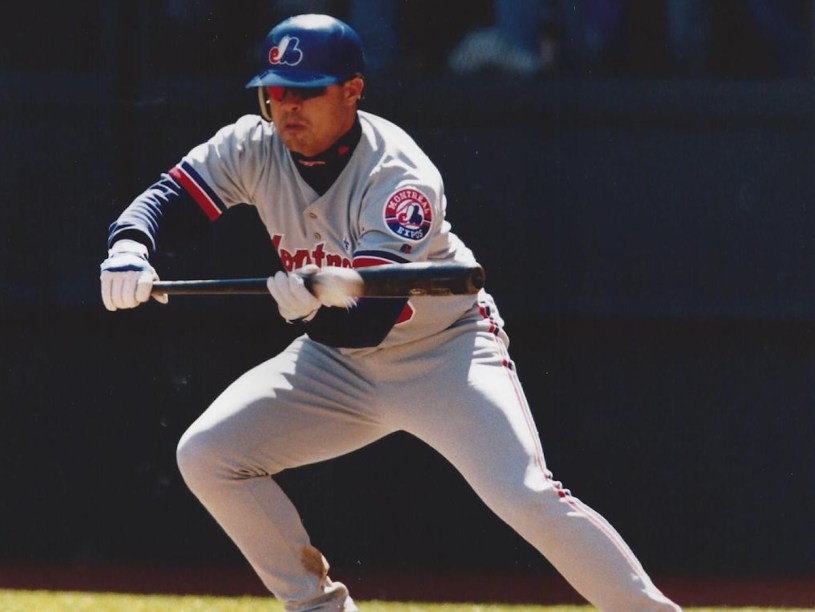
We love Mondays, in general, but one of the main reasons we do nowadays is the MLB Monday miniseries. We often find ourselves thinking about the past in professional baseball and all the things we remember in our five decades of watching the sport. Thus, today we ended up thinking about three-time All-Star second baseman José Vidro. He played in the final eight seasons for the Montréal Expos, before moving to Washington for two more season with the franchise, making him one of the Final Expos.
And we think that is significant, in addition to his .298 career batting average, which was actually at .301 before his final two MLB campaigns with the Seattle Mariners (2007-2008) where he hit a very respectable .285 even though it took him out of an exclusive club. We are not here to judge him for any career decisions that netted him an extra $16M in salary, although it is an interesting asterisk to his career analysis which follows. With 17.4 WAR total in his MLB tenure, Vidro is not Cooperstown material, either.
So, let’s go back to his beginnings: drafted in the sixth round of the 1992 Draft out of his Puerto Rico high school by the Expos, Vidro made his MLB debut at age 22 in 1997 with the franchise. In 62 games that year, he put up a modest .664 OPS while playing both second and third in the majors. The following season, he played in 83 games, although his .596 OPS was quite ugly. Thus, his first 145 games, the basic equivalent of a full campaign, he was not showing much in terms of production required to stick around.
Yet, he asserted himself enough in the eyes of the organization to spend the next five years (1999-2004) as the Expos starting second baseman. In 1999 at age 24, he posted his first positive-WAR mark (2.1), playing in 140 games and contributing an .822 OPS while hitting .304 at the plate. Vidro didn’t have any speed, but his 12 home runs in this third season represented a leap forward in terms of power. And again, it was the start of a five-year stretch where he hit a robust .316 combined in these seasons.
His career power peak came in 2000 with 24 HRs, and Vidro made the All-Star roster for the first time. He would earn this same honor in 2002 and 2003, as well, and his OPS marks were over .821 in six consecutive seasons from 1999-2005. No, his defense was never at the Gold Glove level, but he wasn’t necessarily a disaster in the field, either. His real decline started in 2005 at age 30, when he only played in 87 games due to both ankle and elbow injuries as the team relocated to the Atlantic Ocean seaboard south.
Still, he managed a .763 OPS which translated to a 104 OPS+ mark, showing he was still above the average production level, despite the drop from his All-Star levels. However, his slide continued in 2006, the second year of his final MLB contract, when Vidro played in 126 games while managing a .744 OPS (and a mere 96 OPS+). As a result, the Nationals organization decided to part ways with him and traded him to the Mariners before the 2007 season in a salary dump, basically, ending a long relationship.
With Seattle, Vidro rebounded at age 32 in 2007 with a 1.4-WAR season, hitting .314 although only with a .775 OPS. However, he could not replicate this in his final season (2008), as his batting average dropped to .234—costing him a .300 career BA mark, sadly. Entering that last campaign, his career average (.302) was above the demarcation line, although again, perhaps it is just us who laments such things from our outside(r) perspective, influenced by romantic notions of historical achievements like this one.
In addition to the three All-Star nods, Vidro also earned MVP votes in 2002 when he accrued a career-best 5.4 WAR; in 2003, he won the Silver Slugger for his performance at the plate. Despite the relatively low career WAR mark, he did achieve some notable moments in his major-league run, although he never got to play in October. With career on-field earnings of almost $50M, as well, Vidro was pretty well compensated for his efforts. Hopefully, he can be remembered for what he did do instead of what he did not.

