
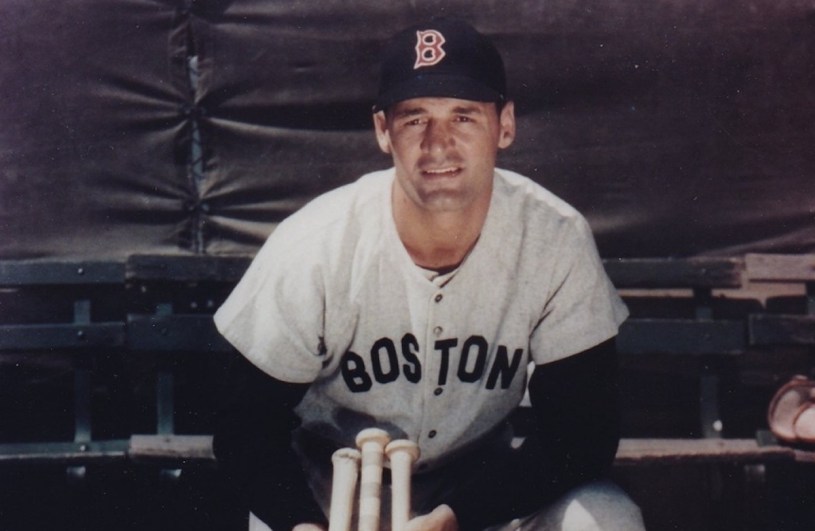
It’s time for more Friday Funday, as we look at a historic baseball player who has intrigued us for many years now: first baseman Walt Dropo. Here is a fellow who won the American League Rookie of the Year vote in 1950—although we disagreed with that result—and barely ever did much else of note in his subsequent 11 years in the major leagues. There have been some flashes in the pan like this before in MLB history, of course, but we’ve always liked Dropo’s name and what it implies about his stat dropo(ff).
[Don’t worry; we will not be quitting our day job.]
He attended the University of Connecticut and made his major-league debut with the Boston Red Sox in 1949, playing in 11 games for a team that would famously blow the AL pennant in the final weekend of the season. Dropo wasn’t good in this brief audition, either, delivering just a .400 OPS in 44 plate appearances. A late bloomer, he was in his age-27 season when 1950 rolled around, and he miraculously shredded the AL with a .961 OPS, 326 total bases, and an MLB-high 144 RBI. Clearly, this was his prime.
And it didn’t last long. First, he only posted 2.6 WAR in 1950 despite those gaudy batting statistics, as his glove was mediocre (minus-1.1 dWAR), and he still struck out 30 more times than he walked that year. Considering, however, that he finished his career with just 3.4 WAR total, it’s obvious he would never come close to that kind of offensive production again. Yet? It netted him an All-Star nod and a sixth-place finish in the AL MVP vote as well; there would be only one other season with MVP votes.
Dropo did, indeed, drop off deeply in 1951: a .681 OPS and minus-1.1 WAR. He only drove in 57 runs as a follow-up effort to his ROTY campaign, while playing in just 99 games and losing his starting status at first base in Boston. In fact, he was sent down to the minors for awhile, and after a decent 37-game start to the 1952 season with the Red Sox—Dropo put up an .801 OPS—he was traded to the Detroit Tigers in a multiplayer deal. He did well enough with the Tigers to earn some MVP consideration, in fact.
Overall, in that 1952 season, he delivered 1.5 WAR combined with 29 home runs and 97 RBI. It seemed like maybe Dropo had rediscovered that age-27 magic, but he reverted in his age-30 season (1953) back to the negative-value side of the ledger: minus-1.1 WAR again, this time with a .660 OPS for Detroit in 152 games. It’s pretty incredible to think he got that much playing time with such terrible sabermetric realities going on with his production, but we assume the Tigers were just staying truly hopeful.
Dropo stayed with the Detroit organization in 1954 at age 31, although he did lose his starting gig again while producing a mere 0.1 WAR, a .703 OPS, and 44 RBI in 107 games. But this would be his final season with the Tigers, as they traded him to the Chicago White Sox in December 1954. He then spent three-plus seasons (387 games total) on the South Side of the Windy City, but his numbers were nothing special: 1.1 WAR combined, 188 RBI, and a .744 OPS. This was a far cry from his 1950 season.
At age 35 during the 1958 season, the ChiSox waived Dropo after 28 games. He had struggled with a .598 OPS in those contests with Chicago, yet he rediscovered a bit of his old stroke in the National League with the Cincinnati Reds, who claimed him off waivers: in 63 games playing for Cincy, he managed an .823 OPS and 31 RBI to produce positive sabermetric value (0.9 WAR). Yet again, Dropo could not sustain his momentum from one season to the next, and in 1959, he got off to a bad start once again.
He generated just a .410 OPS in his first 26 games at age 36, causing the Reds to unload him on the Baltimore Orioles in a throwaway trade. Dropo would spend his final 155 games in the majors, through 1961, with the team, posting a respectable .750 OPS through age 38. The inconsistency of his production from year to year certainly stands out, but overall, Dropo ended up with a .757 OPS, built on a .270 batting average, for his entire career in MLB. His minus-5.9 dWAR over 12 years isn’t that bad, either.
We come back to that inconsistency: playing for five teams for at least two seasons each, he never compiled more than 1.2 WAR for any of those franchises. His ROTY season in 1950 was his best one, by far, and he never came close to replicating that again. We suspect the lineup strength in Boston, and maybe Fenway Park, contributed to his All-Star season there. After all, as we pointed out once before, playing anywhere near Ted Williams would have helped any player be the best he could be, at the plate.
It is just surprising to us that Dropo was so good so early, and whatever lessons he gained that year were lost upon him going forward throughout his career. That rollercoaster ride, too, throughout his career seems more like a curse or a jinx than anything else, too, as it followed him from organization to organization. Obviously, his name probably is not familiar to modern baseball fans, and that is okay; it’s just interesting for us to explore his career and put it in some context after all these years of thinking.

