
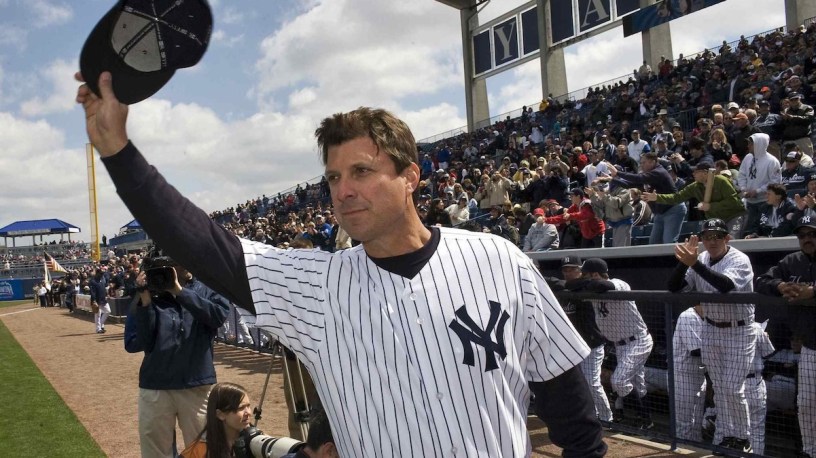
Welcome to another entry in our ongoing (and perhaps endless?) MLB Monday miniseries where we take a look at a professional baseball player from the past … usually. Today, it’s time to analyze and assess longtime first baseman Tino Martinez, who is—in our informed opinion, based on fact(s)—one of the more underrated members of the 1990s New York Yankees dynasty that won four World Series in a five-year span … and came this close to winning a fifth in six years, as well.
Tino just doesn’t get enough love.
And we know why: there were more charismatic players on those Yankees team than the below-the-radar first baseman who joined the team in 1996 and left the team after 2001. Is it a coincidence that these Bronx Bombers didn’t win it all before he showed up or after he left? We don’t think so. Martinez only earned one All-Star nod during his tenure with the Yankees, which is a shameful error on the part of his own manager (Joe Torre), who should have made sure Tino got a few more ASG action.
But let’s go back to the beginning, because he originally was drafted in the third round of the 1985 draft by the Boston Red Sox out of high school. However, he chose to attend college, playing his amateur ball at the University of Tampa, and from there, he was picked No. 14 overall in 1988 by the Seattle Mariners. He eventually reached the majors at age 22 in 1990, and he really didn’t break out until the strike-shortened season (1994) as the franchise was building around some young(er) talent.
From 1990-1993, Martinez only managed to contribute just 2.2 WAR across 305 games as he was not a regular starter at first base, and he also got some playing as a designated hitter. But his .799 OPS in 1993 at age 25 across 109 games gave the Seattle front office confidence he was ready for a full-time gig the following season—and they were right. In just 97 games, he hit 20 home runs and posted an .828 OPS. Never a great glove man, he held his own with 0.7 dWAR combined in 1993-1995.
His first All-Star recognition came in the Mariners’ first-ever postseason campaign (1995): entering his peak at age 27, Martinez delivered 4.5 WAR by hitting 31 HRs and with .920 OPS as Seattle upset the Yankees in that thrilling American League Divisional Series in the first official year of the wild-card era. The AL West champions knocked New York in a five-game matchup that had every baseball fan on the edge of their seats down to the final out. You might remember it. We do!
[Even though that was more than 30 years ago now, we still get goosebumps watching the highlights. Good times.]
At the time, it seemed like the world would be the Mariners’ oyster, but with Martinez due for a big raise after his All-Star season, Seattle decided to trade him—to the Yankees, of all teams. We all know how George Steinbrenner operated: after Tino hit .409 against his team in that postseason series, of course the Boss wanted him. So, the Yankees agreed to a five-year, $20M deal with Martinez so the trade could be finalized. This was a really big raise for the now age-28 Tino from $1M/year.
And he did not disappoint: in those five seasons and one extra (1996-2001), Martinez was the backbone of the Yankees dominance, doing it all without fanfare or flash, really. His 15.5 WAR across those six seasons isn’t flashy, but his OPS peaked at .948 in 1997, his second and final All-Star campaign. Martinez did struggle in 2000, but the Yankees held faith, giving him another $6.3M to stick around for 2001, and he roared back with 34 HRs and an .830 OPS as New York won another pennant.
However, as he would be in his age-34 season in 2002, the New York front office—coming off that memorable World Series loss to the Arizona Diamondbacks—decided to part ways with one of their clubhouse leaders, and the Yankees roster would not be the same for many years, in terms of the success they experienced with Tino in the fold. Yet the St. Louis Cardinals felt Martinez still had something to offer, so they came in with a three-year, $20.75M deal, and he moved to the National League.
In two seasons with the Cards, Martinez certainly did drop off in production, earning just 2.3 WAR combined in 2002-2003 to go along with a .778 OPS based on a .267 batting average and 36 HRs total. That’s not what St. Louis was expecting, of course, so the Cardinals management traded him to his hometown team for the final year of the contract he’d signed with St. Louis. In Tampa Bay with the Devil Rays in 2004, at age 36, Tino had a solid resurgence: 2.4 WAR, .823 OPS, and 23 HRs.
No one knew how much was left in the tank at that point, but the Yankees decided to bring him back for another year (2005) at a modest $2.75M. We suspect this may have had something to do with the New York loss in the 2003 World Series and the epic choke in the 2004 AL Championship Series again Boston; the Yankees needed some renewed leadership in the clubhouse as clearly Derek Jeter wasn’t cutting it as the “Captain”—as we have discussed here before. Martinez brought gravitas back.
But Tino was 37 at this point, and in 131 games, he only produced 1.5 WAR—yet his .767 OPS was respectable, and he clearly brought more than just statistics to the equation. New York reached the postseason again before losing in another playoff upset to the Los Angeles Angels of Anaheim in a five-game ALDS matchup. Still, it could be considered a successful victory lap for Martinez, in terms of wrapping up his MLB career in a place where he was beloved. Not every story has a perfect ending, yo.
We don’t think Martinez would complain about his four title rings, or the $52M-plus he made during his baseball career. With 29.0 WAR, he’s not going to be in Cooperstown, and Tino didn’t win any major awards. Yet he was named a Silver Slugger for his 1997 efforts, and he also won the ASG Home Run Derby that same year. Ironically, it was the one year he played for the Yankees that the team did not reach the World Series; let that sink in for a moment. He certainly was in the middle of it all.
His 339 HRs in the majors represent a very solid career, obviously. although his postseason performances themselves—overall—do leave something behind to be skeptical about in terms of his contributions to the team’s overall successes. He only hit nine postseason homers in 99 games combined, including eight with New York in 81 games. While he certainly had excellent series here and there, his complete postseason profile includes just a .672 OPS, brought down a lot by his last three Octobers.
In 2001, 2002, and 2005 combined, Martinez struggled to hit just .141 in 27 games with the Yankees and the Cardinals. Without those challenging moments as he aged, his October numbers would look a lot better. Alas, age catches up with us all, one way or another, and these individual data points cannot detract from the success he helped achieve in Seattle and New York when he was in his prime seasons. We try not to cherry pick data, but we do offer context … Tino did it a lot of it well.

