
It’s been a month since our last Friday Funday piece, so here we go today with a look at longtime MLB starter John Tudor, who somehow never was an All-Star selection despite a nine-season stretch from 1982-1990 that still looks pretty good on paper. A late bloomer, he didn’t get to the majors until he was in his age-25 season, played for four different franchises, and finished his career with a 3.12 ERA across 281 appearances from 1979-1990 in a 12-year career that saw him win five postseason games in October.
His career 34.2 WAR is somewhat pedestrian due to the late bloom, but it favorably compares to guys like current MLB starter Sonny Gray and the long-retired Charlie Leibrandt, another lefty we examined recently. Of course, all three of these pitchers have contextually different statistical profiles, but hopefully the point is clear. Tudor ranks 229th all time among starters with that WAR mark, and the career ERA is impressive for a guy who was never a strikeout pitcher. He did alright for himself in the end.
Tudor was originally drafted by the New York Mets in the 1975 draft, before staying at Georgia Southern University and being selected the following year by the Boston Red Sox in the secondary draft. He made an unremarkable MLB debut in 1979 with the Red Sox, making six starts and impressing very little with a 6.43 ERA across 28 innings. He showed improvement the following season in 92 1/3 IP for Boston, winning eight games, completing five starts fully, and posting a 3.02 ERA. At age 26, he was ready.
Or was he?
He regressed in 1981 with a 4.58 ERA and 0.0 WAR while pitching only 78 2/3 innings. That was his age-27 season, and Tudor had yet to really establish himself at a point in his career where it’s either put-up or shut-up time. So, the Red Sox were pleased with his 1982 season: a 13-10 record, 3.7 WAR, and a 3.63 ERA in 195 2/3 IP. However, all was not golden, as his stuff was very hittable (215 hits allowed with a 1.400 WHIP). There was still plenty of room for improvement, although Tudor was on his way.
From 1982-1990, he won a combined 104 games despite missing most of the 1989 season to injury at age 35. After his breakthrough 1982 campaign, he returned in 1983 with Boston to win 13 games again, although with a higher ERA. Yet his WHIP and H/IP numbers dropped, so the evolution was continuing in a positive way, overall. Yet, the Red Sox decided to sell high, so to speak, and they wanted more offensive firepower. So Tudor was shipped off to the Pittsburgh Pirates, straight up for Mike Easler.
Tudor would find his groove in the National League, where he pitched for the rest of career forward. In 1984 at age 30, he won 13 games for the Pirates with a 3.27 ERA across 212 IP with a then career-low WHIP (1.208). But Pittsburgh also decided to move him at that point, sending him to the St. Louis Cardinals for George Hendrick. Despite consistently winning games in the prior three years (1982-1984) and posting 10.8 WAR, these teams didn’t seem to realize what they had going for them on the mound.
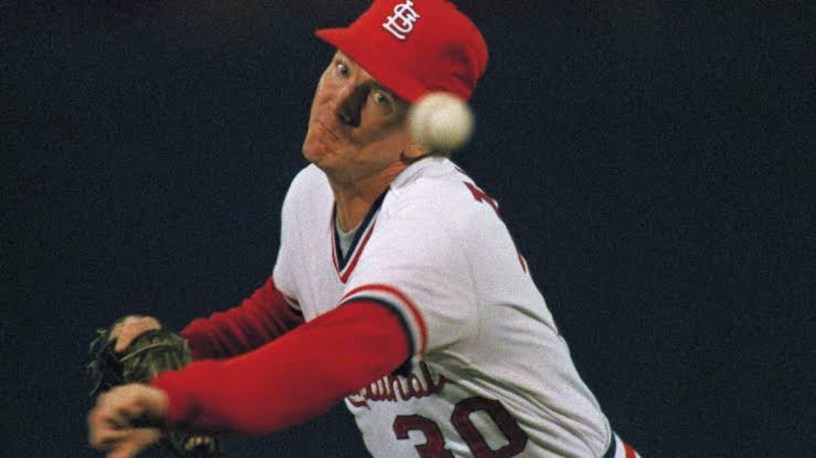
With the Cardinals, Tudor would flourish from 1985-1988, posting 50 victories and helping the St. Louis organization reach the 1985 and 1987 World Series. At age 31, he had his best season ever in 1985 with the Cards: 21-8, 1.93 ERA, and league-leading marks in shutouts (10) and WHIP (0.938). Tudor finished second in the Cy Young vote, only because Dwight Gooden had such a historic season, really. Strangely, it was the only year of his career where he earned Cy Young votes at all, which seems very odd.
His 3-2 record and 2.93 ERA in October 1985 were big reasons why the St. Louis club almost won the Fall Classic, and after posting a crazy-good 8.1 WAR, the 2.7 WAR he managed in 1986 seem like a huge letdown. The base numbers were still good for him at age 32, though: 13-7, 2.92 ERA, and a 1.142 WHIP. The Cardinals, overall, suffered a bit of a letdown hangover after the near-miss experience in 1985, really, so no one could fault Tudor for not replicating his peak performance from the season prior.
A random injury in 1987 limited him to just 16 starts, but he posted a 10-2 record and earned 1.7 WAR for St. Louis as the team once again returned to the World Series, only to lose again in Game 7. Tudor’s 2-2 mark with a 3.42 in the postseason was solid enough, all things considered. But age 33, he may have never fully recovered from that broken leg, despite some very impressive numbers overall from 1988-1990: a 22-12 record with a 2.39 ERA over 358-plus IP. His stamina and strength seemed to suffer.
In 1988, Tudor was 6-5 with a 2.29 ERA after 21 starts when the Cardinals flipped him to the Los Angeles Dodgers for the infamous Pedro Guerrero, and he delivered a 4-3 record with a 2.41 ERA for the eventual World Series champs down the stretch in nine starts. He had a mediocre postseason, but Tudor won his only World Series with L.A. that year before missing most of the 1989 season due to injury. He pitched just 14 1/3 innings at age 35 before returning to St. Louis as a free agent for the 1990 year.
In his final season, at age 36, he successfully restored his reputation with a 12-4 campaign, augmented by a 2.40 ERA and a 1.025 WHIP. With 3.4 WAR in that last year, he decided to hang it up on a high note and walk away. We look back at his record now, and we see a pretty impressive pitcher who may not have had electric stuff, but he was a master of his craft during his best years. Tudor won no major awards, but he did get a ring (overrated yet still a nice “consolation prize” for him here). Many of us would take this.

