
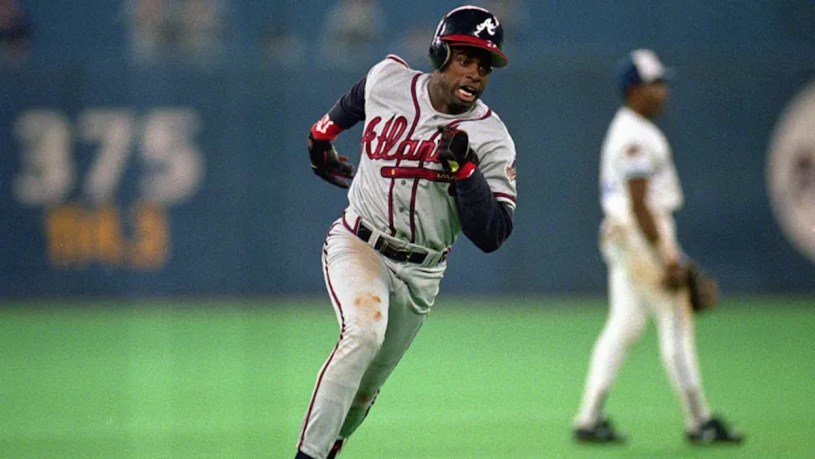
It’s time for MLB Monday, and we really don’t know why we’ve chosen today’s subject: occasional centerfielder Deion Sanders. Yeah, that guy. He only played 100-plus games one time during a four-franchise MLB career than spanned from 1989-2001. Playing in parts of nine different seasons, he compiled a total of 5.5 WAR for his major-league tenure. This is what 641 regular-season games encompassed, in addition to a .263 batting average, a .711 OPS, and a barely above-average 0.6 dWAR, too.
Sanders is more famous for his NFL career, obviously, built upon his time playing college football. However, he was drafted by the Kansas City Royals in the sixth round of the MLB Draft before committing to Florida State. Then, in the 1988 draft, the New York Yankees took a 30th-round gamble on him, and it paid off … sort of? Sanders played a combined 71 games in pinstripes in the 1989 and 1990 campaigns, when the team stunk—and so did he (.178 BA, .553 OPS), really. But he was trade bait, as well.
Or was he? New York released him in late September 1990, probably under the impression he would never leave the NFL for the House that Ruth Built—nor was he going to be Babe Ruth, either. Yet as his NFL career with the Atlanta Falcons progressed, Sanders found himself signing with the Atlanta Braves in January 1991, interesting as this was months before the team went first to last and made it to Game 7 of the Fall Classic. Sanders managed to get into 54 games with the Braves, although his value melted.
With minus-1.0 WAR, he could have made a negative difference in the NL West Division race. Alas, the rest of the Atlanta roster overcompensated for his bad play: .616 OPS and minus-1.0 dWAR. Never buy into the narrative, if it exists, that Neon Deion helped the Braves in 1991. A little tidbit? He didn’t even make the postseason roster for Atlanta at the end of the season when the team advanced to the NL Championship Series against Barry Bonds and the Pittsburgh Pirates. It was not a great career start.
Sanders, through 125 games over three seasons (1989-1991) so far, had managed to “contribute” minus-1.2 WAR to his teams’ cause(s). Yet a lot changed in 1992 when he played a then career-high 97 games in a single season while contributing a whopping 3.2 WAR to the 1992 Atlanta charge back to the postseason. Sanders hit .304, led the majors in triples (14), and added an .841 OPS with 26 stolen bases, too. This was his MLB peak at age 24, while also being a standout cornerback in the NFL at the same time.
Amazing, in truth.
But it didn’t last: he did hit .400 in October 1992, but by the 1993 MLB season, Sanders’ production would decline across 95 games and just 1.5 WAR. That number dropped to 1.3 WAR in 1994, when he split his 92 games between Atlanta (46) and Cincinnati (46). Sanders got thrown out on base-stealing attempts more than anyone else in the sport, as well. Sixteen times he was caught stealing, and his NFL stint with the San Francisco 49ers took precedence as the World Series also was canceled in MLB.
It’s impressive, though, that the Braves received Roberto Kelly in exchange, only in his age-29 season. Clearly, the Reds thought Sanders could produce like 1992 again, and that maybe he could be ready to give up football. Well, it didn’t work out that way, obviously: just 33 games into the 1995 season, the Cincinnati front office flipped him to San Francisco in a package deal as the Giants were losing badly again that summer. Sanders was in his age-27 season and already playing with his fourth MLB team.
He actually did pretty good in ol’ Candlestick Park, playing 52 games for San Francisco and accruing 1.4 WAR in those appearances (.790 OPS). It really would be his last hurrah in the sport, though, even as the Giants finished in last place, 11 games behind the Los Angeles Dodgers in the NL West Division. Sanders did not play baseball in 1996, as his time with the Dallas Cowboys was occupying him. He was an MLB free agent from December 1995 to January 1997, when the Reds came calling.
Somehow, Sanders decided to play as close to a full season as possible, and he appeared in 115 games for Cincinnati as an age-29 CF with low mileage/wear and tear. His .693 OPS wasn’t good, however, and his defense was rough, too (minus-0.5 dWAR). Sanders had been a decent glove man in the middle of his MLB experiences, but football action took its toll on his body, for sure. Yet he went back to the NFL full-time in 1998 and 1999, and it wasn’t until 2001 Sanders once again reached the major leagues.
His last whimper—.475 OPS in 32 games—came with the Reds again, after they’d be left hanging by him for a few years, signing him without getting any return on that action. But he was done in the sport; the Cincinnati front office waived him in June 2001. Interestingly, the Toronto Blue Jays signed him, but they too let him go a month later without seeing him in the majors. Again, his overall numbers weren’t great, but Sanders added at least $13M more to his bank account with this side hustle, so he did just fine.
What we find most ironic is that Sanders missed out on the Braves’ 1995 World Series championship, although he won back-to-back Super Bowl rings with the 49ers and the Cowboys. But he could have had both, perhaps, if he had stuck with the Braves. However, the team may have tired of his act, so there’s that to consider. Either way, he was more hype than substance, save for those flashes of brilliance in 1992 with Atlanta. That was a glimpse of something that could have been so much more. Oh well …

