
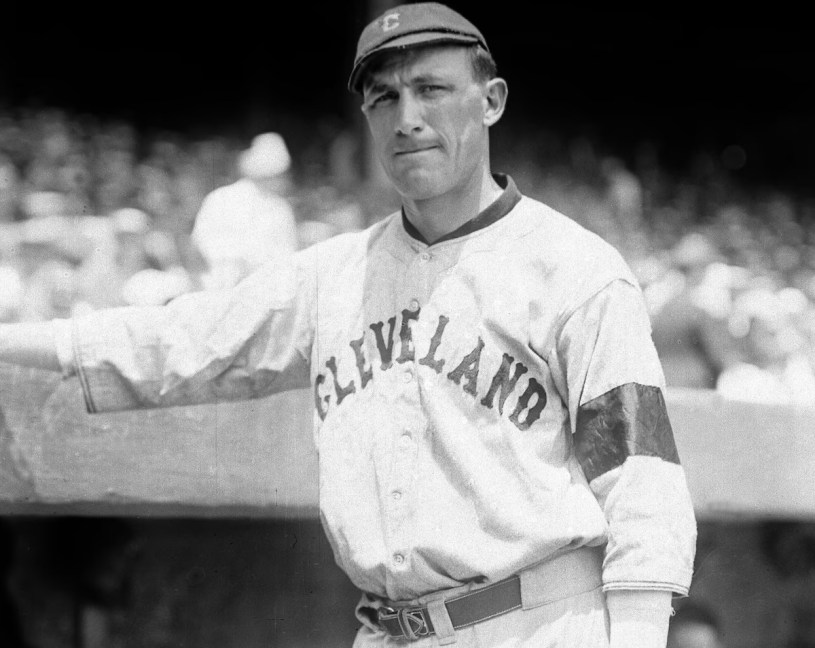
It’s time for Friday Funday, again, and we often think of baseball players from the distant past who end up as trivia answers on Sports Night at the local pub. Today’s feature highlights one of those MLB randos: longtime infielder Bill Wambsganss. If you don’t know why he is “famous”? That’s okay. It’s obscure and more so today than it was when we were kids in the 1970s and 1980s eating up as much sports history as we could. Needless to say, he’s not notable in any other way beyond the singular piece of trivia.
Yes, we’re going to leave you hanging for now, as Wambsganss played for 13 seasons in the majors: ten with the Cleveland Naps/Indians (1914-1923), two with the Boston Red Sox (1924-1925), and one with the Philadelphia Athletics (1926). There is little notable about his profile: a 3.7 career WAR is forgettable, and he only led the American League in a few categories here and there (sacrifice hits in 1921-1922 and plate appearances in 1924). Certainly, something kept him around all those years, right?
It wasn’t his .655 OPS, and while we know the deeper in the past we try to assess defensive abilities using sabermetrics, the harder it is due to data availability, or lack thereof. Yet Wambsganss’ minus-2.1 dWAR doesn’t stand out as atrocious, either. He broke into the majors with the Indians at age 20, playing 43 games in 1914 and hitting a minuscule .217 with .564 OPS. His bat was never the thing, of course, as we know, but he then played in 121 games the following season and hit even worse (.195 BA, .499 OPS). Doh!
So, the defense had to be there, and you can read those qualitative assessments elsewhere: “Contemporary accounts of Cleveland second baseman Bill Wambsganss’ fielding almost universally used the word ‘slick’ to describe his play.” Well, we know what he could do with the bat, and we know what he could not do. Wambsganss walked more than he struck out, and his base stealing seems to have been decent (140 SBs), albeit not spectacular (74 times caught). Thus, the glove kept him employed, slick or not.
His career-best sabermetric season came in 1917, when he delivered a .628 OPS and 0.9 dWAR. He hit only seven career home runs in 1,491 games, and Wambsganss was a starting infielder from 1916-1922 in Cleveland: first at shortstop (1916) and then at second base (1917-1922). He even finished 21st in the 1922 MVP vote, despite his minus-0.4 WAR contribution to the team. We know it was a different time, but we have a hard time understanding that vote when Cleveland finished fourth in the AL that year.
Most famously, Wambsganss was the starting second sacker for the World Series champions in 1920, however. After another nondescript regular season (.633 OPS, 0.2 dWAR), he hit just .154 in the Fall Classic, scoring three runs and driving in another one. Alas, it was a defensive play in that postseason which has kept his name in the minds of baseball fans ever since: in Game 5 against the Brooklyn Robins, in a matchup Cleveland would win in seven-games of a best-of-nine affairs, Wamby made history.
The Indians had lost their starting shortstop Ray Chapman to tragedy during the regular season, which is a footnote to Wambsganss’ achievement: from his position in the field, with runners on first and second with no one out, Brooklyn utility player Clarence Mitchell hit a hard line drive with the hit-and-run play engaged. Wambsganss had to move to the other side of the base to spear the ball, yet he had been heading that way already to cover second with Robins catcher Otto Miller running from first.
Wambsganss caught the batted ball for the first out, stepped on second base to get the second out on Brooklyn second baseman Pete Kilduff who was almost to third base already having been moving with the pitch, and then tagged a stunned Miller who had stopped before reaching second base, seemingly out of confusion. It was only the second unassisted triple play so far in the twentieth century, and it remains the only unassisted triple play in World Series history to this day. You can imagine the shock.
[For comparison, look at this video replay of an unassisted triple play in 1994 by Boston Red Sox shortstop John Valentin, where even the announcers were clueless as to what had just happened.]
Thus, Wambsganss became the answer to a baseball trivia question most people still couldn’t answer today. He would play in Cleveland for three more seasons, and his final year (1923) with the Tribe was his second-best year ever: 1.7 WAR, .753 OPS, and 0.1 dWAR. Odd, too, as he’d lost his starting gig at second base at age 29 and even played a little third base that year to help out the ball club. Either way, the Cleveland organization traded him to the Red Sox in January 1924 in a multi-player exchange.
Now in his age-30 season, Wambsganss was decent enough for Boston as its starting second baseman, playing in every single game and posting a .688 OPS. However, his defense seems to have tailed off that year (minus-0.8 dWAR) for whatever reason. He lasted one more season with the Red Sox as their starting second sacker, but it was much worse (minus-0.7 WAR total), and oddly enough, the rising Athletics—who would win the AL pennant three straight years from 1929–1931—bought him from Boston.
Wambsganss only lasted one year with Philadelphia, playing in just 54 games at age 32. He mostly played short, as the A’s had solid stars at second (Max Bishop) and third (Jimmy Dykes) in 1926. After the campaign was over, Philly eventually sold his rights to the minor-league franchise in Kansas City, and that was the end of his MLB tenure. But his name lives on; his singularly special deed will never be forgotten; and Wambsganss lived to be 91 years old before being buried in Cleveland … not a bad life.

