
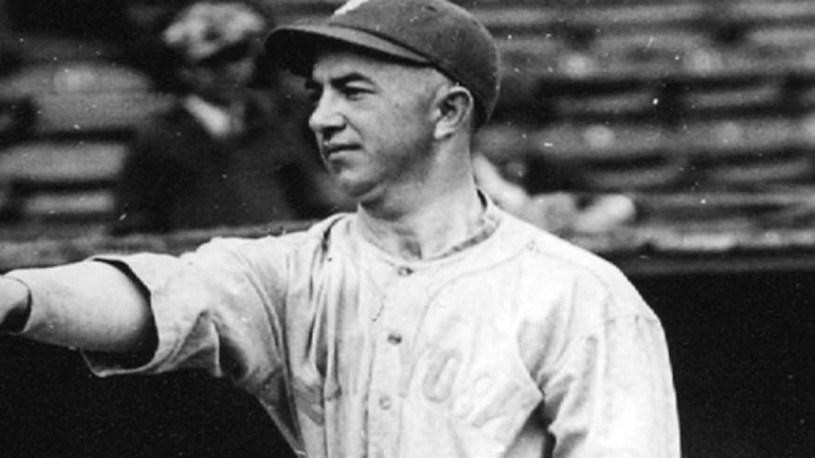
Today on MLB Monday, we try to unravel one of the great mysteries of professional baseball history. Every sports fan knows about Lou Gehrig and Cal Ripken, Jr., yet what they don’t know about Everett Scott is significant as he once held the celebrated “ironman” record for consecutive major-league games played (1,307 from June 20, 1916, to May 6, 1925). He was a part of four World Series championship teams (1915, 1916, 1918, 1923) as he competed for the Boston Red Sox and the New York Yankees.
Yet he’s not in Cooperstown. Anyone want to guess why?!
Because he was downright middling, literally. Not only did the longtime shortstop hit only .156 in five Fall Classics combined, including the 1922 Series with New York, his career OPS (.596) is downright shameful. His 21.8 dWAR mark is the only thing keeping his career sabermetric value above water, as his career WAR mark demonstrates (17.1). For a guy who played across 13 regular seasons from 1914-1926, that’s not actually a lot of value. His glove kept him in the lineup, obviously, at great cost, really.
We want to start first here by acknowledging that he clearly was an integral part of winning, perhaps the originator of the all-glove, no-bat shortstop “theory” that persisted throughout most of the twentieth century in America’s pastime. Today, we know better, of course, but a bat this bad would never survive in the majors today for as long, even if the glove was platinum. A player with Scott’s profile today would be relegated to occasional starts and mostly late-inning, defensive-replacement duty in games that were close.
There’s no way someone this weak at the plate would see the field today for any consecutive-games streak in triple digits, period.
Scott debuted at age 21 in 1914 with the Red Sox as their starting shortstop, piling up 2.6 WAR in his rookie campaign and earning MVP votes. But he hit just .239 with a .586 OPS in 144 games, so he was never a good hitter—not even close. He also was caught stealing 13 times in 22 attempts, so he sucked at that, too. He struck out (43) more than he walked (32); the only thing he seemed to be good at was sacrificing himself, piling up 26 sacrifices in his first MLB season. But this also was the Dead Ball Era, so …
All that garbage above still got him 1.9 oWAR, and his defense was the primary reason he was starting in a lineup that featured our pick for the AL MVP, Tris Speaker—not to mention guys like Harry Hooper, Duffy Lewis, and Bill Carrigan. Meanwhile, the Red Sox rotation included Dutch Leonard, Rube Foster, Ernie Shore, and Smoky Joe Wood. Oh, and there was an age-19 pitcher in his first MLB season, too … some kid named Babe Ruth. The Boston roster was loaded with some real talent, truly so.
Thus, his bat easily could be an unneeded thing, and this is reflected in his entire Red Sox tenure: a .588 OPS plus 16.3 dWAR in eight seasons. Twice, he topped the AL in dWAR (2.4 in 1917, 2.6 in 1921) while also peaking with 3.0 dWAR in 1918. Even in a season like 1915 when he slumped terribly to post a .468 OPS in 100 games, it didn’t matter, because his glove helped his pitching staff—and his sacrifices helped the offensive stars in the lineup score a lot at the same time. He was that interesting puzzle piece.
There may never have been a player quite like him, and it was more about being in the right place at the right time, really, as many things really are when we start breaking it down. For his last six seasons in Boston, Scott produced at a comparable level to that of his rookie campaign in 1914, putting the slump of 1915 behind him, readily. As noted, the Red Sox won three World Series in a four-year span from 1915-1918, and Scott played his stalwart defensive role in those successes, for sure, with sacrifice hits, too.
After the 1921 season, he was traded by the Red Sox with Bullet Joe Bush and Sad Sam Jones to the Yankees for Rip Collins, Roger Peckinpaugh, Bill Piercy, Jack Quinn, and $100,000—yes, we’re also thinking No, No, Nannette here (even though that story needs correcting someday). Scott had just one good season with the Yankees, however, and then he went into steep decline, posting just 1.3 WAR total in four campaigns with New York. He was pretty much done at age 30, all things noted.
When the early-version Bronx Bombers won the Fall Classic in 1923, Scott was a 0.0-WAR contributor as the starting shortstop on a team that highlighted Ruth and his stunning 14.1-WAR effort, not to mention one of the all-time great rotations in Bush, Bob Shawkey, Jones, Waite Hoyt, and Herb Pennock. The batting order also included Wally Schang, Wally Pipp, and Bob Meusel, with an age-20 Gehrig waiting in the wings. Only on a loaded team like this could Scott’s weak bat be tolerated, even with a glove.
Again, as mentioned, it was all downhill from there for him, as over the final four seasons of his career (1923-1926) he managed just minus-0.9 WAR total. By 1925, he’d lost his starting spot, and the Yankees waived him, basically. The original Washington Senators claimed him, but he was waived again in March 1926, only to be claimed by the Chicago White Sox. They, too, gave up on him in mid-1926, and Scott finished his career with the Cincinnati Reds, who claimed him off waivers from the Pale Hose.
Still …
He had an amazing career, all things considered. Surrounded by significantly better talent, he was able to do the two things he did best: field cleanly and sacrifice himself at the plate. This only works when the rest of the roster is full of tremendously great talent. A team could take the offensive hit at a key defensive position if other fundamental needs were filled in the process. We think of someone like Mark Lemke of the Atlanta Braves in the 1990s as a relatively modern example of this long-lasting phenomenon.
Scott got a lot of mileage out of the consecutive-games streak, although today we see that more of a product of his era more than anything else besides his good fortune to be in the right places at the right times. All sports have these kinds of players: glue guys, so to speak, who do some dirty work without a lot of glory in the spotlight—yet get a lot of credit from their more-famous teammates for being contributors to the overall successful cause. As former athletes and coaches, we have seen that play out a lot.
Once the shortstop position began to be redefined in the 1990s, however, there has been little room for someone like Scott in MLB. With rising salaries come rising expectations, too, and no team can afford to throw away a precious roster spot these days for someone who can’t hit a lick—even if they do field well and bunt effectively, etc. Again, at best, this would be a late-inning replacement in close games where every run counts, whether earned offensively or prevented defensively. That’s a tiny niche, too.
The four World Series titles Scott helped win stand as a firm testament alone to his value, something beyond the statistics … noted.

