
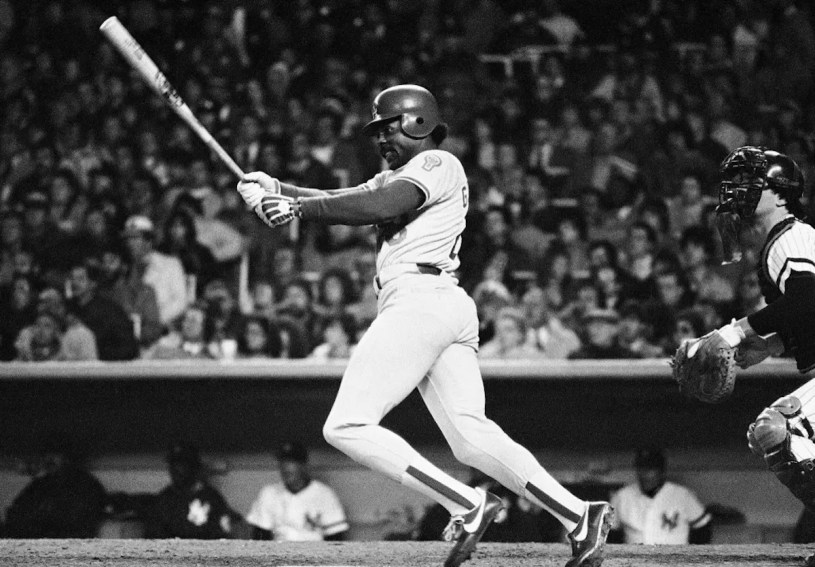
As June gets going today, we’d like to go down Memory Lane again on MLB Monday and look at another one of our childhood favorites: the multipositionally talented Pedro Guerrero. His 15-season career in the majors produced a .300 average, so that’s impressive in that sense, as he spent most of his career with the Los Angeles Dodgers (1978-1988) before finishing it with the St. Louis Cardinals (1988-1992). A five-time All Star, he also was voted one of three World Series MVPs in October 1981, too.
Yet … Guerrero was a bit unlucky, as his career probably should have amounted to a lot more than it eventually did, as evidenced partially by that .300 batting average—which, by the way, is legit, as it was not rounded up to .300 from a .299-plus level. When extended by decimal digits, he hit .30007418, and we like that as a firm measurement. Yet the reality is that Guerrero’s gruesome 1986 injury derailed his career and may have cost him a spot in the Hall of Fame. Despite his greatness, that just wasn’t fair at all.
We’re glad we cannot find a video replay of the injury on YouTube, as we remember it being kind of gross (think Joe Theismann, almost). But the fact is that before the tendon tear in 1986, Guerrero had compiled 25.5 WAR through his age-29 campaign, and after it, he only earned 9.0 WAR in his final seven seasons combined. The injury robbed him of some abilities, and he was never the same player again after posting 8.0 WAR during the 1985 regular season—and earning our NL MVP nod for that year’s effort.
But let’s go back to the start: a product of the Dominican Republic, Guerrero debuted with the Dodgers briefly in 1978 and played in 105 total games from 1978-1980 before securing the starting right- field gig in 1981. He also played first, third, left, and center in his first three seasons as well, however, proving himself to be a valuable asset for a team that won three NL pennants from 1977-1981. The strike-shortened season saw him play in 98 games, finish with 2.9 WAR, and make his first All-Star Game, too.
Of course, the Dodgers won the 1981 Fall Classic, and Guerrero should have won the WS MVP vote on his own. Why it was a rando three-way tie will never make sense to us, although it helped launch his career to new levels of superstardom. Somehow, Guerrero did not make the 1982 All-Star roster, despite 6.8 WAR, a Silver Slugger Award, and a third-place finish in the NL MVP vote. At age 26 that season, the sky seemed the limit for the talented player who hit a combined .306 from 1980 through 1982.
He “regressed” to just 5.5 WAR in 1983, but Guerrero made the All-Star team that year while finishing fourth in the MVP vote with a .904 OPS while also switching positions to be Los Angeles’ starting third baseman. His defense, while rarely stellar in the outfield, was below average at third, and that generally hurt his WAR marks. However, he clearly was raking the ball as he entered his prime years of expected production. In fact, his 6.8 oWAR was just a shade under the 6.9 oWAR he put up the year before.
His age-28 season of 1984 was a weird one, as he still hit .303, but his power and speed production dropped a bit as he wasn’t a regular starter at any position that season, despite playing all five positions noted above. Perhaps that utility role didn’t suit his mentality at the plate very well? However, his .819 OPS was hardly “bad” although he did fall short of expectations all around. This perhaps was the first “moment of truth” in his career, and Guerrero responded in a monster way with his incredible 1985.
Despite playing only 137 games without being a regular starter at any of the five positions he played during his age-29 season, he topped the NL with a .999 OPS while compiling 8.0 WAR—including a 0.2 dWAR, which shows he really applied himself to bring value to whatever place he took in the field on any given day during the season where the Dodgers won the NL West Division. One statistic to point out, too, is that this was the only season of his career where he walked more than he struck out, so he was selfless.
And that was Guerrero’s peak, sadly, due to the injury incurred in 1986 spring training. He only played 31 games late in the regular season, yet he was able to recover enough by 1987 to post a healthy and robust 4.7 WAR at age 31 that year, his last full campaign with the L.A. organization. He hit .338 with a .955 OPS and made the All-Star team for the fourth time. He also drew a career-best 18 intentional walks in 1987, so clearly the opposing pitchers were afraid of him, often. Yet he was limited again on defense, sadly.
Yet through his first 58 games in 1988, at age 32, he only produced a .783 OPS and the Dodgers—on their way to a surprising World Series title in October—traded him to the Cardinals for John Tudor, in a successful effort to strengthen the L.A. rotation. With St. Louis for his final 44 games of a tough season, he was slightly better, but overall, it was a season to forget for Guerrero as his former teammates went on to upset the New York Mets in the NL Championship Series and the Oakland Athletics in the Series.
Once again, though, he rebounded with prominence in 1989: a move to first base, however, killed his WAR mark, as a whopping minus-3.2 dWAR is hard to ignore there as the Cardinals starting first baseman. He finished third in the 1989 NL MVP balloting for some reason, with just 1.9 WAR overall, although he did lead the league in sacrifice hits, showing once again his willingness to take one for the team. He hit .311 with an .868 OPS, too, while also topping the NL in doubles. The bat was still alive, clearly.
That would be his last All-Star campaign: in 1990 Guerrero did earn some MVP votes again, for some reason, but his overall WAR was negative (minus-0.1); he only hit .281 overall; and his OPS was a mere .760 at age 34. This was the end for him, as he played just a combined 158 games in 1991 and 1992 put together, to the tune of minus-0.7 WAR. He never played in the majors again, although he did spend some time in the Mexican League (1994) and the California Angels minor-league system (1995) afterward.
The batting average is the gem of his career stat line, of course, even with the rough demise at the end. Throw in that 1981 WS MVP honor, and Guerrero couldn’t really complain a lot about his career. By some estimates, he made more than $15M in his career, which was pretty solid for his era, all things considered. He certainly had his moments in the sun, even if that unfortunate injury robbed him of a better finish to his career that might have ended up in Cooperstown if he’d just been able to stay healthier.
We would be remiss to not mention Guerrero’s competitive temperament, but the infamous moments of confrontation with other players is not our focus here today. Those stories can be read/viewed elsewhere. However, we will point out that his original MLB employer was the Cleveland franchise, which traded him to the Dodgers in April 1974 for some southpaw named Bruce Ellingsen (career WAR mark: minus-0.1). We can’t imaging him not wearing L.A. blue, of course, because he was so iconic for so long, yo.

