
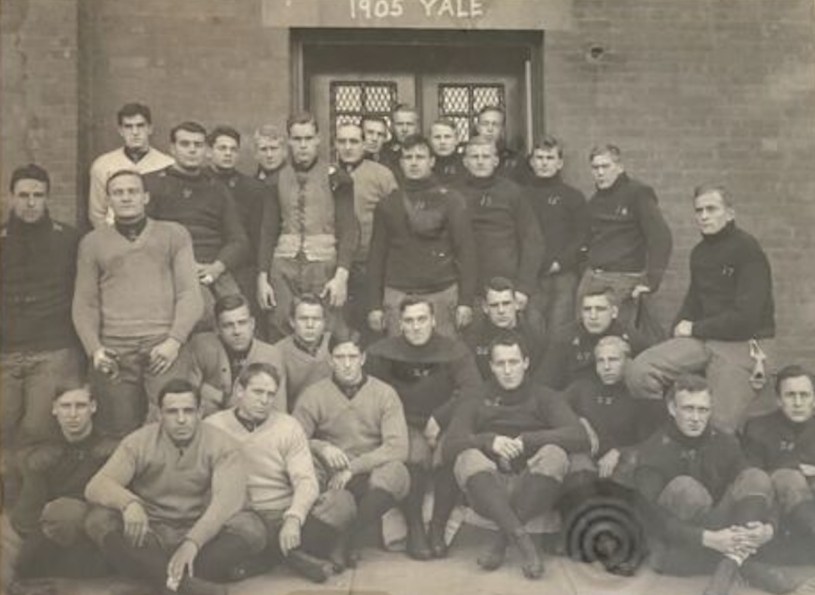
Our MNC Wednesday miniseries is getting closer to its historical terminus as we move back to the 1905 college football campaign. Offhand, we can’t think of anything significant about that year in our immediate thought processes, but we’re sure we could Google it and find out what happened. Well, Theodore Roosevelt did win re-election after ascending from the Vice Presidency a few years earlier, so there’s that. Alas, we are letting our ADHD get the best of us. On with MNC Wednesday!
The 1905 MNC: Chicago (Helms, NCF); Yale (DMP)
This was an interesting season, as three teams in the Western Conference—the early format of the modern-day B1G—posted double-digit win totals, with the Chicago Maroons (11-0, No. 2 SRS, No. 5 SOS) coming out “ahead” in the mind of the experts to claim the mythical national championship. The other two schools were Minnesota (10-1, No. 3 SRS, No. 37 SOS) and Michigan (12-1, No. 6 SRS, No. 42 SOS). Clearly, the Maroons were the “right” school to elevate about those other squads, based on data.
Chicago beat the Wolverines, head to head, in the final game of the regular season. Both teams were undefeated, although Michigan played a patsy schedule that featured seven “small schools”—a practice the school began in its early days when it literally played high-school teams and claimed those as “collegiate victories” in its historical win totals. Alas, that is another conversation for another day. When your SOS is 42nd out of 82 teams, you’ve played a middling schedule, obviously. Ho hum.
The Golden Gophers didn’t get a chance to play either Chicago or Michigan, oddly, and Minnesota’s SOS also lagged due to five cupcakes on the slate. Thus, we now have to look at any other teams in the nation who can go up against the presumptive champs:
- Yale (10-0): No. 1 SRS, No. 2 SOS
Well, we should stop right there, really. The Bulldogs’ profile is next to impossible to beat, and they also hold the sabermetric advantage over the Maroons: a 1.62-point edge on a neutral field. To each team’s credit, both schools played just a single small-time opponent (hence the high SOS marks), although both teams only left the safe confines of their own campuses twice apiece. Again, we know this was a different era, and both Chicago and Yale were even there, either way, so that’s fine with us for now.
Interestingly, all Yale’s opponents were technically independents, while Chicago went 7-0 against Western Conference opponents; the Bulldogs surrendered just four points all season, the Maroons just five total. The bottom line here is that these two teams were excellent, and it’s splitting hairs to choose between them. We suspect the Amos Alonzo Stagg legacy plays a big part here in the retroactive choice of the Maroons, and we don’t give two hoots about that. The Bulldogs’ sabermetric profile is superior, period.
So, that’s that, even though we have no real beef with the Chicago choice; we just try to remain as objective as we can, using data. Thus, we choose Yale for this MNC, just as we did in 1906—and just as the experts did in 1907 and 1909. This was clearly a dominant era for the Bulldogs, with someone picking them as the champs four times in this five-year stretch (1905-1909). Overall, this is the fourth time we’ve chose Yale in our analyses, in addition to 1916 and 1923. Congratulations to both schools, though.
 Daily McPlay: (mostly) Historical Sports Analysis with TENACITY & VERVE