
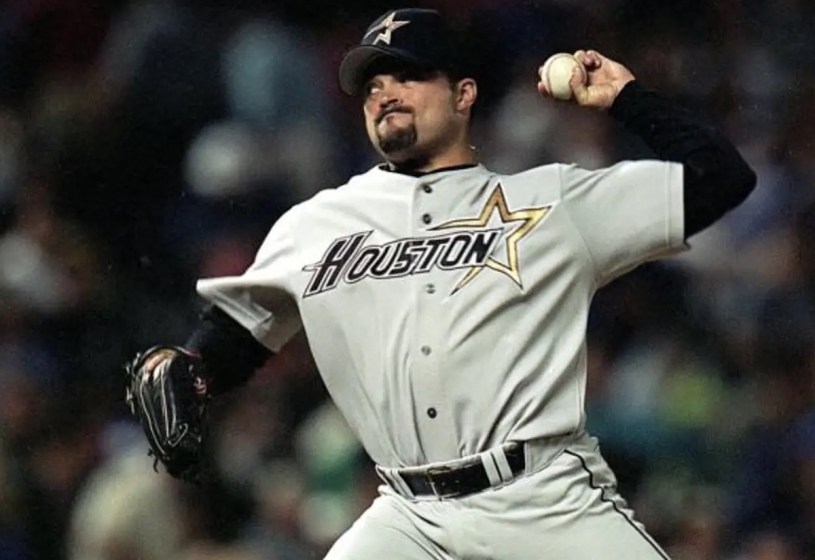
We have been traveling a lot in recent weeks, but today on MLB Monday, we’re back to the “fun” stuff! We’re going to look at the career of left-handed starting pitcher Mike Hampton, who was one of the best in the sport through his age-27 season, and then … he crashed and burned hard, victim to what used to be called the “Curse of Coors Field” … maybe it still is, as the Colorado Rockies have not been known for their pitching prowess, with few exceptions. It’s a sad story we witnessed first hand in 2001.
Way back then, we worked for the Rockies organization in community outreach, even singing the National Anthem at Coors Field in September 1999. So, when Hampton joined the team for the 2001 season at the peak of his powers, it was an exciting time. However, nothing goes as planned, for sure. The story goes that the altitude and its effect on the flightpath of the pitched ball ruined his sinker, and his head was never the same after that. The statistics do somewhat bear this out, but let’s look at it all now.
Hampton broke into the majors with the Seattle Mariners in 1993 as an age-20 rookie, although he only pitched 17 innings for them before being traded to the Houston Astros for the forgettable Eric Anthony. In 1994 with the Astros, he made 44 relief appearances without a start, to the tune of a 3.70 ERA and a 1.500 WHIP. At this point, he had compiled negative-1.1 WAR through 57 MLB appearances with Seattle and Houston, so it might have been a stroke of genius to convert him to starting.
From 1995-2000, Hampton put up good numbers as a starter: 82-49, 3.35 ERA, and 19.3 WAR. His WHIP wasn’t great, due to a high hits-allowed rate, which reveals the underlying problems when we look at it in retrospect. In fact, in those combined 1,202 1/3 IP during these six seasons, he coughed up 1,160 hits. Yet he also had control issues, giving up 456 walks in the same timeframe. These were the warts that were somehow overlooked at the time, in addition to his mid-level strikeouts (820). Hmmm.
We see these numbers now, and it seems obvious: he was pitching to contact and getting a lot of grounders. The WHIP (1.344) revealed this, but at the time, baseball was in its pre-Moneyball era of statistical idiocy. “Experts” saw the win totals, the solid ERA, and what those combined results suggested to the standards of the time—and Hampton parlayed those six seasons, five with Houston (1995-1999) and one with the New York Mets (2000), into an insane, even at the time, contract with the Colorado team.
The “crown jewel” in Hampton’s profile was his 1999 season with Houston, where he went 22-4 with a 2.90 ERA to finish second in the NL Cy Young vote. The 6.7 WAR looks shiny, too, from a distance now. We even gave him our Cy hardware for that year, despite a 1.285 WHIP, which is about average, really. And that’s what the Rockies saw when they lured him to the Mile High City with an eight-year, $121M deal that would eventually hang around his neck like an albatross as the Colorado front office winced.
Hampton’s two seasons in Denver were a nightmare: 21-28, 5.75 ERA, 1.677 WHIP, and minus-1.6 WAR across 381 2/3 IP. We remember him as a good guy who just couldn’t figure out what was going wrong, and historically, it’s interesting to read the analysis of what went wrong for him with the Rockies. There was the preseason injury before the 2001 regular season that may have never healed properly, and there was the aforementioned sinker-don’t-sink-in-altitude theory, as well. Either way, it got ugly.
Maybe it was the altitude, as the Colorado front office was able to trade Hampton to the Florida Marlins before the 2002 season, although that club flipped him right away to the Atlanta Braves. He did okay for three seasons there (2002-2004) before getting hurt and missing both the 2006 and 2007 seasons entirely—while still getting paid on that original Rockies deal (more on that below). With the Braves, he posted 4.4 WAR combined in those first three seasons, which was respectable all things considered.
Hampton came back from missing two seasons to pitch the final year of that contract with the Braves in 2008, and then he signed a modest, one-year deal with Houston for $2M to pitch for the Astros in 2009. But his combined 2008-2009 numbers demonstrated he was all but done (10-14, 5.12 ERA, minus-0.5 WAR). His final MLB action came in 2010 with the Arizona Diamondbacks, and his 10 appearances for that team looked good enough to go out on a high note: a 0.00 ERA and a 0.923 ERA. That’s heartwarming.
He retired officially in March 2011 despite having signed another contract with Arizona after the end of the 2010 season, and that was that. Interestingly enough, though, he kept receiving paychecks—Bobby Bonilla style—from the Rockies until December 2018. We’d say he did alright for himself. He did win the 2000 NLCS MVP vote, which we confirmed, so he really did peak in the 2000 season before signing the contract with the Rockies and descending into a personal hell that no one can imagine themselves.
Overall, Hampton made around $125M in his career, at least, and he had a solid postseason profile, too: 2-4, 3.74 ERA, and a 1.231 WHIP in 65 playoffs innings with the Astros (1997-1999), the Mets (2000), and the Braves (2003-2004). No, he never won a World Series and only pitched in the 2000 Fall Classic with New York (NL), yet overall, his career is the proverbial type we always make note of in this space: most baseball fans would give a kidney to have had his experiences and paychecks. Indeed.

