
As the summer begins, we’re hoping to wrap up this MNC Wednesday miniseries before the start of the next college football season. It’s always fun, though, choosing a mythical national champion in the sport, so we will miss it. But as we look back to the 1906 season, it’s clearer than ever that the sport hasn’t changed too much, really. At this point, we’ve gone 10 straight seasons now without agreeing on the experts’ pick for the MNC. Will that change today? Our hopes are not high, and the odds are not good.
The 1906 MNC: Princeton (Helms, NCF); Yale (DMP)
The Princeton Tigers (9-0-1, No. 2 SRS, No. 5 SOS) got the nod from the individual(s)/organization(s) we’ve been using as the basis for our own analyses. The profile is pretty good, too, as the team played just one small school. However, the Tigers only left home three times during the season. Yet, we also have to look at the No. 1 team, sabermetrically: the Vanderbilt Commodores (8-1, No. 1 SRS, No. 3 SOS). Vandy played two small schools, and it only left its safety zone twice. So, we have dilemmas here, yo.
Let’s list our screened teams under consideration:
- Vanderbilt (8-1): No. 1 SRS, No. 3 SOS (out of 64)
- Princeton (9-0-1): No. 2 SRS, No. 5 SOS
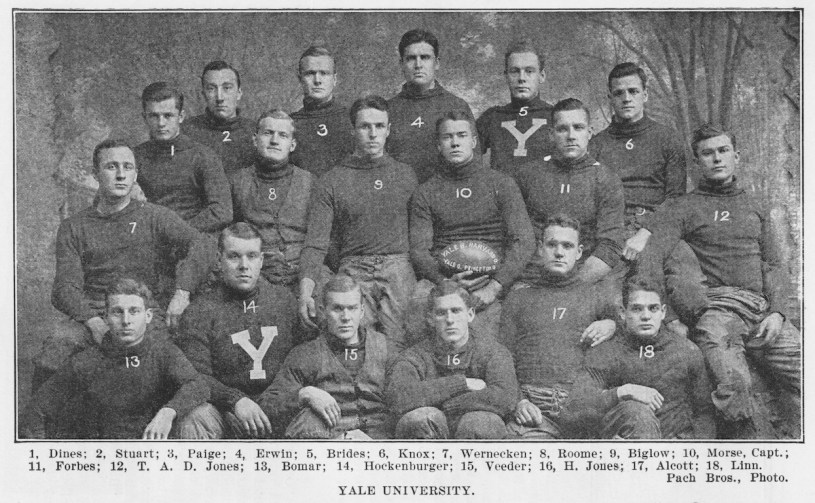
- Yale (9-0-1): No. 4 SRS, No. 4 SOS
- Minnesota (4-1): No. 6 SRS, No. 1 SOS
That’s it, really. The Commodores lost on the road to No. 17 Michigan, while the Tigers and the Bulldogs tied—on Princeton’s home field. Yale played two small-time teams while traveling just twice. Meanwhile, the Golden Gophers played significantly fewer games and left town just once. Minnesota’s loss was to No. 8 Carlisle, and we know there is no shame in that. How do we reduce this “final four” to just one, singular team, worthy of the title? Well, first we should decide between Princeton and Yale.
The Tigers’ SOS is better, because they played only one cupcake. But the tie against Yale did come on their home field, which in a head-to-head sense means the Bulldogs were the “better” team to overcome that disadvantage. On a neutral field, Princeton would have been projected to win by 3.16 points. Throw in the extra home-field edge, and the Tigers should have won this game. It was the final game of Princeton’s season, so it kind of choked. Meanwhile, Yale had to win another game still, and it did, under duress.
Therefore, we disqualify the Tigers and give this edge to the Bulldogs. Now what about Vandy and Minnesota? We respect the Golden Gophers’ profile, but in playing just five games, it’s hard to compare the efforts. We gave Chicago the MNC in 1908 despite playing only six games, and we really don’t think we can go any lighter than that. Playing extra games and finishing higher in the SRS with great SOS ratings has to mean something here, in this specific instance/season. Minnesota just didn’t put out enough.
That leaves us with the Commodores: in theory, the loss should drop them below Yale in the hierarchy. In practice, we have required five SOS spots’ superiority to see a loss equated to a tie. And that is not the case here, and despite Vanderbilt demonstrating a significant edge in sabermetric projection—almost seven points on a neutral field, which is incredible—it’s hard to break that established equation we have used since the start of this process. And we don’t want to compromise on that integrity.
This is just one of those tough quirks where a significantly better team has a “bad” loss on the road costing it in the long run. Those are the waters, really, and we’re sure if they had played a head-to-head game on that neutral field, the Commodores would have emerged victorious. But in the absence of such a result, we have to go with the established parameters. This means we name Yale the mythical champs here, with a lot of respect to Vandy and not much of an argument if someone were to disagree with us on it.
Oh well! This is the third title we’ve awarded to the Bulldogs (1916, 1923), so congratulations to Yale on a job well done in 1906.

