
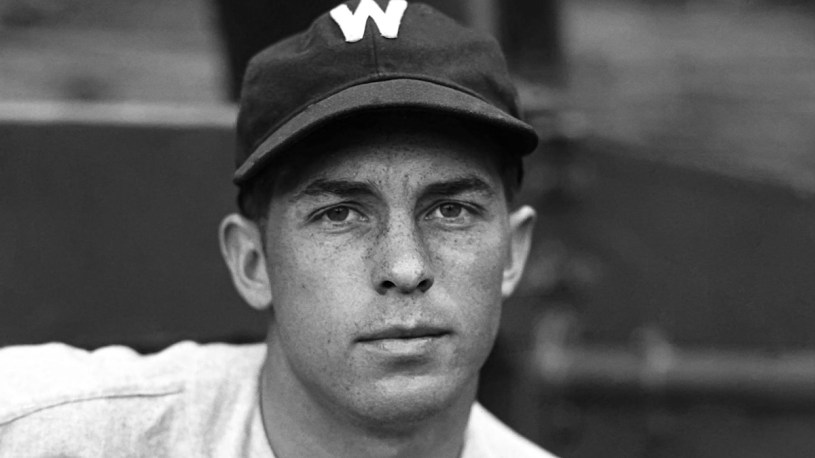
Every week, it’s fun to start off with an entry on MLB Monday, because baseball is our favorite sport, historically speaking. We take joy in many things present day, too, although this whole enterprise certainly was enhanced when we went to the retroactive analysis of what was then and should have been. On that note, we really love looking back at players from the past—both the ones well known yet also those not-so-well known. It’s like the box of chocolates, right? You do know you’ll get something fun, though.
Right? Right?!
Today we bring you the impressive career of Washington Senators infielder Cecil Travis, who accrued 31.6 WAR through his age-27 season, missed the next three campaigns (1942-1944) due to World War II service, and then was never the same player afterward. This is most likely due to his injuries (frostbite) sustained during the Battle of the Bulge in December 1944, both physical and psychological no doubt. It’s hard to imagine any other baseball player to negatively impacted by service to his nation.
Even though he was just in his age-31 season when he returned the majors during the 1945 year, he had lost his prime seasons to the war, and Travis actually posted a negative WAR mark (minus-1.2) from then on to the end of his career in 1947. Overall, he played in all or parts of 12 seasons, all with the original Senators, while making All Star in three campaigns (1938, 1940-1941), and finishing in the Top 11 MVP balloting three times as well (1937-1938, 1941). His career batting average (.314) is stellar, too.
The demarcation line in his statistical profile is real:
- Pre-WWII Batting Average:.327 (4,186 AB)
- Post-WWII Batting Average: .239 (728 AB)
Travis made the move to the big-league Senators at age 19 during the 1933 season. Even though he only played in 18 games, he hit .302 in 43 ABs and did enough to stick with the team for the entire subsequent year, although not as a regular starter. In 109 games, he again hit over .300 for the season, raking the ball to the tune of a .319 average. He didn’t display any power, and Travis didn’t have speed on the base paths. But few had his eye and ability to rack up hits. while not striking out and walking just enough.
By 1935, he was starting at third, hitting .318 (with no home runs), and topping the league in getting hit by pitches. Earning 3.6 WAR overall at age 21 is impressive, especially without much raw power in his swing. But over his career, Travis would get his fair share of doubles and triples, and he was heading on a roll now, on target to his prime years ahead. In 1936, he played mostly shortstop and right field, while also spending time at second, third, and left, proving his worth to the team while moving around.
He hit .317 with career bests (so far) in RBI (92) and OPS (.800), and Travis added overall above-average defense while playing five different positions. The table was set for a big leap in 1937 when he returned to regularly starting, this time at shortstop, and he had the best year of his MLB experience so far at age 23: 4.9 WAR, .344 BA, .834 OPS, and 11th place in the AL MVP vote. Yet this wasn’t a “golden age” or anything for the Washington franchise, as it finished over .500 just once from 1934-1941. Doh!
Travis was making his name in the game, for sure, and his success continued over the next four seasons (1938-1941): the three All-Star seasons, a collective .329 average, and three more times earning MVP votes, peaking at No. 6 on the ballot in 1941. He also led the AL with 218 hits that year, at age 27, while hitting .359 with a .930 OPS to earn 6.8 total WAR while playing solid defense at shortstop. From 1938-1941, in fact, he compiled 4.5 dWAR at the position. Travis certainly had arrived as one of the AL’s best.
But then December 7, 1941, happened.
We know some players endured the war to return as good or better than they had been previously, but the frostbite damage to Travis’ feet almost ended up in amputation. He earned a Bronze Star, but his baseball career was effectively over. He played just 15 games in 1945, 137 games in 1946, and only 74 games in his final season. We can’t imagine the anguish he must have felt, nor can we perceive the heartbreak for Senators fans at the time to see one of their heroes return triumphant albeit sapped of his powers.
With just 30.4 career WAR, Travis is not in Cooperstown, despite his prowess pre-war. It’s an amazing story, as we have snarked many times over the decades how we could never see Barry Bonds drop everything to enter military service and fight for his country. (Of course, his fellow Arizona State alum Pat Tillman did just that.) We look at Travis’ statistics and wonder might have been if not for a loser fascist in Germany and a wannabe Italian sidekick. Travis lived a long life, and we hope it didn’t bother him.
This should have been our post two weeks ago, really, and we’re sorry for that. Our timing was off, and Travis had the same issue: the Senators made the 1933 World Series, although he was too green to see the field in a five-game matchup against the New York Giants. The franchise would not make the Fall Classic again until 1965, when it had become the Minnesota Twins. And we know the Twins didn’t win their first title until 1987, so Travis never had a real chance at postseason glory. Thus, he’s been off the rader.
“No more,” we say. No more!

