
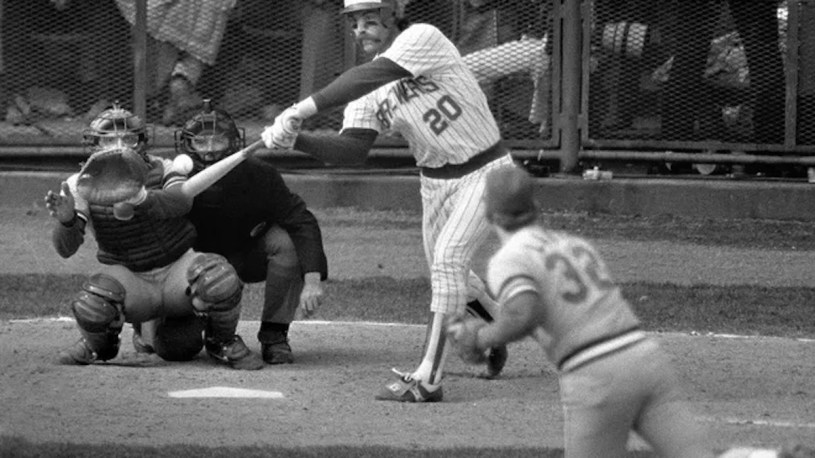
Other work commitments have been heavy this month, so we haven’t gotten to MLB Monday in awhile. But we’re here today, Memorial Day, to remember Stormin’ Gorman Thomas, one of our favorites from childhood. We remember rooting hard for the 1982 Milwaukee Brewers and being as brokenhearted as age-11 kids could be when they lost the World Series to the St. Louis Cardinals, who we perceived as “evil” for some reason. In truth, we just didn’t like Bruce Sutter or Darrell Porter at all (smug!).
But we digress: we’re looking at the career of Thomas today, one of those early three-outcomes types: home run, walk, or strikeout. In fact, for his career, Thomas batted just .225 overall with 268 HRs, 697 BBs, and 1,339 Ks. Twice he topped his league in homers (1979, 1982), and twice he struck out the most times in his league as well (1979, 1980). Across 13 seasons from 1973-1986, he certainly was an entertaining guy to watch at the plate, even if his defense wasn’t great in center field. He was just fun.
Thomas was drafted in the first round, No. 21 overall, by the expansion Seattle Pilots in 1969, but by the time he reached the majors in 1973, the franchise had long since relocated to Milwaukee. At age 22, he got into 60 games with the Brewers in ’73, mostly as a right fielder although he also played the other two outfield positions as well. The results were not good: a .187 average with 61 Ks. He only played 17 games in the majors during the following season, as his development and improvement were slow.
In 1975-1976 combined, Thomas played in 220 games, getting 467 ABs total and hitting well under .200 with 18 HRs and 64 RBI. The Brewers weren’t challenging for any division titles in the AL East, finishing no better than fifth in any of the four seasons of his career so far. Thus, the Milwaukee organization could afford to be patient with Thomas’ potential. They kept him at Triple-A Spokane for the entire 1977 season, as a result, and it paid off as he hit .322 with 36 HRs and 114 RBI in only 143 games there.
Clearly, the Brewers knew what they were doing, but in a funny bit of 1970s chicanery, Milwaukee traded Thomas to the Texas Rangers organization, which agreed to send Thomas back to his original team once the Brewers could make the roster space. We can’t even imagine that kind of agreement today, in truth, but it was a different place and time back then, for sure. Thus, from October 25, 1977, to February 8, 1978, Thomas was technically a member of the Rangers even though he never played a game.
Milwaukee handed the age-27 outfielder the starting CF role, finally, nine years after he’d been drafted in the first round. Thomas did not disappoint, earning 3.3 WAR based on an .866 OPS, 32 HRs, and 86 RBI. His defense was mediocre (minus-0.9 dWAR), although his bat certainly provided a lot of pop. Better yet, the team as a whole was progressing, winning a club-record 93 games and finishing third behind the New York Yankees and Boston Red Sox during their historic and infamous ’78 pennant race.
Thomas was even better in 1979, posting 4.8 WAR which included 0.0 dWAR—an improvement. His .895 OPS was a career high, as were his 45 HRs and 123 RBI. Even though he was just the fourth-most valuable player on the Brewers roster, sabermetrically, he finished seventh in the 1979 AL MVP balloting as Milwaukee won 95 games to finish second behind the Baltimore Orioles. Both Thomas and the team seemed to be headed toward an impressive peak together as the 1980 season loomed ahead, writ large.
Alas, both regressed, as the Brewers won just 86 games and fell back to a third-place finish; Thomas himself wasn’t horrible, but at age 29, his numbers declined in a significant way: his OPS dropped more than 100 points, for example, and he walked 40 times fewer than the year before while topping the AL in strikeouts for the second year in a row. But he bounced back during the strike-shortened 1981 season, making his first (and only) All-Star team, helping the Brewers to a postseason berth for the first time ever.
In fact, Milwaukee’s 62-47 record was the best overall mark in the AL East, although the Brewers lost to the Yankees in the makeshift AL Division Series. Thomas’ .841 OPS during the regular season was back in the neighborhood it was expected to be, but he did not fare well in the postseason spotlight: he went just 2-for-18 in the five-game matchup against New York, striking out a whopping nine times in the process. He did hit a solo home run in the series, but overall, his performance was a disappointment.
The Brewers came into 1982 more focused than ever, and it paid off with 95 wins, an AL East title, the team’s first AL pennant, and a berth in the Fall Classic. Thomas hit 39 HRs and posted an .850 OPS to deliver a third quality campaign in a four-season span, even though he made the final out of the Series, striking out against Sutter. His postseason effort was even more dreadful, too, than the year before, as he posted just a .098 batting average across 12 games—although he did drive in six runs overall.
Looking at the end of his prime now in 1983, Thomas perhaps pressed too hard to start the year, and his first 46 games were atrocious: a .183 average and a .607 OPS. Milwaukee, which would sink to fifth place with 87 victories by the end of the season, had seen enough, and the Brewers flipped Thomas—for real, this time—to the Cleveland Indians, a surprising trade within the AL East itself. Thomas improved over his final 106 games of the year, hitting .221 with the Tribe, along with a .726 OPS. Better, but …
Stormin’ Gorman was in decline after his five-year peak from 1978-1982. After the 1983 season concluded, Cleveland traded him to the Seattle Mariners, straight up for second baseman Tony Bernazard. Over the subsequent 2.5 years with Seattle, Thomas continued his mediocre play, hitting just .202 combined in 227 games although his .728 OPS remained slightly below average (99 OPS+). The Mariners finally pulled the plug on the relationship in mid-1986 before Milwaukee signed him for old time’s sake.
Thomas’ final 44 MLB games came with the Brewers, as he came full circle in his career. But his .179 average over those 44 games came with a mere .669 OPS, and when the season was over, Thomas formally retired. His one big contract was a $5M deal for six years signed with the Brewers after the 1980 season; if he played in today’s financial world, Thomas would have made nine figures across his career, at least. The lifetime .772 OPS translates into a 114 OPS+, which would have kept him employed longer.
Sometimes it is a matter of timing, and Thomas was ahead of the sabermetric learning curve in the sport. He didn’t always play pretty baseball, but he often played effective baseball. He spent parts of seven seasons as a starting CF in MLB, despite being 6-foot-2 and weighing 210 pounds. He stole 50 based in his career, in 99 attempts, too, which makes us smile as we look back on his playing days as we remembering seeing them on television in the early 1980s. A fan favorite in Milwaukee, we salute him today.


Great write-up on Gorman!
LikeLiked by 1 person