
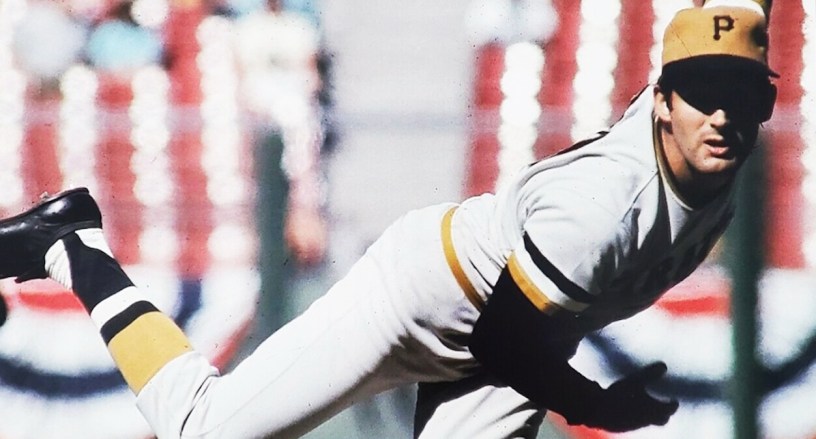
It’s time for MLB Monday again, and may the Fourth be with you (even though we maintain, in an originalist tradition, that the real Star Wars Day is the Wednesday before Memorial Day—if you know, you know). Alas, here we are in May, and today we’re looking at the mystifying career of starting pitcher Steve Blass. For five seasons from 1968-1972, he was a pretty good starter for the Pittsburgh Pirates, helping them win the 1971 World Series over the heavily favored Baltimore Orioles. And then, it all ended.
Sadly, Blass is now best known for his psychological collapse on the mound in 1973 that ended his career the following season, so abruptly. “Steve Blass Disease” became his unfortunate recognition factor, but we want to focus on his MLB tenure as a whole, starting in 1964. Overall, he pitched in 10 different major-league seasons, posting a 103 victories in the regular season with a 3.63 ERA combined. However, it’s the last 93 2/3 innings pitched his final two seasons with the Pirates which branded him over time.
Back to the beginning: he was a rookie in 1964, throwing almost 105 IP for Pittsburgh in a nondescript season for the storied franchise. His 5-8 record, 4.04 ERA, and 1.452 WHIP were not signs of greatness at age 22, although he did produce positive WAR (0.6) for the club. As a result, the Pirates kept him in the minors for all of 1965, and he did not return to the big-league roster until the following season at age 24. In tossing 155-plus innings, though, Blass was technically worse (minus-0.1 WAR) this time.
Yet, there were some signs of progress: an 11-7 record, a 3.87 ERA, and a 1.407 WHIP were all improvements on his prior efforts. The Pirates won 92 games and finished third, although it can be argued that had little to do with Blass. The team regressed to just 81 victories in 1967, as he was once again mediocre (minus-0.2 WAR). He only managed 126 2/3 IP at age 25, this time with a 6-8 record, a 3.55 ERA, and a 1.366 WHIP. Those baserunner-ratio marks were problematic, of course, as was his low strikeout rate.
For his career, Blass only K’d five batters per nine innings pitched, and in his first three seasons, the individual campaign marks were 5.8, 4.4, and 5.1, respectively. His pitches were always around the plate, producing more than a hit allowed per inning, but his control was also suspect: 3.9, 2.7, and 3.3 walks per nine innings. Therein was the problem: too many baserunners, too many hits allowed, and not enough strikeouts to prevent them from scoring more readily. Somehow, though, Blass figured it out in ’68.
At age 26, he hit his stride with an incredible 1968 season that somehow did not involve an All-Star nod, although he did earn some MVP votes: 18-6, 2.12 ERA, and a 1.126 WHIP. The winning percentage led the National League in a season dominated by pitchers, really. He tossed seven shutouts, but Pittsburgh still finished under .500 on the season—impacting his WAR mark (2.5), for sure. Still, it was a step in the right direction for the Pirates pitching staff, and hopes were high for the 1969 season to follow.
It didn’t happen, as Blass regressed a lot in 1969, although he still won 16 games for the Pirates. All his other numbers regressed, except for his K rate, which increased to a career-high rate (6.3/9IP). He would improve in 1970, bouncing back with a 3.52 ERA despite finishing with a losing record (10-12). All this was prelude to his two best seasons, though, as he contributed 8.0 WAR in 1971-1972 combined, helped the team win that MLB championship (1971) and made his only All-Star team (1972). Success!
The numbers for his age-29 and age-30 seasons combined are impressive: 34-16, a 2.67 ERA, and seven shutouts (including an NL-best five in 1971) over almost 490 innings. His K rate dropped to 4.2 per nine innings in 1972, but the end results were stellar. His WHIP was in the 1.230s range, and this was clearly a master of his craft now in his physical prime. To review, the five seasons between 1968-1972 produced 78 victories, a 3.05 ERA, and 10.7 WAR for Blass. The sky seemed the limit for him at this point.
And then it all crashed in 1973. The All-Star starter forgot how to pitch, seemingly, scuffling to a 9.85 ERA in only 88 2/3 IP. To quote Blass himself, “It was the worst experience of my baseball life … I don’t think I’ll ever forget it. I was embarrassed and disgusted. I was totally unnerved. You can’t imagine the feeling that you suddenly have no ‘idea’ what you’re doing out there, performing that way as a major league pitcher. It was kind of scary.” We can only imagine what that would mean in our own lives.
Combined with the unexpected death of Roberto Clemente after the 1972 season, the Pittsburgh franchise suffered incredible misfortune. Blass made one appearance in 1974 and never appeared in majors again, deciding to retire officially in 1975 after a single outing in Spring Training when the Pittsburgh organization released him. As the SABR bio notes, “The most frustrating and bewildering thing about the entire ordeal was that when he threw alone with a catcher, he threw as well as ever.” Inexplicable.
The negative-3.9 WAR in 1973 killed his career mark, of course, as did all the other numbers in the sense of detrimental impact on overall statistics. But that was small potatoes, of course, to what Blass was feeling: “[He] claimed that the toughest thing he ever had to do was tell his teammates that his career was over.” The emotion of thinking he was letting his teammates down shows what kind of person Blass was, and we generally think people who put others over themselves at times are the best kind of people, no?
The good-news ending here is that Blass gave back to the organization and its fans as a beloved broadcast analyst from 1983-2019. And in the end, he did win a World Series and make an All-Star team, and we want to add that we chose him as the Fall Classic MVP in 1971 as well: his 2-0, 1.00 ERA, and 0.611 WHIP in two complete-game efforts spearheaded the Pirates’ victory in the championship round, and his WPA mark (0.98) was basically triple that of any other Pittsburgh pitcher in the matchup. Boom.
His final career WAR mark (7.5) doesn’t do him justice, of course, reminding us it’s not always just about the numbers, is it? Nope.

