
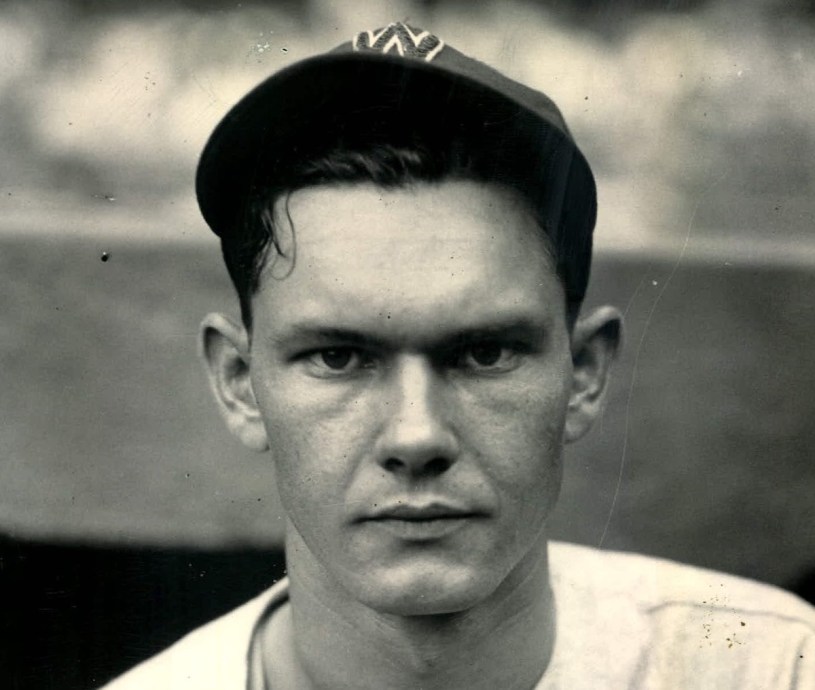
Our entries on MLB Monday always vary, or so we’d like to think. Almost two months ago, we looked at the career of Cecil Travis—and how it was impacted by his service in World War II. Today, we’re doing the same again, except with Buddy Lewis. The stories are similar, sadly, and it just goes to show how much “luck” factors into someone’s legacy, whether in professional sports or real-world lifetimes, really. Lewis played six full seasons in MLB before missing three to military service (1942-1944).
And he wasn’t really the same afterward.
Lewis reached the majors in 1935 for a cup of coffee with the original Washington Senators, getting three hits in eight games. But at age 19 in 1936, he earned the starting third baseman role and acquitted himself well: 2.4 WAR with more walks than strikeouts, although his OPS (.746) was subpar for the time. He improved in 1937 to post 3.3 WAR and raise the OPS to .792 while even earning some MVP votes in the process for a sixth-place American League team. Lewis clearly was on the correct trajectory now.
At age 21 in 1938, Lewis was an All Star for the first time: his numbers weren’t anything significantly different than the year before, but people around the sport were taking notice of his contributions to the Senators. He improved to a career-best 5.6 WAR in 1939, his last one as the starter at third. Lewis had really honed his craft at this point: a .319 batting average, an .879 OPS, an AL-high 16 triples, and 72 walks to go along with just 27 Ks. His glove peaked at 1.0 dWAR during this season as well: rock star.
While his production dropped a little bit in 1940 and 1941, Lewis still put up an OPS+ mark of over 120 for the two seasons combined while making the move to starting right field. He contributed 7.8 WAR as well in those two campaigns even though the Senators were mere spectators in the AL pennant race, finishing a combined 57 games out of first. Lewis was just 24 during the 1941 season, and there was no reason to think he wouldn’t be a serious piece of the franchise’s plans going forward for many years.
Then … this.
As Wikipedia notes, “Lewis had accumulated 1,112 hits, the 10th highest total for a 25-year-old player in MLB history, having more than Orlando Cepeda (1,105), Rogers Hornsby (1,073) and Mickey Mantle (1,080), all of whom were inducted into the Baseball Hall of Fame.” He would not really get the chance to have the lengthy careers as those guys, due to service in World War II. He missed three-plus seasons in his prime years flying in the US Army Air Corps and earning the Distinguished Flying Cross.
Crazily enough, he was back playing baseball by the end of July 1945, at age 28, just a week after the Army released him from duty. In the remaining 69 games of the season, Lewis seemed better than ever: .888 OPS and 3.5 WAR in under half a full season. However, that was a mirage, for one reason or another. At age 29 in 1946, he wasn’t bad, but he wasn’t the same, either, posting 3.4 WAR and a .780 OPS in the full 1946 campaign. His defense in RF was never as good as it was at third base, on top of all that.
Either way, it would be his last productive season as 1947 was the final full season of his MLB career, and it was literally just average (0.0 WAR) despite playing in 140 games. Lewis hit just .261 with a .672 OPS, while becoming a terrible liability in the field (minus-1.3 dWAR), too. The highlight was being named to the All-Star team (for some reason), although that clearly wasn’t based on actual production. His starting mates in the AL outfield? Joe DiMaggio in center and Ted Williams in left. Impressive.
His 1947 decline was brought about, evidently, by a hip injury and business interests that were suffering. Thus, Lewis “retired” after the season to tend to both issues: at that time, he had a .300 lifetime batting average (technically it was .29976). But he missed playing baseball—who wouldn’t?!—and he returned to the Senators for a third stint in 1949. And while he was better at age 32 than he had been at age 30 in 1947, Lewis couldn’t stay healthy, either. He managed to appear in just 95 games in his final year.
The WAR mark (0.9) and the OPS (.721) show the impact of age and injury, for sure. He also hit a career-low .245 despite drawing 51 walks and only striking out 27 times. There was defensive improvement (0.1 dWAR) that represented his best glove work in the outfield for his career, but the lost skills at the plate were too much, really. Lewis left the game with finality this time, dedicating himself to multiple business ventures that turned out to be very successful. It’s a life we all could admire now from afar, of course.
For the record, let’s break down his pre-WWII numbers and compare to his post-WWII stats:
- 1935-1941 (895 games): 21.4 WAR, .304 BA, 0.9 dWAR
- 1945-1947, 1949 (454 games): 7.8 WAR, .281 BA, minus-2.3 dWAR
Never blessed with significant power or speed, Lewis finished with 71 career home runs and 83 career stolen bases. His final .297 BA represents a great eye at the plate, with those 573 free passes and only 303 Ks. With 29.2 overall WAR, his career could have been so much more if he hadn’t missed three-plus seasons to military service fighting against the fascists of Asia and Europe. Using rudimentary projections, Lewis could have lost 16.5 WAR in those years given to World War II, not to mention the fatigue.
One could argue his great second half of the 1945 season a lot of adrenaline and enthusiasm at being back in his element, and then reality of his aging and the wear-and-tear effect from military life settled in after that. His career WAR right now ranks as 80th all time for third baseman, for example, but adding missed time, Lewis could have been closer to a Top 40 player at the position. That still wouldn’t make him Cooperstown worthy, but it says a lot how he could move up halfway in the rankings with lost WAR, eh?
Editor’s Note: Lewis was the uncle of Hal Morris, another one of our subjects here on The Daily McPlay.

