
We didn’t do an WNBA Tuesday piece last week when we were in Chicago visiting Wrigley Field for the first time ever, and we apologize. We’re back today with a look at the current season so far, as every team has played at least 10 games. Thus, we’re 25 percent through the regular season, even though it won’t end until mid September. So, what’s the story, sabermetric glory?! Well, we have some answers there, with the usual data and facts to back up the conclusions we arrive at here on The Daily McPlay.
Let’s start with Player Efficiency Rating (PER), where Las Vegas Aces center A’ja Wilson (32.5) leads the next-best player by a full five points (Los Angeles Sparks guard Kelsey Plum at 27.5). That’s an incredible gap as Wilson chases another MVP award. Tenth on that list is Indiana Fever frontcourt star Aliyah Boston (23.1). She’s the only player from her team in the Top 20, while her more-famous, less-talented teammate Caitlin Clark languishes 4.4 points behind Boston, nowhere near that same Top 20.
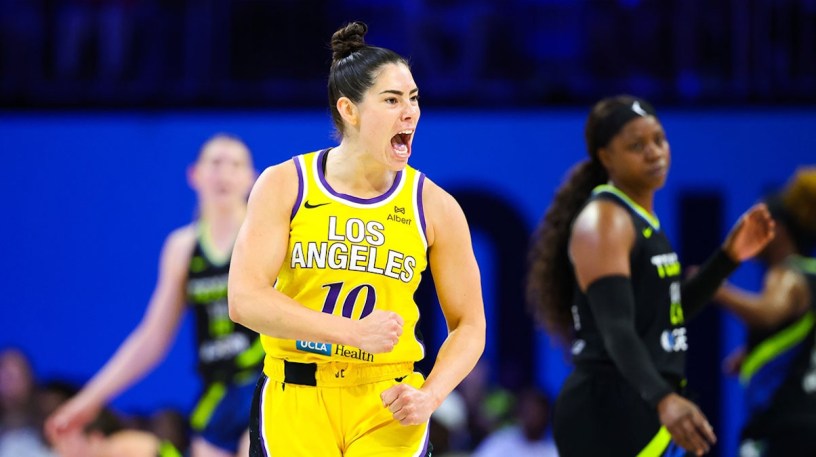
The Sparks actually have three players in the Top 15, but that hasn’t helped the team to a winning record so far this season. The expansion Toronto Tempo also have three player in the Top 20, and they’re over .500 so far through 11 games. It’s interesting to see how that works. Either way, Wilson is in a league of her own up there, really, and we’ve seen that in person already this spring. If it was about PER alone, there’d be no doubt about the MVP vote, although it is silly to make such prognostications right now, really.
Now, onto Win Shares (WS): Wilson (2.5) tops the league here, too, although the margin is nowhere near the same as PER, since there is such a parity in the league now with more teams to dilute the talent base. Minnesota Lynx guard Olivia Miles (2.2) is second, while New York Liberty forward Breanna Stewart (2.0) is the only other player at or above the 2.0 threshold. Five players in the Top 18 play for the Lynx, the only team in the WNBA right now with as many as nine victories so far this year.
Suspiciously absent from the Top 20 in Win Shares is any member of the Fever. Boston (1.2) is just short of the 20th player’s mark, and guard Kelsey Mitchell (1.1) is right behind her frontcourt teammate—and way ahead of her backcourt buddy, Clark (0.8). In fact, Clark is fourth on her own team with that mark … and only the third-most valuable guard, since Sophie Cunningham (0.9) is outplaying Clark this season so far. It certainly makes you wonder why Clark gets all that attention when she’s a fourth fiddler.
One more thing to note about Wilson: she is second in Offensive Win Shares (OWS) and second in Defensive Win Shares (DWS). No one else in the league even comes close to being that balanced and superior; interestingly, Clark has better DWS value (0.5) than OWS value (0.3), showing just how much her bad shooting percentages (38.3 percent overall, 33.3 percent from three-point range) and turnover rate (a league-worst 43 turnovers in just 10 games) are hurting her team. So much for her scoring capability!
The final thing we will point out is usage rate: Wilson tops the WNBA there, at 32.6 percent, while Clark is second (31.5). It doesn’t take a genius to see that Wilson is efficiency and valuable like no other, thus justifying her usage rate. Meanwhile, Clark languishes as the fourth-best player on her own team—yet gets more touches than all but one other player in the league. When people complain about Fever coaches, they have it all wrong: Clark needs to touch the ball less … not more. What a conundrum!
Not really. Ironically, Mitchell (27.3) and Boston (27.0) are in the Top 10 for usage, too. Clearly the coaches should be giving Cunningham more opportunities, while diminishing Clark’s usage rate and moving some of it to the more-valuable players on the roster. Alas, this comparison between Wilson and Clark illustrates what the WNBA media is missing: the facts. The people who attend women’s basketball games aren’t as thick as those who attend NBA games; they deserve truth, and they can handle it, too.

