
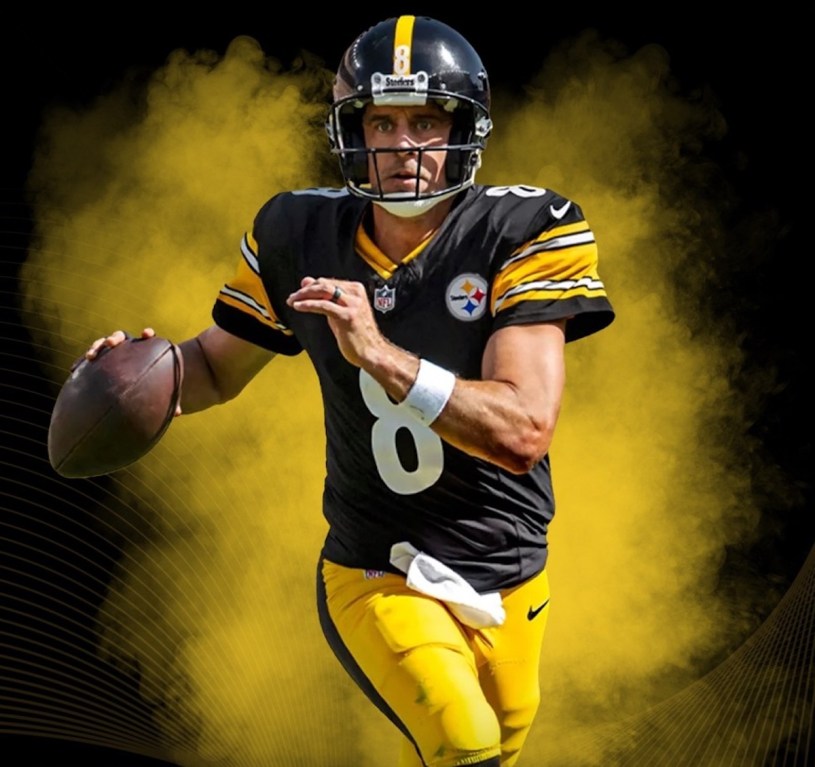
Sometimes, our NFL Thursday column can be a “now” thing, like today: it’s time for veteran quarterback Aaron Rodgers to walk away from the game for good. We’re not going to bother recounting the current drama with his Pittsburgh Steelers situation; we’re just looking at the hard data. And what that data shows anyone is that Rodgers is having the worst year of his Hall of Fame career, no doubt because he is in his age-43 campaign and has lost the physical tools that propelled him to great heights in the league.
His current completion percentage through 10 games this year is just 60.9 percent—that’s the second-lowest mark of any “full” season in his 22-year tenure in the NFL, with only a 60.7 rate in 2015 being worse. His career mark (65.0) demonstrates the average level of his long-time production quality in this area, so that’s certainly one strike against him trying to continue his pursuit of a second Super Bowl title at his age. In an era where QBs are now expected to be closer to 70 percent? He’s not good.
The next data point we’d like to bring up is his QB rating, which measures overall efficiency at the position—one of the first real “sabermetric” calculations in professional sports, and one that has been around for most of our adult life. Rodgers’ rating this year is a pedestrian 86.8 right now through 10 games, and that not only pales in comparison to his career rate (101.6), but it’s by far his lowest effort in any full season of his career. His prior worst QB rating? It was 90.5 in 2024 with a mediocre New York Jets team.
We have commented many times on Rodgers’ late-career situations, for better or for worse. Just by exploring all the pieces we’ve featured him in over the years in this space, it’s clear to see how far he’s fallen since … well, since he lied about his Covid vaccination status during the 2021 season and barely got a slap on the wrist for it from the league. That campaign was his last Pro Bowl season, and he’s been in pretty sharp decline since then, which was to be expected for an aging QB who doesn’t take PEDs.
There is no point is recapping his impressive career here and now, yet if this is the end of the road for Rodgers, we want to point out two more intriguing data points where he is the all-time NFL leader among quarterbacks: lowest interception rate (1.4 percent) and most sacks taken (631). The former reveals a highlight of his accuracy while also signifying his unwillingness to take chances and force balls into spaces where they do not fit; the latter reveals an unwillingness to trust his receivers and a lack of team focus.
Basically, he’d rather take a sack than risk an interception, which on the surface seems to be smart. Turnovers are bad, obviously, in any sport. Rodgers’ ability to limit those surely contributed to his 169-97-1 record as a starting QB in the regular season for the Green Bay Packers (2005-2022), the Jets (2023-2024), and the Steelers (2025-2026). Yet his unwillingness to merely throw the ball away, thus lowering his completion percentage and QB rating, is bad, as taking so many sacks directly hurt his teams, too.
In pick-your-poison situations over his entire career, Rodgers arguably chose his own stats over the team’s down-and-yardage situation(s), time and time again. Somewhere in his past, he was either coached to do this, or he chose to do this. If it was the former, then it was designed to prevent turnovers; if it was the latter, it was designed to maximize his own perceived efficiency. The reality is there is a middle ground there, where you’re not committing a turnover or hurting your team by throwing it OOB.
Who knows? Maybe he took too many intentional-grounding penalties in Pop Warner or high school; yet, considering what we know about Rodgers, that he was snubbed in recruitment by the big colleges, in addition to his public persona over the years, we tend to think this was more about his own ego. We could be wrong, but there is a lot of circumstantial evidence to lead us to believe we are right here: his ego demanded superior stats even if his team took the brunt of adverse yardage loss, in a nutshell.
Regardless, his method surely didn’t stop him from winning; only fools will point to his single Super Bowl start as evidence of anything. We’ve discussed the silly notion of this “ring culture” here before, as many amazingly great players in all sports have been deprived of winning rings because of many reasons beyond their control, and Rodgers falls into that group. Heck, just looking at our piece on former Green Bay running back Eddie Lacy last week shows what kind of bad luck Rodgers had going.
His postseason numbers back this up: with a 98.1 QB rating in 22 playoff starts (for an 11-11 record), he ranks ninth all time in NFL history among quarterbacks. That slight drop off from a 101.6 QB rating in the regular season is actually pretty good, too, as we have pointed out before with such alleged luminaries as Tom Brady. In fact, cheatin’ Tom himself is just 22nd all time on that same postseason QB rating list, with a mere 89.8 playoff rating. Rodgers has been that much better overall in the postseason, yo.
Rodgers will make it into Canton on the first ballot, and he deserves that. Yet he also deserves whatever criticism has come his way in the last handful of years for hanging on too long instead of walking away from the game with his dignity intact. We realize he probably did want another shot at a second Super Bowl championship that had long eluded him, and we don’t fault him for that. What we do fault him for is signing with the Jets when he did and then hanging on too long again by trying to win with Pittsburgh.
Alas, since it may always have been about ego for Rodgers, with a chip on his shoulder to prove something, we can’t really fault him too much for that. It’s what sometimes makes the great ones “great” in the first place: motivational revenge. We understand it.

