
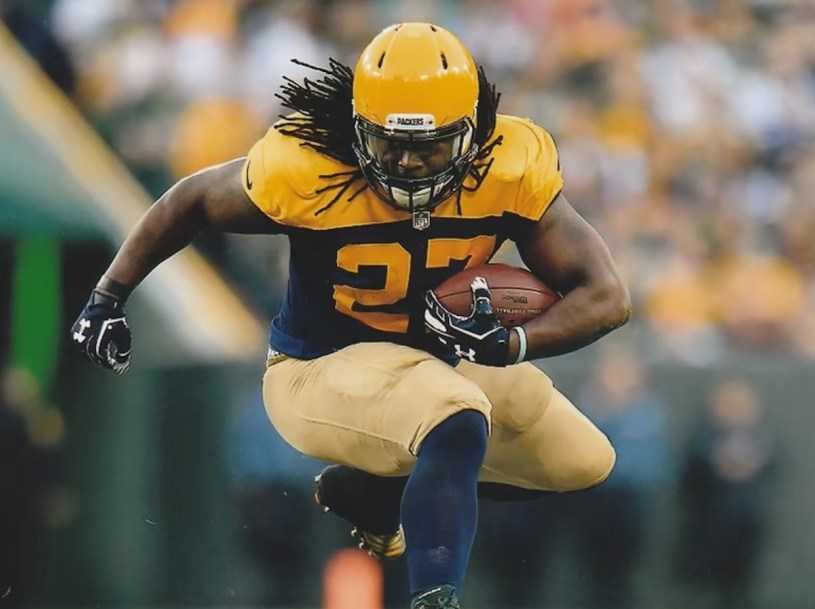
We’re trying to make our NFL Thursday entries a regular thing, as we look into the past of professional football and its historic players. Today that means looking back at the surprisingly short career of Green Bay Packers running back Eddie Lacy, who won the vote for NFL Offensive Rookie of the Year in 2013—in addition to our overall selection for NFL ROTY. Yet he was out of the league by 2018, for physical reasons. It was a sharp fall from grace for a guy who won two “championships” in college football.
Lacy was a member of the 2011 and 2012 Alabama Crimson Tide teams that “won” Bowl Championship Series “titles” (although we didn’t agree with either of those fixed results for a team that was clearly cheating). In the latter season, he posted over 1,500 scrimmage yards while scoring 19 touchdowns; this wasn’t enough to get him any Heisman consideration from us, however. In fact, the NFL had fallen out of love with overrated Alabama running backs by this point, too, so he wasn’t even drafted until late.
The Packers made him the 61st selection in the 2013 NFL Draft, and Lacy made every team that passed on him look foolish by rambling for 1,178 yards and 11 TDs in Green Bay and winning the aforementioned ROTY honors that we confirmed and elevated. He also was named to the only Pro Bowl of his career after this first season in the league, as the Packers won the NFC North Division despite their starting quarterback missing seven games during the campaign. A lot of that had to do with Lacy.
As great as Lacy was as a first-year player (10 AV), he was even better in his second season, posting 16 AV when Green Bay won 12 games and advanced to the NFC Championship Game against the defending Super Bowl champions before losing a heartbreaking game in overtime—they had led 16-0 at halftime and still lost after blowing a 12-point lead with less than three minutes to play. Lacy had played well enough in that game, churning out 73 yards on 21 carries, but it was the peak of his life.
He would fight through multiple injuries in 2015 to gain just 758 yards on the ground, yet Lacy played well in the postseason again: he ran for 152 yards in two games on just 24 carries while having the long run of the NFL postseason as a whole (61 yards). Alas, the Packers once again lost in overtime, this time to the Arizona Cardinals in the division round in a game where Green Bay tied it up on the final play of regulation via the Hail Mary—and then basically lost it on the first play of overtime, in essence. Oi!
But even looking at that 61-yard run by Lacy in the Arizona playoff loss, it’s clear he was way too heavy, for whatever reason: the injuries or something else. We suspect the ankle injury he suffered during the 2015 regular season had something to do with this, as we too had a bad ankle injury that derailed our Ironman Triathlon career in our early 40s, as it took almost four years to heal. Trying to maintain a proper athletic weight with bad joints is next to impossible; Lacy ended up injuring the ankle again in 2016.
As a result, he played only five games in his age-26 season, even though he averaged a career-best 5.1 yards per carry. His rushing success rate (49.3 percent) was also the best of his career, so in his physical “prime”? Lacy was let down by the ankle injuries he couldn’t shake for whatever reason. It’s the age-old question: did weight gain cause the injuries? Or did the injuries cause the weight gain? We may never know, but Lacy’s time with the Green Bay organization came to an end after just four seasons, sadly.
Despite averaging over 67 yards per game with the Packers over his four campaigns in Green Bay, the franchise decided they didn’t want to re-sign Lacy for more than the going market rate. The Seattle organization signed Lacy to a one-year deal as a replacement for Marshawn Lynch. Even though the Packers and the Minnesota Vikings offered comparable compensation, he signed with Seattle for $5.5M. He did have to pass a weight check in order to get a roster bonus, though, which is interesting.
Beast Mode had retired after the 2015 season before making a comeback with his hometown Oakland Raiders in 2017, and Lacy was viewed as the successor to that mantle in the Pacific Northwest. Unfortunately for both the player and the team, it didn’t work out that way in Seattle. The Seahawks didn’t really have any productive running backs, despite having our pick for the NFL MVP at quarterback. Lacy was unable to establish himself on a team where no RB gained more than 240 yards for the entire season.
That isn’t a typo: Lacy himself managed just 179 yards in nine games, and that brought an end to his NFL career at age 27—the time when a player more often than not is entering his prime production seasons. Although running backs tend to flame out earlier than most others due to the pounding they take in the sport, this is still quite an early exit for a runner of Lacy’s capability and quality, in truth. He later had a tryout with the Baltimore Ravens, but it didn’t pan out … and that was the end of his short career.
Lacy’s journey certainly looks like a disappointment, no matter what angle you view it. Yet even with the sad finish in Seattle, he averaged over 60 yards per game in his five NFL seasons, and his postseason per-game average (81.4 yards) is very impressive. He got to play with NFL MVP QBs in Aaron Rodgers and Russell Wilson, and Lacy was a part of some famous postseason contests—both of which did not go his team’s way, or else maybe his fate might have been different in the end. Who knows how that goes?
What we do understand is that his career seems like it was over way too soon, and that doesn’t seem fair. Alas, life is not fair, obvi.

