
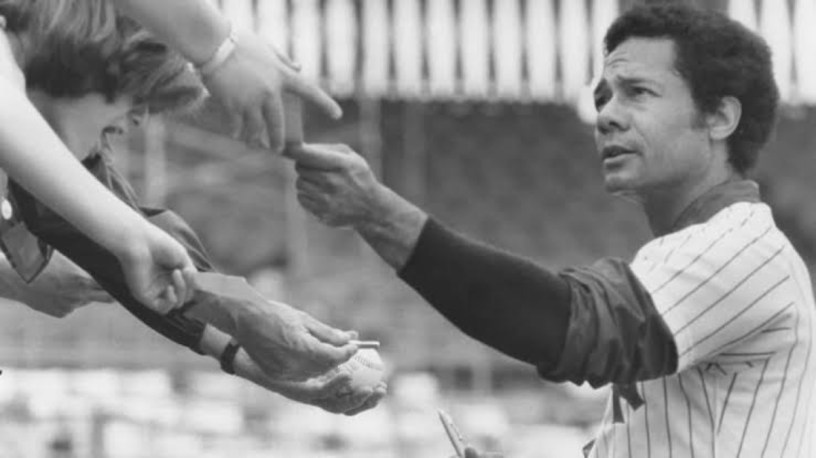
From 1963 to 1976, the New York Yankees did not win a World Series. That doesn’t seem like a big deal today when big franchises go decades without winning a World Series, but at the time, it was shocking as the Bronx Bombers had won 20 Fall Classics in a 40-season span from 1923 to 1962. Alas, today’s MLB Monday analysis looks at the career of left fielder Roy White, a longtime New York stalwart who almost missed out on Yankees glory in a pretty good career than spanned 15 campaigns from 1965-1979.
White reached the majors at age 21 in 1965, playing in 14 games at three different positions: right field, second base, and center field. His .785 OPS was promising enough, but in 1966-1967 combined, he struggled, playing in 185 games total and hitting just .225 at the plate while playing all three outfield positions as well as second and third bases. Entering his age-24 campaign in 1968, perhaps he was fortunate that the Yankees had fallen upon hard times after finishing in 10th and 9th places the prior two seasons.
Otherwise, maybe he’d never gotten his shot … no joke.
He earned the starting LF job in 1968 and posted 4.4 WAR after producing a combined 0.0 WAR from 1965-1967 in his first 199 MLB games. Playing his first full season (159 games), White helped the Yankees to their first winning season since 1964 and earned enough MVP votes to finish 12th in the balloting. His .764 OPS wasn’t great at first glance, but in an era of dominant pitching, that equated to a 137 OPS+ mark. His defense, however, was pretty ugly (minus-1.3 dWAR), as his glove needed work.
Through his first four seasons, he was way below average in the field (minus-3.5 dWAR combined), as he once again played all three OF positions despite being the nominal starter in left. To his credit, White turned his defense around completely starting in 1969, as he was able to focus on left field alone for most of the rest of his career. In the end, he finished with minus-5.8 dWAR for his 15 years in the majors, so he did clearly get a lot better over the long run, even if no one ever would have claimed he was good.
White earned All-Star nods in 1969 and 1970, the only two times he achieved that status in his career, as he followed up his breakthrough season with 4.2 WAR and 6.8 WAR efforts, respectively, the latter being the high-water mark of his career at age 26. He displayed a good eye at the plate, walking more than he struck out, and even though his power varied throughout his MLB tenure, he was consistently good enough as a hitter to finish with a 121 OPS+ mark at the end of his playing days—pretty good.
He never hit .300 in a single season, but for three straight campaigns (1969-1971), White did hit over .290 each year, peaking at .296 in 1970. His 22 home runs, 94 RBI, and .860 OPS that year were also career bests. His 6.7 WAR mark in 1971 at age 27 was an excellent repeat performance, in essence, and White also led the majors that year with 17 sacrifice hits after he’d led the American League in the same category in 1969. He was the kind of player a lot of insiders had serious respect for at the time.
While 1970-1971 did represent his sabermetric apex, White still was a very productive player throughout the 1970s as he aged gracefully. He topped the AL in walks (99) during the 1972 season, and in 1976, he led AL in runs scored (104), too. From 1972-1976, he added 21.6 WAR to his team’s success, which culminated in the AL pennant for New York during his age-32 season. He certainly was recognized for value by finishing 26th in the AL MVP vote that year as well with his 5.5-WAR contribution overall.
The 1977 season would be the last “good” one of his career, in addition to being his last as a starter. With 3.6 WAR at age 33, the Yankees returned to the “winner’s circle” of MLB with a World Series victory over the Los Angeles Dodgers, permanently solidifying White’s status as an all-time revered Yankees star. He had joined the major-league roster a year after the last AL pennant, and he had endured the storm for a long time while connecting the franchise to its next wave of title-winning success.
By 1978, though, White was riding the pine and appearing in only 103 games as an age-34 reserve outfielder. He still posted positive WAR (0.8) as New York repeated as MLB champions with a second-straight defeat of the Dodgers in the Fall Classic. Overall in three consecutive postseasons (1976-1978), White hit .278 with an .817 OPS, while saving his best for the 1978 playoffs (two HRs, five RBI, .325 BA). In 25 total October games, he walked 14 times while only striking out eight times.
The final year of his career was an afterthought, and that’s okay. He struggled at age 35 to be productive, appearing in just 81 games. Who could blame him if he just ran out of gas? He had given everything he had to the team, risen to the top of the pyramid with them after years of not winning at all. White petered out with minus-1.3 WAR for that 1979 campaign and retired afterward, with two World Series rings on his fingers and 46.8 WAR overall. That still ranks 29th now all time for left fielders, which is good.
When his name appeared on the 1985 Cooperstown ballot, he somehow got zero votes. That surprises us as his LF ranking all time would have been much higher then than it is now, obviously. Did “experts” and writers think so little of his career as to not give him a single Hall of Fame vote? Evidently. Maybe he didn’t belong, but he deserved a little bit more love than none. Again, he was a two-time All Star, led the AL in major categories four times, and carried a lot of water for a lot of nondescript Yankees rosters.
We love the fact he was made whole in the end by the World Series wins, and we love this one-sentence description of his written by our friends at the Society for American Baseball Research: “Roy White was a quiet, graceful leader on the New York Yankees during a transitional period in the club’s history.” He surely was, and today we acknowledge that in our own way, in our usual fashion here. In playing six different positions over 15 campaigns in the Bronx, White certainly has earned our historical respects.

