
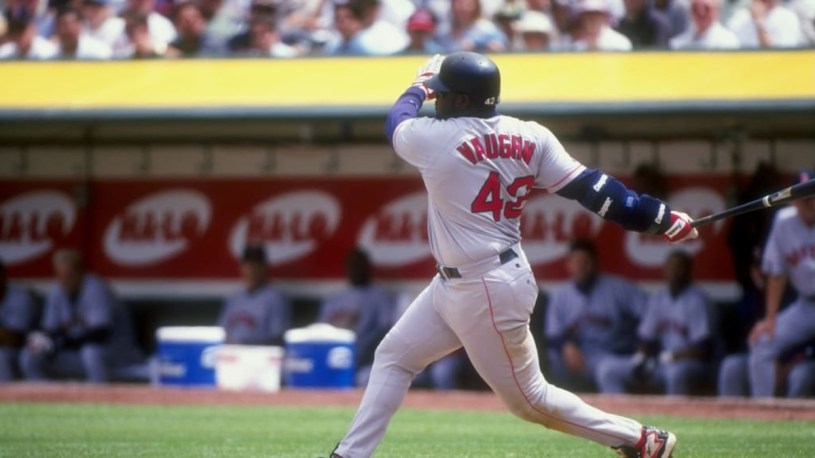
Every so often, some former professional baseball player pops up in our minds for a random reason, and we add them to the list of MLB Monday subjects to take on in the future. Today, we look at former first baseman/designated hitter Mo Vaughn, a three-time All Star and the 1995 American League MVP vote winner. That balloting result was one of the worst-ever selections in the history of the sport, in truth, as we previously explained over five years ago in this very space. But this piece today is about his full career.
Oddly, Vaughn played only 12 seasons in the majors: eight for the Boston Red Sox (1991-1998), two for the Anaheim Angels (1999-2000), and two for the New York Mets (2002-2003). He was at his best with the BoSox, of course, compiling 25.3 WAR from 1993-1998. However, his career WAR mark (27.1) demonstrates that he didn’t do much else with his career outside of those six peak campaigns with Boston. There are a lot of reasons for this, of course, which we will explore a bit more later in the piece.
But to start, he was a first-round pick by the Red Sox in the 1989 MLB Draft out of Seton Hall University, and even then, he didn’t make his MLB debut until age 23 during the 1991 season. Vaughn didn’t do much in his first two years in the Show, combining for just 187 games and a minus-0.5 WAR total. The adjustment to major-league pitching was a slow process for an accomplished college player like himself, but by 1993 at age 25, he was ready to take over the full-time responsibilities at first base for the Sox.
That 1993 season started a streak of eight consecutive years in positive WAR for Vaughn, as he became a pretty good hitter at the MLB level. He hit .297 with a .915 OPS to also start a stretch of a half-dozen years earning MVP votes. From 1993-2000, he would average 35 home runs and 111 RBI, in fact, although his defense was never much to write home about on a yearly basis. Finishing his MLB lifetime with minus-12.4 dWAR really demonstrated this guy never should have been given a glove at all.
That defensive blackhole in his stat line clearly damaged his overall value to any team he played on, but his value at the plate could not be denied (career 31.7 oWAR). Yes, he topped the AL twice in strikeouts (1995, 2000), but his career .293 batting average and .383 on-base percentage are both good, and his career OPS+ mark (132) is borderline great. Vaughn could rake, and while most of his prime was spent in Fenway, he also didn’t do so bad after his late-career move to Southern California, either.
He led the majors in intentional walks once (1994), while posting the most RBI in the AL during his MVP season. The 1995 Red Sox were a surprise AL East Division winner, and the memories of that are bittersweet for Vaughn as he went a disastrous 0-for-14 in the AL Division Series against the Cleveland Indians, the eventual pennant winners. To his credit, he redeemed himself in his only other October games, the 1998 ALDS against the Tribe: even though Boston lost, again, Vaughn hit .412 in that matchup.
Those were the only two postseasons of his career, however, as he was in his age-30 season in 1998, and with his skill set, the Red Sox didn’t feel like committing to him longterm. The Boston front office had seen his salary rise from $2.7M in 1995 to $6.6M in 1998, and with his offensive statistics, the market value for his services would be pretty high. Also, the team was headed in a direction we like to imagine that Vaughn also wanted no part of, generally, so he signed with the Angels for six years and $79M.
That turned out to be great for Vaughn—but not so good for the Angels, and thus his overall reputation took a hit as a result. Part of the problem was that Anaheim insisted on playing him in the field, of course, instead of just slotting him into the DH position. But Vaughn also was aging with his limited skill set, that infamous “three outcomes” role, although he wasn’t really that bad at the plate, either. He hit .276 in 1999 and 2000 combined with the Angels, posting an .865 OPS in the process, more than respectable.
However, it wasn’t exactly justifying the money he was making, either, despite the combined 69 HRs and 225 RBI. When he missed the entire 2001 season due to injury at age 33, the Angels decided to trade him to the Mets straight up for age-35 starting pitcher Kevin Appier. Vaughn finished his career in New York unceremoniously, posting minus-1.2 WAR in two seasons combined, and he still got paid for the sixth year on that last contract (2004), even though he did not play in the majors at all.
One additional thing that added to his “legacy”—or rather perhaps detracted from it—was his personality clashes with the Boston front office and his Anaheim teammates. It doesn’t help that both teams went on to win the World Series after he left the teams, respectively: the Angels won their only World Series right after trading him to the Mets, and the Red Sox won the Fall Classic for the first time in 84 years a few seasons after that. However, it is hard to argue he didn’t contribute to both teams’ success at all.
For one, the Red Sox made the postseason twice in his final four campaigns there, and the Angels didn’t make the postseason without him in 2001 or in 2003, thus making their random 2002 postseason seem like a fluke. His defense may have been bad, but that’s on the managers for not making him the DH more often; the offensive production and value he brought to both teams is hard to ignore, especially when considering who else was on those rosters—or rather, who wasn’t on the mediocre pitching staffs:
- 1998 Red Sox: Only one SP had an ERA under 3.96 on this 92-victory club.
- 2000 Angels: The lineup was loaded on this 82-80 team, but the pitching staff was atrocious (5.00 ERA).
We’re not defending Vaughn, but he’s been a bit slighted in historical analysis for some subjective-memory reasons. Plus, without him, the Anaheim club slumped to only 75 wins in 2001. He could hit, yet his body type didn’t bode well for a long career—so that error in judgment is on the Angels front office for throwing so much money at him, the biggest contract in MLB history at the time for a demonstrated slugger in the middle of their lineup. Vaughn was what he was, and overall, he was pretty impressive on paper.
He did admit later that he tried HGH to salvage his career while injured in 2001, but we don’t hold that against him, because it had next to no impact on his stat line with the Mets in 2002-2003: a .249 BA, .784 OPS, and 29 HRs in only 166 games with New York. Although he did end up collecting his last year of salary in 2004 without playing, he was entitled to that, legally. Does this complicate his legacy? Not to us, because again, it didn’t really do much for him, and he didn’t gain any extra money from it.
Vaughn made just over $100M in his MLB career, and while he won’t get into Cooperstown without buying a ticket, he certainly had a pretty good run of very productive offensive seasons. He was let down by his defense and injuries, but he had a good ride while it lasted. We’re not claiming much more than what the statistical and sabermetric records show above, yet we do think he’s gotten a bad rap, generally speaking. Most teams today would be thrilled to plug a guy with this profile into their DH slot daily.
[Editorial Note: Vaughn also was the last position player to wear No. 42 in MLB. Here’s why.]

