
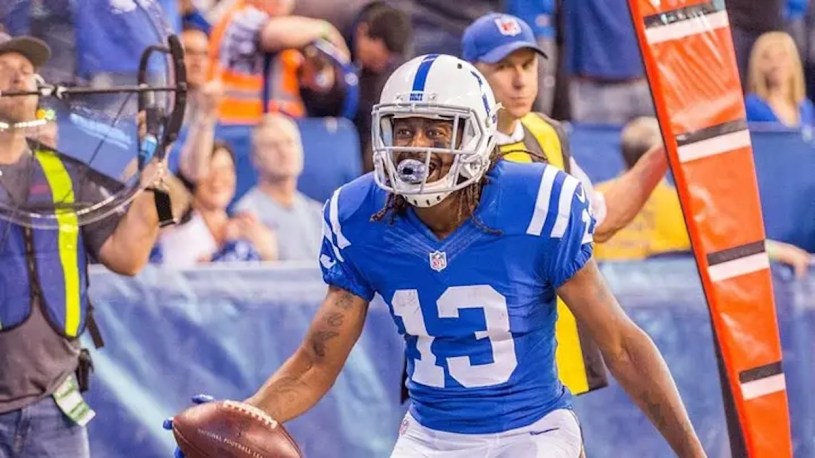
Our NFL Thursday piece today is about former wide receiver T.Y. Hilton, and we’re not sure why he ended up on our editorial list for profiles now. It’s possible we put him on this list years ago, and the original inspiration has now faded from our memories. So be it; that can happen. What matters now is we look at his 11-season career, sabermetrically and statistically, and offer some interpretative analysis, which is what we do here, in case you haven’t noticed yet. So, welcome back to another trip into the past!
Hilton, whose real name is Eugene Marquis, was drafted in the third round of the 1992 NFL Draft by the Indianapolis Colts, falling right into the lap of a perfect situation, being paired with rookie quarterback Andrew Luck, the No. 1 overall pick that year. Imagine that: the alignment of a rookie WR with a rookie QB had Colts fans dreaming of Super Bowls aplenty for the next decade. Alas, it didn’t happen that way, of course, but the fantasizing was real, even if it not quite evident at first glace that year.
Starting just one game in his rookie year, Hilton still managed to catch 50 balls in 15 games, scoring seven touchdowns on pass receptions in the process. The sky would be the limit with Luck throwing to him, too, and in 2013, his second campaign was much better: 16 games, 10 starts, 82 catches, and almost 1,100 yards receiving. Overall, he averaged 10 more yards per game in receiving than he did as a rookie, showing good progress and developing rapport with Luck. Hilton also excelled in the playoffs.
He topped all NFL receivers in the 2013 postseason with 327 yards in just two games as the Indianapolis squad won the AFC South Division for the first time since the 2010 season when Peyton Manning was still in town. By 2014, Hilton had arrived as a Pro Bowl WR, starting a streak of four consecutive designations to that all-star roster. In fact, from 2013-2018, which turned out to be his best seasons, he averaged 76 receptions for 1,206 yards. He was never a scoring machine, but Hilton hit the end zone plenty.
The Colts, as a team, however, peaked in the 2014 season with a trip to the AFC Championship Game, where they promptly got stomped, 45-7, by the cheatin’ New England Patriots. After winning 33 games in Hilton’s first three seasons, Indy won just 20 games combined from 2015-2017, missing the postseason all three years. He remained the team’s best WR, of course, but as the overall roster declined from that 2014 peak, there were no postseason appearances again until 2018. And then the “luck” ran out.
Indianapolis went 1-1 in those 2018 playoffs, beating the Houston Texans in the wild-card round before losing to the Kansas City Chiefs in the divisional round. But it would be the last season of Luck’s career, and with him went the promise of that bright future that the fans would have envisioned back in 2012. Hilton was aging, too, playing his age-30 season without Luck in 2019, and his last three seasons (2019-2021) with the Colts were not impressive: 35 games with only 124 combined catches. It was a quick end.
Hilton spent one last season with the Dallas Cowboys in 2022 at age 33, playing in three games and catching a total of seven passes for 121 yards. For his career, he caught a total of 638 regular-season passes and 50 postseason passes; with 87 AV in 146 career games, his historical ranking is not much to discuss due to the short nature of his statistical peak. His 2016 season was his best overall, though, with 14 AV and an NFL-best 1,448 receiving yards. Again, once he hit 30 and Luck was gone, he faded.
And hard.
Interestingly enough, Hilton did not formally retire until 2026, despite not being signed for the 2023-2025 seasons. According to T.Y., his common name came into use due to his father’s name being Tyrone. And that’s all we have to say about him here in this space: his career forever will be linked to Luck’s ill-fated NFL journey, for better or for worse. Sometimes, as the baseball adage goes, you’d rather be lucky than good, and we will let that sit here for now, without any need for further explanation, obviously.

