
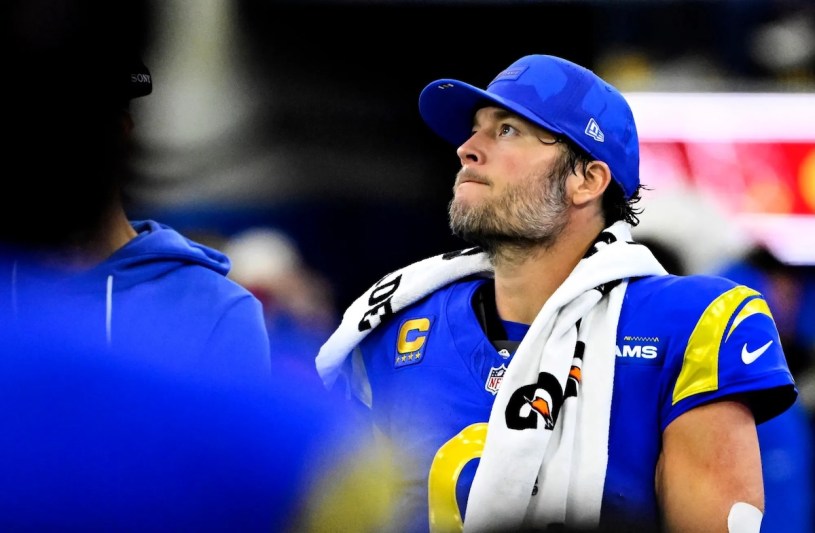
Our NFL Thursday column touches down again today with the 2026 World Series complete and the 2026 WNBA Finals near completion. Oh, yeah the NHL and the NBA also have started new seasons this month, and we’ll get around to more NHL Saturday and NBA Tuesday soon. For now, though, let’s talk football! Specifically, we want to talk about Los Angeles Rams quarterback Matthew Stafford. We will admit upfront we have never thought much of him, even in his college football days.
We were living in Michigan during the 2008 NFL season when the Detroit Lions went 0-16, and Stafford was their “prize” in the 2009 NFL Draft, going No. 1 overall after his three-year career at the University of Georgia. He was a volume-only kind of player in college, topping the nation in attempts, completions, and yards in his junior year as the Bulldogs went 10-3 to finish 13th in the Associated Press poll. We didn’t even discuss him in the QB category for our 2008 Heisman Trophy analysis, yo.
Thus, we thought little of the Lions’ decision to pick him first in the NFL Draft. Of course, he played on a lot of mediocre Detroit teams in the first 12 seasons of his professional career, putting up just a 74-90-1 record in the regular season and a mere 0-3 in the postseason with the Lions. Yet he didn’t really stand out individually, either, topping his QB peers during those dozen years in a significantly meaningful category just once (first downs in 2012 when the team won just four games). Ouch.
Stafford always has been the kind of quarterback that needs good players around him to thrive, while he’s rarely, if ever, been the kind of quarterback that makes everyone around him better. That is reflected in the individual sabermetrics (133 AV) and the overall team performance (see above) for those first 12 years with the Lions organization. When we think of great QBs, we think of Joe Montana winning two Super Bowls with no one noteworthy at running back or really even at wide receiver.
[No offense, Dwight Clark. We loved you; we always will.]
Of course, scouts always loved Stafford for his arm strength and size (never mind his head). His 89.9 QB Rating in Detroit was a good measurement of his quality: solid, but never spectacular, and unable to elevate the play of the talent around him on a regular basis. His playoff QB Rating dropped two points, which is not unusual, but it is—again—a sign that he wasn’t elevating his play in the postseason like a lot of great quarterbacks do, and heck, even Eli Manning won some playoff games.
We think very little of Manning, obviously, and it says a lot that we have thought more of Stafford than we ever did of Lil’ Manning. What Stafford needed, clearly, was a good team around him in order to thrive, and he got that with his post-Covid trade to the Rams. Given a talented roster, Stafford was usually in a position of just needing to not lose games rather than feeling like he had to win them on his own all the time, as he usually felt in Detroit. He certainly has looked better in L.A.
His 49-32 record with the Rams is not amazing, but it’s certainly much better than his time with the Lions. His 98.1 QB Rating with Los Angeles is an improvement, especially considering his age (he joined the West Coast franchise when he was entering his age-33 season), as immobile QBs like Stafford tend to become statues back there in the pocket as they move through their mid-30s. But after winning the Super Bowl in the 2021 season, Stafford hasn’t been able to replicate that Eli-like success at all.
Again, the only non-volume stat Stafford has ever led the NFL in was his TD percentage last season (2025). So even with the Rams, he hasn’t been a sabermetric success at all; his counting stats have been roughly the same as they were in Detroit, as well, with just a few league-leading numbers. He honestly had no business winning the NFL MVP vote last year, as we recounted earlier this calendar year. We’re pretty sure it was just some career-achievement nod, which even in itself is wrong.
And now, after an offseason of roster loading in attempt to win another Super Bowl, the Rams find themselves with just a 3-4 record. At age 38 now, Stafford’s QB rating has dropped 15 points from its 2025 level, and it’s only slightly above his career mark (92.5). Since that Super Bowl win five seasons ago, Stafford is just 3-3 in the playoffs, making the 2021 postseason seem like a distinct fluke in hindsight—sort of like Eli Manning’s two Super Bowl victories, which we’re pretty sure were contrived.
At this point, Stafford’s overall record as a starting QB in the NFL is a combined 123-122-1 in the regular season and a collective 7-6 in the postseason. That career QB Rating puts him 28th overall in NFL history, even below the guy the Rams traded to Detroit in exchange (Jared Goff, 97.4, 11th all time). We find that amusing; if not for a team meltdown in the 2023 playoffs, as well, Goff would have more Super Bowl starts than Stafford does. So, did the Rams really get an upgrade there?!
Well, they did win the one Super Bowl with Stafford, so even if they never win another with him, the trade was worth it. However, Stafford just isn’t the great player people claim he is, based on common sense, logic, and statistical analysis. He’s been a good QB, yes, but not really a difference maker despite the Super Bowl victory; he wasn’t even the MVP of that game, for example. In fact, even in that successful postseason, Stafford still tossed three interceptions, the most of any QB that year.
We could go on; we will not. People will disagree with us, and that’s fine. But again, we use advanced analytics and sabermetrics as evidence, while other people generally use their feelings, based on statistical misconceptions from the last century they’ve continued to adhere to deep into this century. Sound familiar? It should; people just do not understand sports analysis anymore, if they ever did. Either way, Stafford probably makes the Hall of Fame on counting stats alone; so be it.
He’s much better than Lil’ Manning, either way, although that bar is pretty low, generally.

