
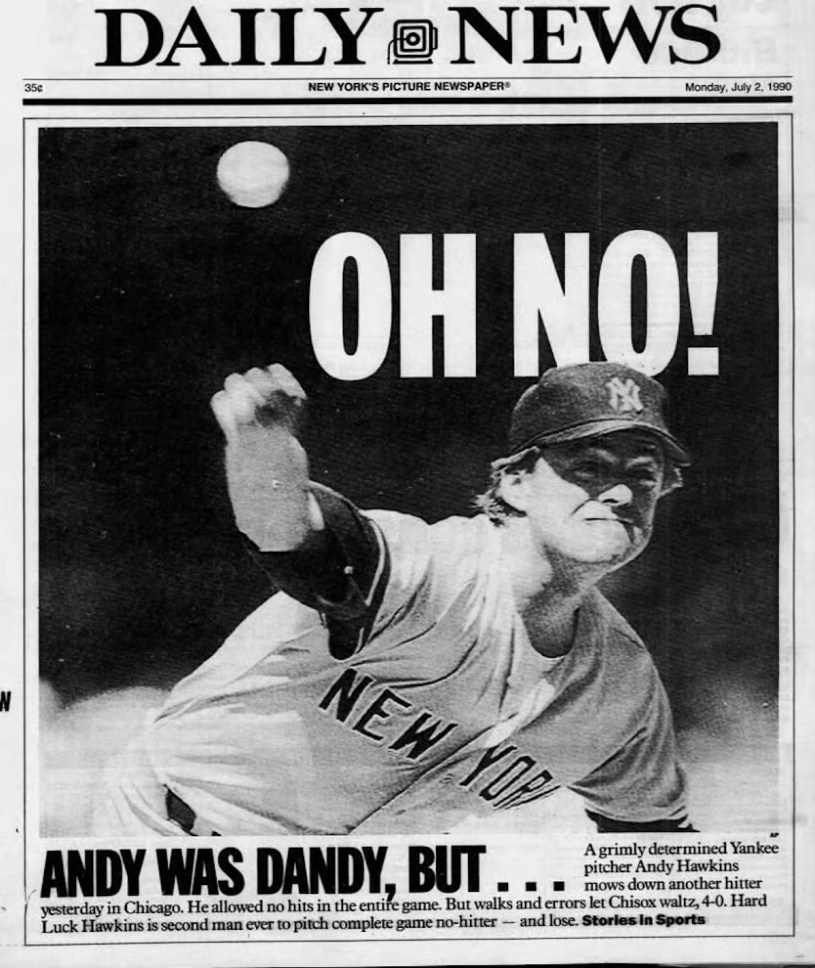
For this installment of MLB Monday, it is time to go back again into the twentieth century to examine the full career of journeyman starting pitcher Andy Hawkins. Definitely best known as the New York Yankees pitcher who once tossed a no hitter while losing the game by a 4-0 score in July 1990, he had a relatively unremarkable career, earning just 1.3 WAR total across a 10-season span, playing for the San Diego Padres (1982-1988), the Yankees (1989-1991), and the Oakland Athletics (1991).
He was never an All Star, and Hawkins only “topped” his league once in any category: earned runs allowed in 1989 for the American League—not something anyone wants to ever do, sadly enough. In 280 appearances, which included 249 starts, he won 84 games, lost 91 times, and posted a 4.22 ERA. In modern times, as a point of fact, he’d probably be making $5M a year with numbers like that (including his 1.403 WHIP). Four times, he surpassed 200 innings pitched in a season: durability, yo.
But let’s start at the beginning: he was the No. 5 overall pick in the 1978 Draft by the Padres, out of his Waco, TX, high school. He made his MLB debut four years later in July 1982 with San Diego, and his rookie numbers weren’t great: a 1.461 WHIP, more walks (27) than strikeouts (25), and a 2-5 record to go along with a 4.10 ERA. At age 22, those weren’t statistics that screamed “Top 5 draft pick” at all. But at the time, the Padres had never even made the postseason, so they were patient.
San Diego was a 1969 expansion franchise, and it had experienced just one winning season so far (1978). Finishing at .500 in 1982, the team was building around some young talent would help it win the National League pennant in 1984—including Hawkins, believe it or not. He would improve in 1983 to a 2.93 ERA and a 1.287 WHIP as the Padres once again posted a .500 record, but at least Hawkins was looking more like a top prospect at this point. Things were coalescing in Southern California.
But he took a step backward in 1984, despite the team’s overall success. His age-24 season was ugly: 4.68 ERA and 1.473 WHIP. Hawkins scuffled to an 8-9 record in 36 appearances, including 22 starts. He wasn’t part of the San Diego rotation in October, but he thrived in a bullpen role: in six games over 15 2/3 innings pitched, he posted a 0.57 ERA and a 0.766 WHIP, looking like a world beater as a reliever. The Padres may have lost the World Series to the Detroit Tigers, but they had arrived.
Buoyed by his postseason success, Hawkins enjoyed his best year in the majors at age 25 in 1985: in 33 starts, he put up a 18-8 record, a 3.15 ERA, and a 1.286 WHIP. In his first three seasons, he had been underwater with a combined minus-0.8 WAR, but his 3.4 WAR mark in this single season pushed him into the positive side of the career ledger. Why his own manager, Dick Williams, did not select him for the NL All-Star team is beyond us at this point, but that may have been his best shot to do it.
The issue was that Hawkins was not a strikeout pitcher, and without that skill set in his toolbox, his performance would be volatile throughout his career. Even in that great season of 1985, he walked 65 batters and only struck out 69 guys. Pitching to contact was a last resort for pitchers with mediocre stuff, and that pretty much defines Hawkins in many ways. For his whole career, he gave up 9.1 hits per 9 IP, and he generally was not able to overcome the diverse outcomes of pitching to contact.
In 1986, he was not able to sustain his momentum, and even though he wasn’t bad (0.8 WAR), he was not impressing anyone with a 4.30 ERA and a 1.400 WHIP. Yet because of arbitration, he got a raise for 1987, from $300K the prior year to $535K in his age-27 season. And Hawkins all but cratered: 3-10, 5.05 ERA, and 1.530 WHIP for negative WAR (minus-0.4). Thus, his salary was reduced in 1988 to a mere $453K—still not bad considering how atrocious he was in his 117 2/3 IP, in all truth.
At this point, entering the final year of San Diego retaining his rights, Hawkins knew he had to get better or take his glove and go home. So, of course, in traditional fashion, his walk year with the Padres turned out well: 2.1 WAR, 14 victories, 3.35 ERA, and 1.250 WHIP. This rollercoaster ride certainly scared off potential suitors, but the Yankees came calling in their usual fashion of the era, overspending by offering Hawkins a three-year, $3.6M deal, hoping for the “better” version of him in 1989.
At age 29, he should have been something more consistent and better, yet it did not happen in the boiler pot of the Big Apple: Hawkins won 15 games with a 4.80 ERA and a 1.507 WHIP, while giving up the most earned runs in the majors (111). He started 34 games, finished five of them, and even tossed two shutouts, so it was a mixed bag of hot garbage, really, overall. Could he get any worse in 1990? The answer was yes, as he started 26 times and made two relief appearances to sink hard.
The stats? 5-12, 5.37 ERA, 1.510 WHIP, and the aforementioned no-hit loss. He did throw a shutout again during the regular season, but clearly the Yankees had lost their bet on his up-and-down production swings. Two years had produced minus-1.9 WAR, as New York crashed and burned hard in 1990. Not surprisingly, Hawkins lasted just four appearances into the 1991 season with the Yankees (0-2, 9.95 ERA, 12 2/3 IP) before George Steinbrenner flat released him into the waiver pool. Ouch.
Interestingly, the A’s took a chance on him, and in three months with an Oakland team that would miss the postseason after three straight AL pennants, he started 14 games to the tune of a 4-4 record, a 4.79 ERA, and positive WAR somehow (0.1). And even though Oakland was not on the hook for his full salary, the A’s front office decided to release Hawkins in mid-August, and he never pitched in the major leagues again. His uneven ride through professional baseball was over at age 31.
We remember Hawkins for that no hitter that eventually wasn’t, of course, and now we wonder why his own manager in San Diego didn’t reward his 1985 brilliance with that All-Star designation. Either way, Hawkins still made at least $5M in his MLB career, and that was a lot of money back then; it’s a lot of money now. Many people would take that lump sum in their early 30s today and find a way to make it last for a long time. We hope Hawkins did just that as he eventually got into coaching, too.

