
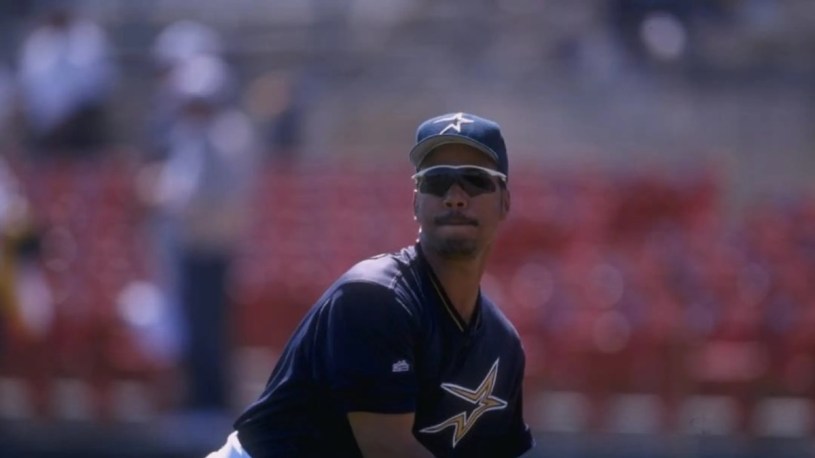
Today on MLB Monday, we are peeking back at a member of the 1997 Florida Marlins, who won the World Series in a tremendously surprising result for the era. That’s right, it’s time for assessing the baseball career of Moisés Alou. He also was a member of the infamous 1994 Montréal Expos, a small-market team that was shafted by the labor strife and missed its best chance to win the World Series. Alou was the son of Felipe Alou, of course, and he enjoyed a 17-season MLB residency.
He failed to reach 40 WAR for his career, however, despite hitting .303 overall—putting him in exclusive company, for sure—and hitting 332 home runs. Those are pretty good accomplishments, but Alou was hurt by his minus-9.6 dWAR mark, even though he was named to six All-Star teams along the way and played for postseason squads in both Chicago (NL) and Houston, too. Heck, Alou even played next to Barry Bonds in San Francisco for a spell, too; maybe that’s not a good thing.
Alas, let’s go back to the beginning, shall we? Interestingly, he was the No. 2 overall pick in the 1986 MLB Draft by the Pittsburgh Pirates after he played at little Cañada College in Redwood City, CA, in the heart of what would become Silicon Valley eventually (we lived for four years ourselves in nearby Belmont, after working earlier for two years in next-door Redwood Shores, the home of Oracle). Bonds, of course, was already a part of the Pirates organization, which is curious.
However, after making his MLB debut with Pittsburgh in 1990, playing in just two games, Alou was traded to the Expos for Zane Smith, a starting pitcher the Pirates wanted to secure for their pennant chase that summer. He appeared in 14 games for Montréal that season, and then Alou missed the entire 1991 season due to injury. By the time his first full season came along in 1992, he was in his age-25 year and already somewhat “old” for a rookie. But the Expos didn’t care, because he could hit well.
In 115 games that season, he hit .282 with 9 HRs and 56 RBI, to the tune of a .783 OPS overall and 2.5 WAR total. This earned him a second-place finish in the NL ROTY voting, and his career was off and running. Alou had manned all three outfield spots in 1992, but he was named the starter in left field for the 1993 campaign. He played in 136 games, matching that 2.5 WAR output on the back of an .823 OPS, 18 HRs, 17 stolen bases, and a .286 batting average. Again, clearly he could hit.
The defense on Montréal rotten field surface was another issue, though: his minus-0.1 dWAR in 1993 was passable, but for a younger player not even yet in his prime who could steal bases effectively—a combined 33-for-41 in steal attempts for 1992 and 1993—it’s clear that fielding was never going to be Alou’s strength. And perhaps that didn’t matter as he made his first All-Star squad in the shortened 1994 season: he hit .339 with a .989 OPS to contribute 5.1 WAR in only 107 games played.
In his age-27 season, Alou clearly was hitting his prime years in an impressive way. However, he regressed in 1995 and 1996, playing in just 236 games combined and adding only 2.4 WAR to the two seasons’ effort in Montréal. His OPS dropped and hovered around a mere .800 for both years, and this led the Expos to choosing to not re-sign him before he became a free agent at the conclusion of the 1996 season. His age-30 season loomed, and the low-payroll Montréal franchise didn’t want to risk it.
Via arbitration based on his 1994 campaign, Alou had made a combined $6M in 1995-1996, and the Expos didn’t think he was worth that money. In came the Florida Marlins, then entering just their fifth season of existence: they gave Alou a five-year deal worth $25M overall, and he responded with a pretty solid season (3.5 WAR, .866 OPS) that culminated in the World Series championship that no one saw coming. Yet the Marlins famously slashed payroll right away afterward, and … yeah.
Alou was traded on November 11, 1997, to the Houston Astros. There in 1998, he had the best campaign of his entire career, posting 6.2 WAR and making the All-Star team for the second season in a row after he’d made it with the Marlins in 1997. That sabermetric high was compiled through a .312 BA, a .981 OPS, 38 HRs, and 124 RBI. He even stole 11 bases, too, the first time since 1993 that he’d reached double digits in SBs. A career-best 84 walks also helped his overall value, of course.
However, once again, he was unable to sustain the high level of success, as he missed the entire 1999 season with another injury (an odd ACL tear on a treadmill). Combined with the ankle injury that cost him all of 1991, it was clear his body was a liability even more so now at age 33 heading in the 2000 campaign. To the casual fan, it seemed like Alou got old very fast. Yet he managed to hit .355 across 126 games, his highest single-season BA ever. His 1.039 OPS also established a career high.
Again, Alou could hit even though he never played for an American League team to take advantage of designated-hitter opportunities, and that took a toll on his overall value, playing mediocre defense all the while. After combining to produce just 5.6 WAR in 2000 and 2001, while also making another All-Star team in 2001, the Astros decided they were not going to invest any more cash in Alou’s future. So be it: his bat alone earned him another $25M deal, this time for three years with the Cubs.
It was a mixed bag there from 2002-2004: he only contributed 5.4 WAR overall in three seasons, despite playing in 438 games for Chicago, in total. His .837 OPS with the Cubbies also represented a significantly ugly drop-off from his .988 effort with Houston, and that makes sense as the three years in hitting-friendly Wrigley were his age-35, age-36, and age-37 seasons. Alou was old, for sure, and of course, the Cubs were not going to waste any more money on a slightly above-average, aging hitter.
But the San Francisco organization would, because his dad was the manager: nepotism at its ugliest, perhaps? The Giants gave him a two-year, $13M deal to play for them in his late 30s, and well … playing in the House that Steroids Built (a pitcher friendly park, no less) Alou improved his OPS back up to .920 for two years in San Francisco, making his final All-Star team in 2005. Yet he still only managed to get in to 221 games with the Giants, even as his dad was filling out the lineup card daily.
Perhaps he was able to hit a combined .312 with San Francisco due to his dad managing his appearances effectively considering his age, etc., although that’s a little weird to not be able to hit as well in Wrigley but then thrive in Pac Ball Park. We have covered this elsewhere, but either way, when his deal was up, the Giants were not interested in keeping Alou for his age-40 season (2007). The New York Mets came calling with $15M, however, for a two-year deal, and Alou signed with them.
[Nothing changes, eh, Mets fans?]
Alou played decently enough in the Big Apple initially, posting 2.3 WAR in 2007 across only 87 games, but he could only reach the field for 15 games at age 41 in 2008—and that was the abrupt end of his MLB tenure. Overall, his career .885 OPS still looks quite good, although uneven production across most of his career due to injuries and advanced aging is quite interesting to ponder and re-assess today. The batting average speaks for itself, consistently, for the most part, so there’s that.
A sidebar: in four postseasons with Florida, Houston, and Chicago, Alou hit just .276 with a .775 OPS. His best overall postseason came with the 2003 Cubs—who fell in the NL Championship Series to the Marlins, of all teams—perhaps thanks to the Bartman Incident at Wrigley Field, where Alou was the left fielder crying foul over the fan interference. It is worth mentioning that Alou played with Sammy Sosa under Dusty Baker in Chicago before heading to the Giants organization, too.
[Draw your own conclusions from that evidence; we have.]
Overall, Alou had a pretty good career despite the injuries and defensive shortcomings: he earned around $86M playing the game, made those six All-Star teams, and won a World Series ring. He has the shiny career BA to hang his hat on in the seven NL cities where he played, plus the added legacy to the family name since his father and two uncles (Jesús, Matty) were also major leaguers—in addition to his brother and two cousins. Quite a baseball family; Moisés may have been the best hitter in it.
[We won’t bother mentioning this other stuff, though; we just can’t do it with a straight face.]

