
We do something different today on WNBA Tuesday as the league is on break for the FIBA Worlds. It’s always interesting to consider a coach’s playing background in a sport, as it can tell us a lot about their coaching style and success (or lack thereof, perhaps). In baseball, for example, it’s often catchers—who see all on the field of play—who make the best managers, and likewise, in basketball, it is often the point guards who find themselves thriving as coaches … not always, of course, but often.
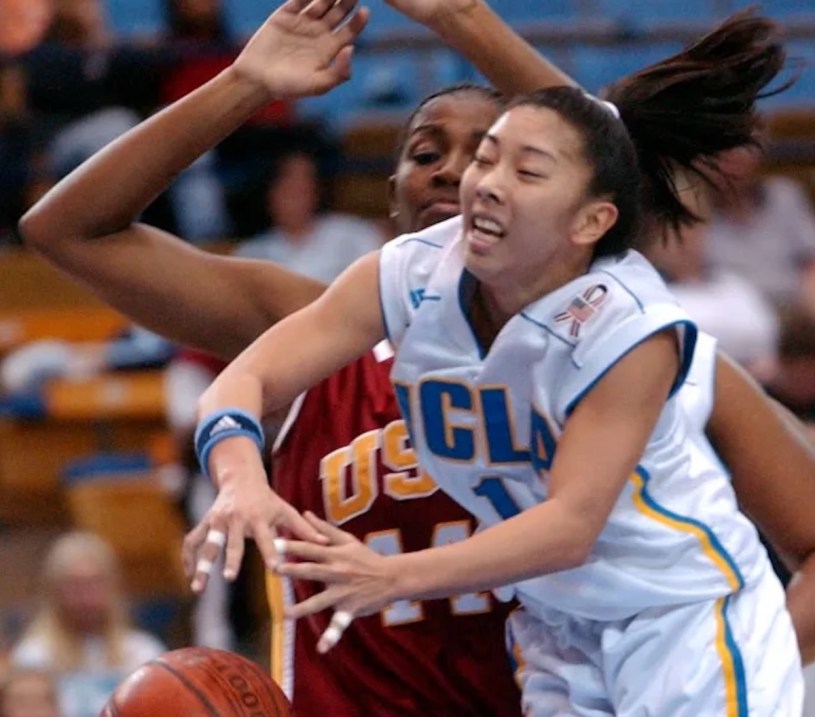
This brings us to Golden State Valkyries Head Coach Natalie Nakase, who won the league’s Coach of the Year vote in 2025 for leading an expansion team to the playoffs. She played four seasons of big-time college basketball at UCLA, despite being undersized even for a point guard at five-foot-two-inches short. She wasn’t a star, and statistical records for her career are incomplete, but we’re going to look at those numbers right now and derive what we can from a statistical profile for insight.
First, Nakase played in only 11 games as a first-year player in 1999-2000. Her statistical impact was minimal, as she was just 2-for-3 from the field in those contests, in addition to being 5-for-7 from the free-throw line. It’s such a small sample size, so we don’t want to assume anything about the field-goal percentage, although all free-throw percentages are valid, simply because of the circumstances in which those shots happen: making 71.4 percent from the charity stripe is low-end decent.
That Bruins team went 18-11 overall and lost in the first round of the NCAA Tournament as a 10 seed, so the team was solid—but not spectacular. Two players went on to the WNBA, but Nakase herself was still five inches shorter than anyone else on the team. We don’t mean to harp on height, but this is a sport where certain physical characteristics can impact one’s ability to play it effectively, and Nakase was starting off with an inherent disadvantage there. In those cases, players must compensate.
They usually do that by being smart, and it looks like Nakase worked hard in the offseason to come back as a better player in 2000-2001. She got into 29 games during her second UCLA campaign, although some of that may have been because the Bruins took a huge step backward and won just six times overall—including just a single out-of-conference victory. Nakase herself benefitted from this by playing more, although this didn’t help her efficiency at all in the ways we will analyze below.
Her field-goal and free-throw percentages took a hard dive: she was 46-for-125 from the floor and 30-for-60 from the line. The volume rose while the efficiency dropped; that is somewhat typical in most data sets, of course, when sports statistics are involved. This is about “regression to the mean” in many ways, but either way, Nakase got the experience and the playing time that all developing athletes need to improve. She shot an even 40 percent from two-point range but just 24 percent on threes.
The volume went up again in her third season at UCLA, as the Bruins slightly improved to a 9-20 mark overall, with Nakase playing in all 29 games again. She took 199 shots, and her overall field-goal percentage was a smidge below where it had been in her second year; that was certain acceptable. Where she improved was in her three-point percentage (up to 33.9 percent) and her FT conversion rate (up to 78.3 percent). Again, these are hallmarks of a player who truly is working hard in the offseason.
Nakase was finding ways to overcome a physical disadvantage, and the fact she got to the charity stripe as much as she did (83 times) is impressive. Her two-point shot rate did decline, however, to 37.1 percent, showing that she was still trying to figure out how to shoot “around” taller players that would inevitably be guarding her on the court. All this mental development from both her on-court play and her ability to learn from her coaches while also observing the game from the bench was significant.
In her final year at UCLA, her playing time diminished a bit for the Bruins once again posted an 18-11 record. As noted, Naase was not a star, and quite possibly she never had a legitimate chance to be one. But that did not stop her from developing as a player, growing as a person, and learning as a future coach. Her overall volume was down to a level lower than her second season, but she made the most of her chances: she shot 39.1 percent from downtown and 82.1 percent from the free-throw line.
Those are numbers which illustrate her development as a smart player, even if her two-point percentage declined down to an ugly 29.6 percent. What Nakase was realizing, of course, was that at her height, it was to her advantage to shoot threes and try to draw fouls if she penetrated the interior defense. She wasn’t always going to get fouled, though, as defenses wised up to her strategies, yet when she did get fouled, she made the defense pay for that. So picking her spots would have been the next step.
Of course, though, this last season of hers (2002-2003) was long before Covid times, so her eligibility was up. Yet, she learned what she could, put that knowledge into practice to be the best she could be, and the end results weren’t too bad, overall. Again, basketball players should be hitting 40 percent from downtown if they’re going to bother taking those shots, or else they’re not worth it, mathematically. And she was clearing the 80-percent threshold at the charity stripe, too, which is needed.
Other than her struggles as a shorter player trying to move among pines in the key, Nakase was doing everything right on offense at the end of her career. We don’t have a lot of defensive data from her playing era to work with, but for this final season, we do see she posted 0.5 Win Shares on offense and 0.7 Win Shares on defense. In terms of assists, rebounds, and steals, her career per-game averages ended up at 3.7 apg, 2.0 rpg, and 1.5 spg. Those aren’t bad numbers at all, in truth.
They’re just counting stats, however, and that’s why the sabermetric WS data for her senior year matters a lot: she was bringing positive value to her team on both ends of the floor, demonstrating she had developed, grown, and learned in her time playing big-time college basketball at UCLA. She managed to earn an honorable mention for the Pac-10 All-Conference team in 2001-2002, despite the team’s nine-win season. She saw her playing time reduced after that and remained a team leader for UCLA.
Perhaps the best thing about this story is she was able to play professional basketball, albeit not in the WNBA, for a long time around the world before joining the NBA’s Los Angeles Clippers organization in 2012 and working her way up over six years to a coaching position in the men’s league. From there, she moved to a coaching role with the Las Vegas Aces, and the rest is now a part of history as they say. As the Valkyries close in on a top seed in the 2026 WNBA playoffs, her career path is sharp.
And that arc shows up strong in the Golden State franchise’s overall attitude and execution during its short existence.

