
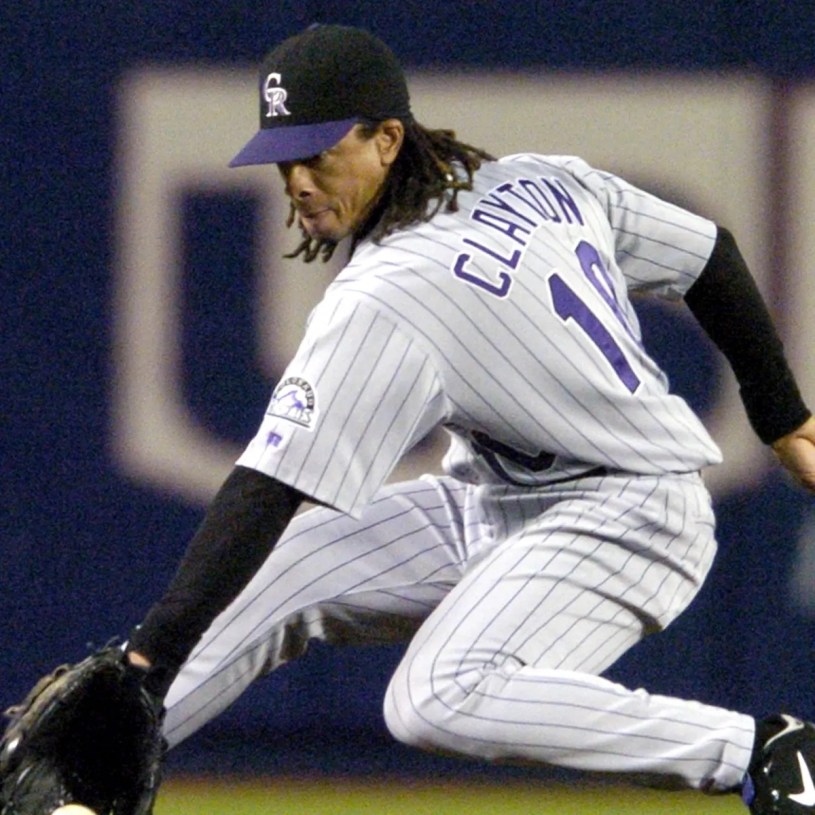
We start a new month of MLB Monday with a glance back at former major-league shortstop Royce Clayton, a guy who played with Barry Bonds, Mark McGwire, and Juan González—not to mention Iván Rodríguez. Alas, it seems clear he was a lot more honest that those guys were, despite seeing firsthand an easy ticket to riches and success. Clayton spent 17 seasons in MLB, earning just 19.5 WAR along the way, thanks to his defense, mostly, despite the fact he never won a Gold Glove.
His one All-Star designation came in 1997 when he was playing with the St. Louis Cardinals, and he was picked as a reserve by his own manager (Tony La Russa). Otherwise, his career looks pretty plain. The only time he led his peers in anything significant at the plate was in 2004, when he topped the majors with 24 sacrifice hits. Yet he topped MLB with 2.5 dWAR in 1994 and the National League in 1995 with 2.6 dWAR; neither effort earned him a Gold Glove, thanks to a lack of popularity.
But we digress: let’s start at the top. Clayton broke into the majors with the San Francisco Giants in 1991, doing nothing good in a nine-game stint (.115 batting average, minus-0.2 dWAR). However, at age 21, he held a lot of promise, and the San Francisco front office knew it. In 1992, he made it into 98 games, posting 1.0 WAR overall, although his .589 OPS was an issue, of course. Yet it was the first year of 14 straight where he posted positive defensive value, setting the trend in motion.
The Giants handed him the start SS gig in 1993 and were rewarded for it with a 2.4-WAR season on their way to a 103-victory campaign that fell just short of the postseason in the final MLB year without wild-card teams in the playoffs. Clayton hit .282 with 70 RBI, a .702 OPS, and 1.0 dWAR. He became one of the top defensive players at his position in the next few years (1994-1995), while his offense was barely above average (1.6 oWAR combined). Of course, with Bonds, he didn’t need to hit.
However, as the S.F. squad sank back into mediocrity in those two seasons, finishing a combined 15 games out of first place, the Giants began to sour on Clayton somewhat, enough to trade him to St. Louis for nothing much in return. The fact he was due a huge raise in arbitration (from $475K/year to $1.6M) probably had something to do with it. Regardless, now in his age 26 campaign in 1996 with the Cardinals, Clayton helped his new team come within one win of reaching the World Series.
He still was a glove-first shortstop, even as the position itself was being redefined by his peers to be one of offensive strength, too. After a career-high .704 OPS in 1997 at age 27, however, plus another 2.4 dWAR, the Cardinals decided to flip Clayton to the Texas Rangers after 90 games into the 1998 season. In the final 52 games of the season with his new club, his bat came alive for reasons we may never understand (.771 OPS). It is possible his new teammates had something to do with that, too.
In 1999, his first full year with the Rangers, at age 29, he put up his best offensive year (.792 OPS in 133 games), although his defense had slipped a bit to “just” a 1.3-dWAR level. He had re-signed with Texas after his 1998 stint there, getting a four-year deal worth $18M, and perhaps the Rangers front office expected more from him. This does sort of make us question whether or not he was drinking from the same clubhouse water fountains as Juan Gone and Pudge (not to mention Gabe Kapler, eh?).
Either way, by age 30 in 2000, it all fell apart for Clayton in Texas, as his OPS dipped to .685, and even his defense abandoned him, really, as he finished with 0.0 dWAR. For the money the Rangers were shelling out, they expected more than his minus-0.4 WAR for that full season. As a result, the team dumped him on the Chicago White Sox for nothing in return, and Clayton spent the next two seasons on the South Side of the Windy City, playing decently enough to accrue a total of 2.8 WAR overall.
He was 32 now, and the White Sox just released him in September 2002, unceremoniously, as his big contract was going to expire, anyway. The Milwaukee Brewers offered him a single-year deal for his age-33 season in 2003, paying him $1.5M in the process. It was a disaster, really, as Clayton posted minus-1.3 WAR overall in 145 games, hitting just .228 and once again finishing with 0.0 dWAR after his two decent years with the glove in Chicago. There really was not much left in his tank now.
However … have glove, will travel? The Colorado Rockies figured they’d take a shot on his defense, hoping the Mile High City thin air would help his bat, despite his age (34). It was low risk for the Rox, too, as they signed him for just $650K to be their starting shortstop. And Clayton’s bat did rejuvenate a little bit at high altitude, posting a .735 OPS and contributing those numerous sacrifice hits to the Colorado cause. It was one of the few seasons where his oWAR was higher than his dWAR, too.
But it was not enough for the Rockies to keep him on; once again, Clayton was unemployed after the season. At age 35 now, he crazily got a raise (to $1.35M) from the Arizona Diamondbacks in 2005 to be their starting shortstop. He predictably regressed to a 0.1-WAR campaign, and that experiment in the desert was over. What could possibly be next for him at this age? The lowly Washington Nationals, in just their second season, decided he could start for them, still, at this point in time.
They gave him a $1M deal for the single season at age 36, but after just 87 games and minus-0.4 WAR total, the Nats flipped Clayton to the Cincinnati Reds for the rest of the 2006 campaign: his total marks for the year included a .648 OPS and a minus-0.8 WAR valuation. The writing really was on the wall at this point for him, but for some reason we cannot fathom, the Toronto Blue Jays signed him—at age 37—to a $1.5M deal for the 2007 season. And it didn’t turn out badly for him, either.
In 69 games north of the border, Clayton produced 0.3 WAR total, but the Toronto organization still ended up waiving him in August. He received a temporary reprieve when the Boston Red Sox—the eventual 2007 World Series champions—picked him up, but after he went hitless in eight games for them, they too let him go, and that was a quiet end to his career. Overall, he suited up for 11 franchises in his MLB career, and he only played 13 postseason games overall (1996, 1998-1999), sadly.
Still, Clayton made over $30M playing the child’s game, which is not a bad career, of course. He should have received more recognition for his glove across his years in the majors, so that’s a bummer there. Yet his bat just never showed up enough in a time when his positional peers were now expected to produce something more than nothing at the plate. His career .679 OPS really ended up hurting him in the end, as revealed by his 78 OPS+ mark. He did steal 231 bases, however, so that was good.
Overall, he had an interesting career, and we still wonder about that brief “peak” of offensive prowess in Texas, but it was so fleeting, it fits right into a normal trajectory for player development and decline. We won’t think of that again, in terms of remembering Clayton’s career. We were lucky enough in our college years to watch him play the field for the Giants a lot, both in person at Candlestick Park and on the television. He was a favorite of ours for those reasons, and we remember him well.
[Editorial Note: Some of the motivation for this piece was due to the fact we saw Clayton’s son play this summer in an independent-minors game. Fascinating how time flies!]

