
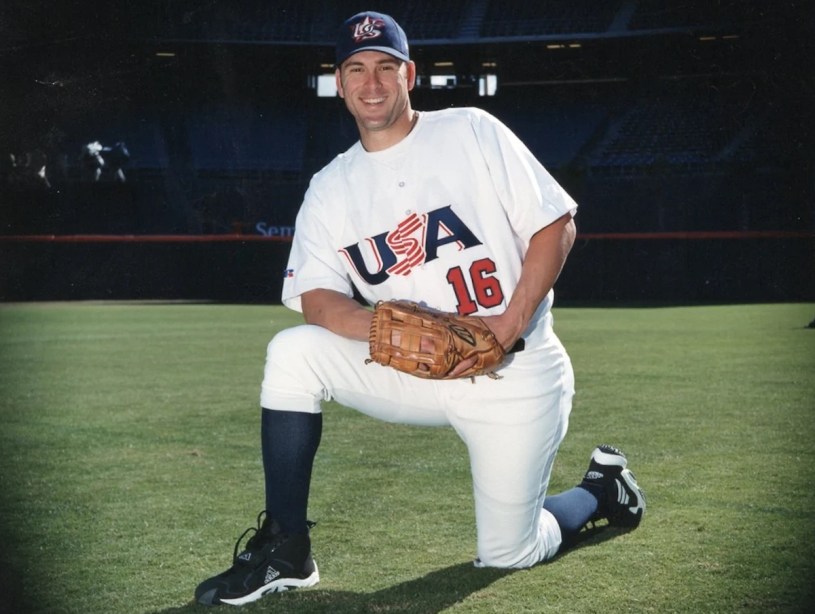
We open the September 2026 window of Friday Funday pieces with a look at longtime MLB first baseman Doug Mientkiewicz—certainly not known best for his career achievements. Forget on how to pronounce his name; how did a guy at his position last 12 seasons in the major leagues while posting just a .765 OPS (equating to 100 OPS+ mark)? Well, if you guessed “defense” … you’re only half right, really, as he merely won a single Gold Glove in his career. The mythos goes deep with this one, so let’s unpack it.
Mientkiewicz was drafted originally by the Toronto Blue Jays in the 12th round of the 1992 Draft, but he chose to attend Florida State instead. Three years later, the Minnesota Twins picked him in the fifth round, and he made his brief MLB debut in 1998 at age 24 for just unremarkable eight games total. The following season, he made it into a respectable 118 games, but he underwhelmed—which is a nice way of putting it—at the plate with just a .655 OPS mark at a position that demands a lot more.
As a result, he spent the vast majority of the 2000 season, at age 26, in Salt Lake City, playing for the organization’s Triple-A club; he saw only three games of action with the big-league squad, and those were the final three contests of the season. However, Mientkiewicz had thrived on the U.S. Olympic team in Sydney, Australia, and that changed his career trajectory. He hit .414 in nine games as the Americans won the gold medal, and he then played in a career-high 151 games for the 2001 Minnesota team.
With negative-2.0 WAR to his name before that season, he quickly established himself at age 27 in the starting role he’d bungled in 1999, posting 2.8 WAR this time around to get his career into the positive-value column. With 15 home runs, a .306 batting average, and an .851 OPS, it seemed Mientkiewicz had figured out MLB pitching, finally. Now in his prime years, perhaps this was the start of something new as the Twins roster overall improved the team made a run in the 2002 American League playoffs.
He had won his singular Gold Glove in 2001 despite a minus-0.8 dWAR valuation, and he regressed a lot in that 2002 regular season, all across the board, resulting in just a 1.4 WAR mark. The good news is that Mientkiewicz rebounded in 2003 to have his best-ever MLB campaign: 4.3 WAR, 0.6 dWAR, and an .843 OPS. The Twins returned to the playoffs before losing in the first round to the New York Yankees, so it all felt like a letdown after the club had reached the AL Championship Series the year prior.
And even though Minnesota won its third-consecutive AL Central Division title in 2004, Mientkiewicz would not be with the team by October. He had a rough start to the campaign at age 30, hitting just .246 through 78 games before the Twins decided enough was enough with his inconsistency at the plate: he was shipped to the Boston Red Sox in a blockbuster, four-team trade that also included Nomar Garciaparra and Orlando Cabrera, famously. And we all know how 2004 ended for the Red Sox, don’t we?
Without that trade, we probably wouldn’t even be writing this piece, in truth.
Mientkiewicz played above average defense for Boston (0.2 dWAR in 49 games, and his glove, in theory, helped the Red Sox win the World Series. In fact, he was in at first base for the final out for World Series, taking the throw on a groundout to clinch the team’s first MLB championship since 1918. He kept the ball, and there was some drama about that, in terms of historical significance and potential financial advantage, individually. That didn’t sit too well with those in Red Sox Nation, and it was news.
And not the good kind. With Mientkiewicz heading into his final year before free agency, the Boston organization now had little use for a light-hitting, decent-glove first baseman, so it traded him to the New York Mets in a salary dump (saving $3.75M and some public-relations headaches in the process). Even though Mientkiewicz’s days as a starting first baseman were over, he still managed to stay in the majors through the 2009 season—somehow, thanks to the mythos of being a good defensive replacement.
But the data doesn’t support that: overall, for his career, he finished with minus-0.7 dWAR, and even at first base, someone needs to be a little better than that to be considered a “good” defender. Admittedly, Mientkiewicz improved a lot after his first five MLB seasons (1998-2002: minus-2.4 dWAR), and his 2005-2007 efforts were collectively pretty good (1.9 dWAR). He was a vagabond for the last five seasons in the majors, too, playing for a new team each of those seasons while watching his playing time vary:
- 2005: 87 games with the Mets, 1.1 WAR, .729 OPS
- 2006: 91 games with the Kansas City Royals, 2.2 WAR, .770 OPS
- 2007: 72 games with the Yankees, 1.4 WAR, .789 OPS
- 2008: 125 games with the Pittsburgh Pirates, 1.2 WAR, .753 OPS
- 2009: 20 games with the Los Angeles Dodgers, 0.0 WAR, .789 OPS
At that point, he was done after his age-35 season, and the interest was minimal. The Dodgers actually re-signed him for 2010, but they waived him before the season started. Then the Florida Marlins signed him before changing their minds nine days later, and he was gone. Mientkiewicz made at least $13M in his career through base salaries, and he only hit .235 in 29 playoff games across four Octobers with the Twins, the Red Sox, and the Yankees. His career WAR mark (11.8) rates out to less than 1.0 per MLB year.
With a total of just 66 HRs, too, he wasn’t anyone’s idea of a “classic” first baseman. However, his seasonal notation—counting statistics per 162 games played—looks much better than the whole: 10 HRs, 60 RBI, etc. Yet he only played more than 100 games in a season six times across a 12-year career. His peak years, 2001-2003, produced 8.5 WAR, and obviously, there was not much else going in his profile, otherwise. But Mientkiewicz has the World Series title to hang his hat on, always, and that means a lot.
[Not to mention the 2000 Olympic gold.]
It’s also odd that the only MLB organization that he spent more than one season with from 1998-2009 was his first one. Every other stop along the way was a season or less, and he played for seven organizations in total. Mientkiewicz certainly had an interesting journey, and it’s one that can defy logic on many levels. His defensive reputation with Boston in the 2004 championship run held true through 2007, but otherwise, he wasn’t a very good glove man. But he was in the right place at the right time … once.

