
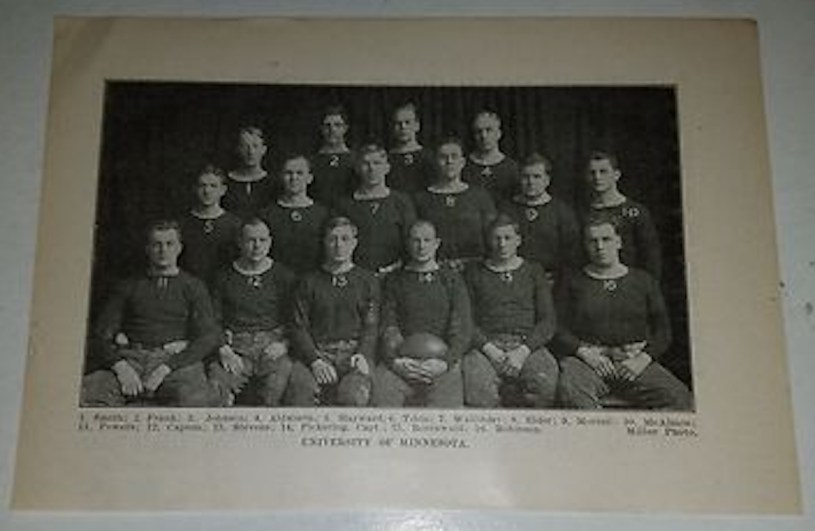
The long-running MNC Wednesday miniseries continues toward its inevitable end today with another look at a distant mythical national championship. And once again, we have a split decision from the experts, giving us a fun job to do in the process. Since the 1928 season (counting backward), there only have been four instances where we saw it the same way as the others did/have. There’s a chance, of course, it could happen today, but the odds are against it. We just have more data now.
The 1911 MNC: Princeton (Helms, NCF-tie) & Penn State (NCF-tie); Minnesota (DMP)
The Princeton Tigers (8-0-2, No. 17 SRS, No. 55 SOS) and the Penn State Nittany Lions (8-0-1, No. 13 SRS, No. 53 SOS) were the alleged dynamic duo for the campaign, but—and stop us if you’ve heard this one before—with only 71 major-college teams competing in 1911, neither school’s schedule rating is even close to being acceptable enough for the MNC crown here. Hence, they both have low overall sabermetric rankings, and that leaves the field of teams under consideration wide open:
- Minnesota (6-0-1): No. 1 SRS, No. 3 SOS
- Texas A&M (6-1): No. 2 SRS, No. 11 SOS
- Vanderbilt (8-1): No. 3 SRS, No. 44 SOS
- Wisconsin (5-1-1): No. 4 SRS, No. 12 SOS
- Georgia (7-1-1): No. 6 SRS, No. 6 SOS
- Carlisle (11-1): No. 7 SRS, No. 45 SOS
- Chicago (6-1): No. 10 SRS, No. 2 SOS
The Commodores and the Indians do not have the schedule strength to endure this comparison, but we wanted to tip our hats to them nonetheless. Vanderbilt played five small schools and lost its only road game by one point (to No. 22 Michigan). Meanwhile, Carlisle played five small schools, and even though the team played its final eight games on the road (!), it lost one of those, by one point, to No. 56 Syracuse. That’s a bad loss, even if the roster was tired from travel and so many games.
We have three teams from the Western Conference here, the precursor to the B1G: Minnesota, Wisconsin, and Chicago. The Golden Gophers tied the Badgers and beat the Maroons, while Wisconsin lost to Chicago. Got all that? Combined with the fact the Maroons lost to Minnesota by a 30-point margin, it’s clear both on paper and in the math that the Golden Gophers were the best team of the bunch. The tie between Minnesota and Wisconsin occurred in Madison, so this is a closed discussion.
That sabermetric profile atop the SRS is also going to be hard to beat, even if the Golden Gophers only hold a 0.80-point advantage on the Aggies. Speaking of TAMU, they played two small schools and lost a neutral-site game to No. 15 Texas—getting shut out in the process. The Aggies’ SOS is not enough to overcome that loss, leaving us with just Georgia left to evaluate: the Bulldogs lost on the road to Vanderbilt by 17 points, which isn’t a great loss. But there is also that tie result.
At home against No. 8 Auburn in the final game of the season, on November 29, the Bulldogs played to a scoreless tie. With all things on the line there, so to speak, it’s not a bad tie, but Georgua needed to make a statement there, and it did not. Despite the excellent profile, the SOS still doesn’t do enough to erase that loss, and thus, by our established process and standards, we will crown Minnesota as the de facto national champion for this long-distant season. We feel pretty confident in this one.
This is the fourth crown for the Golden Gophers, but the “first” one we have awarded them since the 1934 season. For the record, Minnesota played just one small school, while also playing three road games. The champs scored just 102 total points in this era of football, but they also allowed a mere 15 points combined—while tossing three shutouts against major-college opponents, including the Chicago Maroons. That game may have ended up deciding the MNC, in fact. Congrats, Minnesota!
[Editor’s Note: It’s hard to find good images from more than a century ago—obviously. Forgive us.]

