
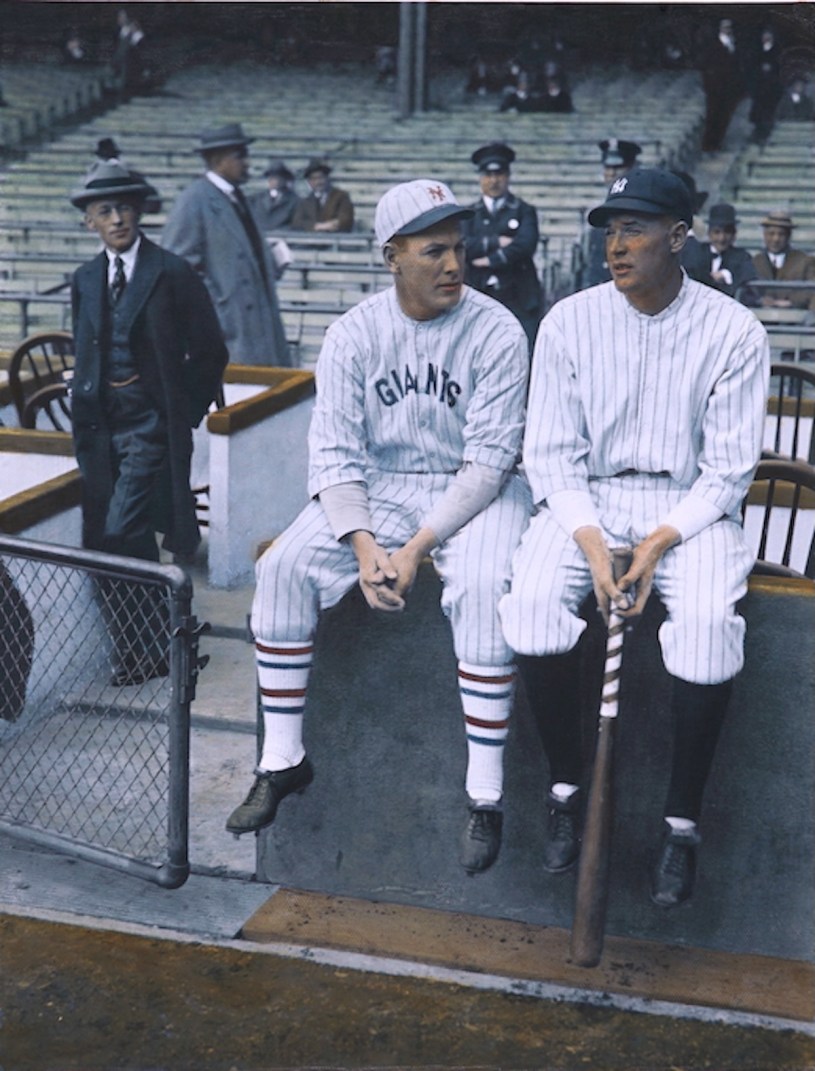
Last summer, we did a piece on longtime New York Yankees outfielder Bob Meusel, and today on Friday Funday, we’re going to look at the career of his brother, Emil—better known as Irish Meusel. Three years older than his little brother playing in the Bronx, he played the bulk of his career for the crosstown New York Giants, setting up an interesting rivalry for two brothers born in the San Francisco Bay Area. Emil was born in Oakland (1893), and his brother was born in San Jose (1896). We love our locals.
The elder Meusel broke into the majors with the Washington National (now the Minnesota Twins) in 1914, but he only played in one game before he was traded to the minor-league Minnesota team in the American Association before the 1915 campaign. This was a bit ironic, since the Los Angeles team in the minor-league Pacific Coast League had traded him to Washington before the 1914 season. Either way, Meusel didn’t return to the majors until 1918 with the Philadelphia Phillies, who acquired him from L.A.
However, his return to MLB was permanent this time as he was the Phillies regular starting left fielder in 1918, hitting .279 with a .706 OPS in 124 games for the team. This generated 2.2 WAR for Philadelphia, so Meusel’s value was clear. Over the next 2.5 seasons, he posted a combined 6.7 WAR for the team, even though the Phils were terrible, finishing sixth in 1918 and dead last each year from 1919-1921. Fortunately for Meusel, he was traded midway through the 1921 season to the first-place Giants.
After hitting a collective .318 for Philadelphia from 1919-1921, he proceeded to contribute a .329 average in 62 games for New York down the stretch. At age 28 now, Meusel was clearly in his prime, and this showed during the 1921 Fall Classic, where he was the hitting star for the Giants in their eight-game victory over the Yankees—the team his younger brother Bob had joined in 1920. This really was the peak of the elder Meusel’s career, and it’s not a bad one at all. He was now a “world champion” after all.
His combined 3.5 WAR in 1921 for the Phillies and the Giants represents the best year of his career, where he totaled 21.9 WAR overall. And from 1922-1926, he was the regular left fielder for New York as well: he contributed 12.0 WAR in those five seasons to the Giants’ cause, which included another World Series win in 1922 and National League pennants in 1923 and 1924. Collectively in four World Series, he hit .276 across 92 ABs in 23 games (.767 OPS) while posting three home runs and 17 RBI.
However, by the end of the 1926 season, at age 33, Meusel was slowing down, as he posted just 0.9 WAR during that season, despite hitting .292 still. The Giants released him, and he signed with the Brooklyn Robins for the 1927 season. Alas, after hitting just .243 in 42 games, he was released, never to play in the major leagues again. Overall, he hit .310 for his MLB career, led the NL in RBI once (1923), and put up an .813 OPS along with a 119 OPS+ mark. Irish Meusel was a very good hitter, as data shows.
In 765 regular-season games with the Giants, he hit .313, and in 481 games with the Phillies, he hit .308, too. For his career (1,289 games), he struck out just 199 times, while walking 269 times—the very definition of a contact hitter. In an era of just-blossoming HR hitters, he posted double-digit homer efforts in five of his nine full seasons. He also drove in 100+ runners every season from 1922 to 1925, playing on some pretty good teams. He fit right in with them after escaping the lowly Philadelphia franchise, too.
He is not in the Hall of Fame, obviously, and he was a below-average fielder if dWAR data from the era is to be trusted. Together, the Meusel brothers won five World Series, making for some fun family conversations, we suspect. Like his brother, he eventually returned to Southern California; despite both being born in the S.F. area of Northern California, they both went to high school in Los Angeles and spent their post-career lives there. It’s not often brothers are such comparably good players, but they fit the bill.
Irish’s career is slightly “less than” that of his kid sibling, and the only year he earned NL MVP votes was in 1925, when he finished 22nd in the balloting based on 3.3 WAR, a .328 batting average, 21 HRs, and 111 RBI for a team that finished second in the NL pennant race. His six-season peak (1920-1925) produced 2.9 WAR per season, which isn’t great … but it’s solidly good for a guy who was never a star despite playing a key role on multiple pennant-winning squads. We should all be so lucky in our careers.
[Oh, and the nickname? Well, the brothers were French and German in their heritage, but Emil looked Irish with his complexion and red hair. We all know how that goes, right?]
 Daily McPlay: (mostly) Historical Sports Analysis with TENACITY & VERVE