
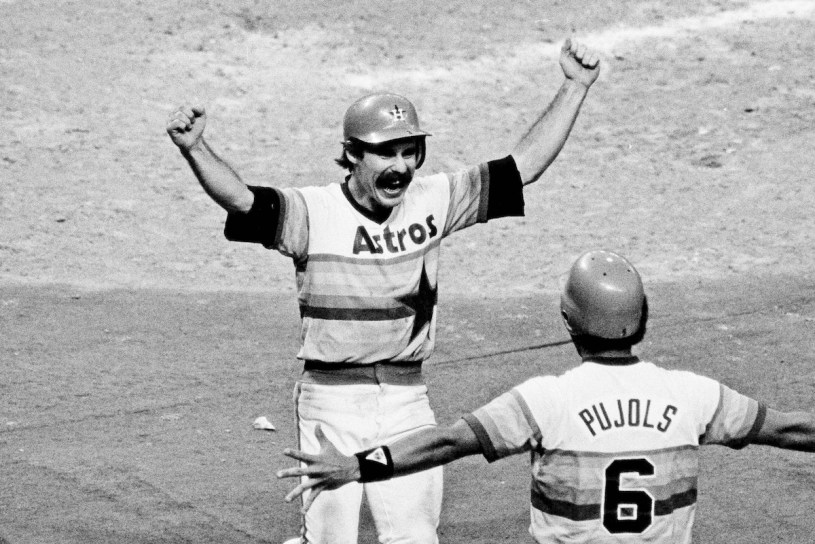
We would be remiss in our duties if we didn’t use this MLB Monday space to assess the playing career of Phil Garner, who passed on April 11. He is local flavor, as he started his big-league career with the Oakland Athletics in 1973 and ended it with the San Francisco Giants in 1988. In between, he spent five years with the Pittsburgh Pirates and seven seasons with the Houston Astros, on his way to building a solid career which led to a second MLB life as a manager later on with three different ball clubs.
Garner even stole 35 bases for the ’76 A’s, earning his first All-Star nod that season for one of the strangest teams ever put together. He also made the National League All-Star team twice with the Pirates, making him a unique player to play for both leagues in the Midsummer Classic. No, his 29.7 career WAR mark is not going to get him into Cooperstown posthumously, nor are his 985 wins as a manager (including the 2005 NL pennant with the Astros). We also noted earlier that he certainly deserved a Gold Glove, too.
Overall, he was a classic overachiever in many ways, playing a combined 39 games for the 1973 and 1974 A’s without being on the playoff roster for either World Series championship team. Finally, at age 26 in 1975, he got his big break with Oakland as the roster changed dramatically after the 1972-1974 three-peat effort by the Swingin’ A’s. He played in an AL-best 160 games that year, starting at second base in place of the retired Dick Green—and logging 1.9 WAR overall as a rookie, including 1.3 dWAR.
Yet after his All-Star season in ’76, the A’s continued to strip their roster, and the Oakland management traded him to Pittsburgh in March 1977 as part of a package deal that brought Rick Langford, Mitchell Page, and Tony Armas to the Athletics (among others). With the Pirates, Garner served as a utility infielder, playing second, short, and third throughout the 1977, 1978, and 1979 seasons before finally becoming the starting second baseman in Pittsburgh at age 31 in 1980. But he was an outstanding UTL guy.
In those three seasons as a catch-all fielder, Garner produced a combined 10.1 WAR while playing over 150 games each season despite not being a regular starter at any one position. Of course, the Pirates famously won the 1979 World Series, getting Garner the ring he probably had been chasing since his early days in Oakland. In fact, after going hitless in the 1975 AL Championship Series with the A’s, he thrived in the 1979 postseason, hitting .472 in 10 playoff games for Pittsburgh, with a 1.259 OPS to boot.
That was his age-30 season, but Garner still had so much to offer on the diamond. After another All-Star campaign in 1980 once he became entrenched as the Pirates starting second baseman (and put up another 3.8 WAR in the process), Pittsburgh decided to trade Garner to the Astros in August 1981, even though he’d made the NL All-Star squad that summer. The big return piece in that trade was (eventual) longtime Pirates second baseman Johnny Ray, although Garner would have just as long a stay in Houston.
During his Astros stint, Garner was the regular starter at second (1982) and third (1983, 1985). He helped the team get to the postseason twice as well (1981, 1986), the latter time coming during his age-37 campaign when he posted a 107 OPS+ mark. However, by 1987, the age thing really caught up to him, as he put up his worst batting average ever (by 32 points), resulting in the Astros trading him to the Los Angeles Dodgers in June 1987 for no one needing mention. His performance in L.A. was worse.
For what would be his final season, Garner signed a $375K, one-year deal with the ’88 Giants, who were coming off a rare playoff appearance in 1987. His decline continued and contributed to his demise after playing just 15 games for San Francisco, and that was the end of his playing career. A career .260 BA to go with his lifetime 99 OPS+ mark demonstrates where his value truly resided: his solid ability to get on base (.323 OBP), while playing three infield positions and defending well (7.0 dWAR overall).
He also stole a respectable 225 bases in his career, with the bulk of them (200) coming before he reached age 35. From 1976-1983, Garner averaged 24.4 steals per season, which was an added bonus on top of the skills we denoted above. The full picture comes into play here, as anyone can see the little things he did to contribute to his teams’ successes, particularly across that eight-season span we can consider his prime years. Again, the “overachiever” label comes to mind, along with the concepts of scrappiness, too.
Hence, Garner’s nickname: Scrap Iron. It really is self explanatory, as in those eight seasons, he played in at least 128 games in every full season from 1975 to 1985 (excepting the strike year of 1981), despite not always being a full-time starter. But he earned the respect of his teammates by answering the call whenever it came. Those intangible qualities made him a solid manager, too, even though he finished well under .500 for his career in the dugout. He never won a division title as a skipper, but he won enough.
Managing in Milwaukee (1992-1999) and Detroit (2000-2002) didn’t bless him with great rosters, but his time in Houston (2004-2007) was much more successful. Those first two years as the Astros manager produced a 137-99 regular-season record, two straight appearances in the NLCS, and the first-ever World Series for the franchise. That alone should make him a beloved figure in Houston, not to mention his playing time there, too. No coincidence, he passed away in that city when the bell tolled for him.
Garner barely made $5M in his entire playing career, and we know his abilities delineated above would gift him at least that much per season these days if he was a current-day player. Alas, it’s not always about money, is it? We hope not. We tip our caps to ol’ Scrap Iron today, and we remember him with a smile on our faces. We were in third grade when the Pirates pulled off their upset World Series win over the Baltimore Orioles in October 1979, and we never forgot him from that point on—even to this day now.

