
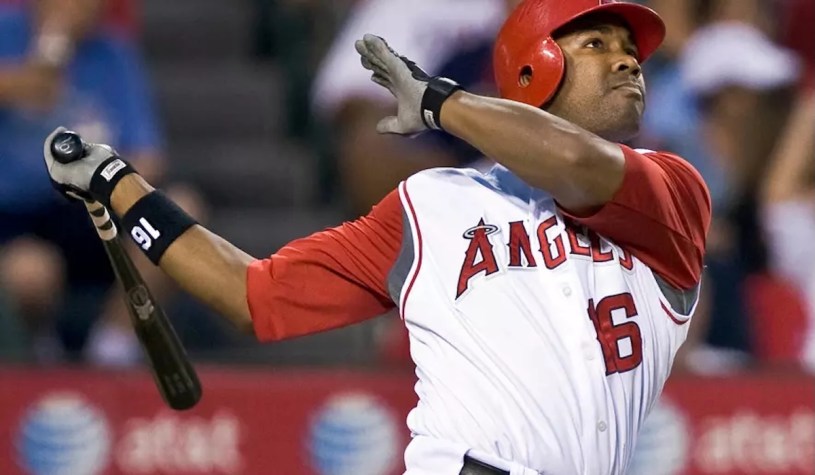
It’s been a day already, and our usual Friday Funday has been pre-empted by the news that longtime MLB outfielder Garret Anderson passed away yesterday at age 53. A three-time All Star, he also won the Home Run Derby once in addition to being the MVP of an All-Star Game and winning the World Series with the Anaheim Angels in 2002. Overall, Anderson spent 17 seasons in the majors, and 15 of those campaigns came with the Angels franchise. A lifetime .293 hitter, he seemingly always was smiling.
Thus, today we will look back at his career like we do with many players to celebrate his impact upon the sport. Anderson broke into MLB during the doomed 1994 season, playing five games with the then-California Angels. The following year, his age-23 season, he finished second in the AL ROTY vote as the Angels finished second in the American League West Division, losing out to the Seattle Mariners in a famous pennant race we don’t need to recap here (others have done that already, to be sure … read on).
His 3.0 WAR mark for a contending team was impressive, as Anderson hit .321 with an .857 OPS to make an emphatic mark on his franchise, for which he would play 14 full seasons with from 1995-2008. Overall, with the Angels, he hit .296 with 272 home runs and a .796 OPS. During the 2002-2005 years, he made the All-Star team three times, peaking sabermetrically with 5.1 WAR during the improbable team’s run to the 2002 World Series title. He didn’t walk a lot; he didn’t have much speed. He just hit well.
Twice he topped the AL in doubles, too (2002-2003), and he added 522 doubles to his lifetime slate, contributing to his career .461 SLG mark. But with just 429 walks, compared to 1,224 strikeouts, his plate discipline was focused clearly on contact and putting the ball in play. He stole just 80 bases in his career, and his defense could best be described as mildly subpar (minus-3.9 dWAR for his career). However, from 1994-2002, in his “youth”? He was a much better gloveman (plus-2.6 dWAR in those years combined).
His career OPS+ mark (102) doesn’t scream Cooperstown, nor does his career 25.7 WAR total. Yet Anderson was a team leader on many winning teams, including those 1995 and 2002 squads. Five times total, he was a part of Angels playoff teams, and in those five Octobers, he hit a collective .245 across 147 ABs in 36 games with a .661 OPS. Yet he was never better than in that 2002 postseason, though, as he hit an even .300 in 16 games with two HRs and 13 RBI as the franchise won its only World Series title.
Only once again did the Angels reached the AL Championship Series with Anderson, and that was in 2005 when they ran into the Chicago White Sox, a team of destiny perhaps. His final four seasons with Anaheim (2005-2008) were unspectacular, in terms of his 2.3 WAR combined in those years, so the team chose not to re-sign him. He signed with the Atlanta Braves at age 37 and survived at the plate (.705 OPS) although not in the field (minus-1.7 dWAR). They decided to not to bring him back after 2009.
His final season (2010) was spent back in Southern California, albeit with the Dodgers, but age catches up with everyone. He played in only 80 games before being released in August, never playing in the majors again. That last campaign is something to forget (.181 BA, .475 OPS), so we will move on from it. His statistical and sabermetric profiles show an above-average player who seemed to have a bigger impact on team success than the measurements would suggest. Let’s look at that WAR data, for example.
Only four times did he reach the 3.0 WAR threshold in an individual season, which doesn’t seem like a lot. But from 1999-2003, ages 27-31, Anderson was a Top 5 player, value-wise, on his team’s roster, and that’s kind of what you want from a player in his prime. The Angels franchise paid him well over $70M during his tenure with the club, and you could say it was a good investment considering the prime years above—which included that MLB championship. He wasn’t a superstar, even though he looked like it.
And we don’t that mean that in an arrogant way, describing him in those terms. He carried himself well, really, and he contributed in whatever ways he could to the team’s successes. Oddly, he made the most money—$44.4M—in those final four years with Anaheim, almost as if the team was rewarded him for past successes even though he was past his prime. That’s what the team’s front office thought of him, right or wrong. His last year with the Angels was 2008, and the team has faltered hard since that year.
With only two postseason appearances (2009, 2014) since Anderson left the team, it’s clear he was more than just statistics. He was the heart and soul of the most successful stretch of seasons in franchise history (2002-2008), with five playoff appearances in those seven seasons. The Angels fans will miss him, and even though our local teams certainly hold no love for that franchise here in the Bay Area, we as baseball fans can admire and respect Anderson’s career as a worthy adversary. May he rest in peace … godspeed.

