
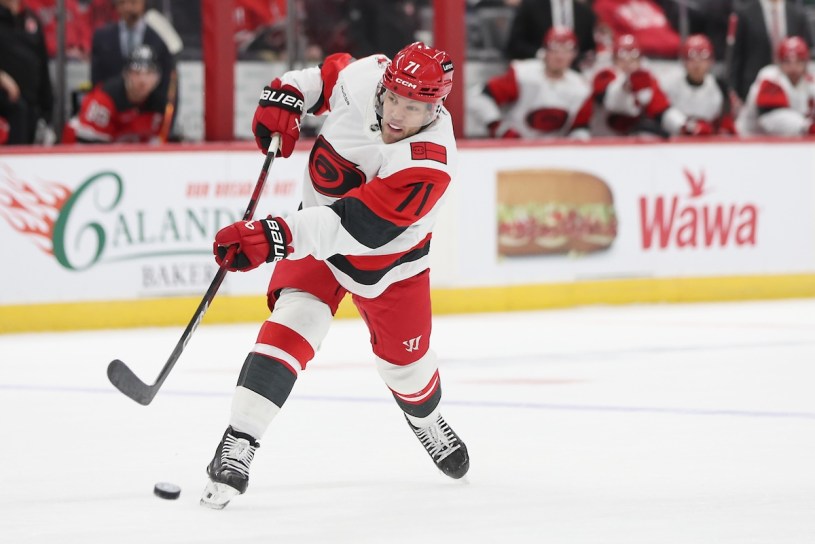
Our original NHL Saturday miniseries returns for its annual appearance, now that the Stanley Cup has been won by the Carolina Hurricanes. Last year, we dawdled into August before doing this, but with the completion of the NHL Draft today, we decided to do this now and get it out of the way—not that we feel this way about the miniseries. This is one of our OG miniseries, of course, dating back a long time. We’re always thrilled to do a seasonal awards analysis, in truth. It brings us joy, which is what we want!
2026 Hart: Nikita Kucherov, RW, Tampa Bay (original); Connor McDavid, C, Edmonton (revised)
The Tampa Bay Lightning had a great regular season, and star right winger Nikita Kucherov (15.7 Point Shares) won the Hart vote. At age 32, this was his second Hart vote win, the first coming in 2019, which we confirmed. His PS total was third in the league overall, so the other contenders here we want to consider are Colorado Avalanche center Nathan MacKinnon (16.4) and Edmonton Oilers center Connor McDavid (15.9). These three forwards separated themselves from the pack by 2.5 PS overall.
And really, there is no debate here: the Avs finished with 121 points, the Lightning posted 106 points, and the Oilers managed just 93 points in the standings. It’s clear which player brought the most value to their respective team, although we’d definitely place Kucherov second in this process. He won this award from us in 2024, too, but this time we have to give it to McDavid. The Edmonton roster, while somewhat loaded, seems to often underperform, yet McDavid is dominant year after year no matter what.
McDavid previously won Hart votes in 2017, 2021, and 2023, although we only confirmed the last one. Thus, as usual, we see that these processes even themselves out in the end. This is his second Hart in our miniseries analyses, and we expect he will win a few more since this was only his age-29 season. He topped the NHL in assists (90) and points (138), demonstrating the Oilers would have missed the postseason without him. Even if Edmonton came up short, again, in its quest for the Cup, don’t blame McDavid.
2026 Norris: Zach Werenski, Columbus (original); Evan Bouchard, Edmonton (revised)
Four defensemen finished in the NHL Top 10 for sabermetric PS impact, and so we have to consider all of them: Edmonton’s Evan Bouchard (15.2); Colorado’s Cale Makar (12.8); Montréal Canadiens youngster Lane Hutson (12.8); and Columbus Blue Jackets star Zach Werenski (12.1). The latter won the vote, so where do we stand on this? Well, we gave this nod to Bouchard in 2024, and Makar won the vote last year (which we confirmed). Those data points have no bearing whatsoever on this process now.
Bouchard’s sabermetric value was the highest by far, and we know how “weak” Edmonton was overall in the standings. Makar won’t be overtaking him in this analysis, and Les Habs also finished with 106 points, so Hutson will have to wait for his first Norris nod from us. As for Werenski? The Blue Jackets posted 92 points and missed the playoffs by six points in the standings, so that pretty much does mean we’re giving this nod, again, to Bouchard, as he is the Oilers’ defensive version of McDavid, really.
2026 Vezina: Andrei Vasilevskiy, Tampa Bay (original); Jeremy Swayman, Boston (revised)
Seven different goaltenders finished between 11.1 and 12.8 PS this season, and one those—Andrei Vasilevskiy—won the vote based on his 11.8 PS. Yet clearly, we have to consider all seven of these guys … or at least the ones who backstopped their teams into the postseason. That whittles it down to only the following: Boston Bruins veteran Jeremy Swayman (11.9) and Vasilevskiy. They’re basically even in sabermetric value, but Tampa Bay finished six points ahead of Boston in the Atlantic Division standings.
Thus, we take a Vezina vote win away from Vasilevskiy again, just as we did in 2019. One year after giving up the most goals in the NHL, Swayman pulled a complete reversal to help the Bruins return to playoffs as he finished third in the vote. That’s good enough for us, and this is his first Vezina nod from us, of course. Who knows if he has another in his glove? It doesn’t matter.
2026 Calder: Matthew Schaefer, D, New York Islanders (original, confirmed)
We discussed Calder vote winner Matthew Schaefer earlier this year in a San Jose Sharks piece after the New York Islanders came to Silicon Valley. Schaefer was one of the best defensemen in the league as a rookie, and he topped all first years with 12.0 PS, which is really incredible. But … his team missed the postseason. Thus, the challenge is whether or not any playoff-bound rookie is deserving this, in spite of Schaefer’s dominant performance. And in reality, there are two rookies who may qualify.
Both Minnesota Wild goalie Jesper Wallstedt (8.5 PS) and Canadiens netminder Jakub Dobes (8.3) could be considered here. The former won 18 games for a 104-point team, while the latter went 29-10-4 for a 106-point team. Generally, we’d say Doubs was more impressive, considering the comparable quality of both goalies’ teams. Yet they’re so close in sabermetric value, it is tough to decide between them when it comes down to it, and with Schaefer posting 3.5 more PS for a “bad” team, well … yeah.
We’re going to confirm the vote here, although we do tip our sticks to the two other guys in the conversation, for sure.
2026 Conn Smythe: Jordan Staal, C, Carolina (original); Taylor Hall, LW, Carolina (revised)
The Hurricanes won their second Cup overall (the first came in 2006) by beating the surprising Vegas Golden Knights in a six-game Stanley Cup Final. After the first three games of the Finals were decided by one goal each, the Carolina squad said, “Enough!” and won the last three contests by multiple-goal margins each time. Even though veteran center Jordan Staal (12 points) won the vote here, he finished tied for fifth in scoring on his own team that went 16-3 in the playoffs. We’re not sold.
In truth, Carolina goalie Frederik Andersen should have been shoo-in winner here, with his 13-2 record in the playoffs, to go along with a 1.89 GAA and a NHL-high three shutouts in the postseason. But after he was pulled in Game 3 of the Finals, giving up four bad goals, his backup won the last three games of the championship round, tarnishing his achievements hitherto. On the skater side, we like right wing Jackson Blake and left wing Taylor Hall, with us leaning toward Hall for his two-way play here.
Blake had 20 points in 19 games, while Hall had 19 points in 19 games—while also topping all NHL skaters with a plus-14 rating. Either way, both these guys had two game winners in the playoffs, while Staal had just one; weird. Overall, we have three better candidates for this trophy than the vote winner, context or not. It comes down to Andersen and Hall for us: the Hurricanes don’t win without either one of them, and in truth, they don’t even reach the Cup Finals without Anderson’s stellar play for two months.
The fact he got pulled and benched doesn’t cancel out a 13-2 record prior to that. Yet his play was inconsistent, as there were five postseason starts where he saved less than 85 percent of the shots on goal from the opponents. The GAA doesn’t reflect that, and the shutouts seem to contradict it. Thus, Andersen was statistically hit or miss in the postseason, and Hall was the steadiest hand on the skating side of the ledger for the Hurricans. He won the 2018 Hart, which we took away, so again, all things even out here, eh?

