
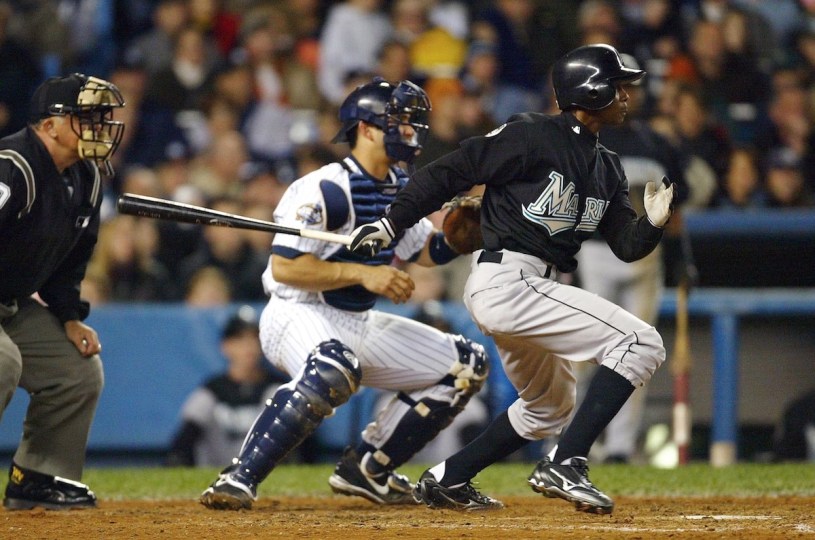
We’re back for another Friday Funday, and we really do need this one today. So, to entertain ourselves—and hopefully, others—it’s time to take a look at former MLB outfielder Juan Pierre … not exactly a household name. However, over a 14-season career in the majors, spanning from 2000-2013, he stole 614 bases, a figure that remains still in the Top 20 all time. Pierre topped the National League once in steals (2001) while also leading MLB overall in two other campaigns (2003, 2010). He was pretty solid.
What’s interesting is that each of those seasons above came with different teams: the Colorado Rockies (2000-2002), the Florida/Miami Marlins (2003-2005, 2013), and the Chicago White Sox (2010-2011). Pierre also toiled for the Chicago Cubs (2006), the Los Angeles Dodgers (2007-2009), and the Philadelphia Phillies (2012). Why did he play for six teams while hitting .295 overall in his career? Well, that’s a complicated question, but in essence, he had no power, and he was average on defense.
He also got caught stealing a lot (203 times total, “leading” his league in seven different years there). Still, he brought a lot to the table: a good contact hitter, he didn’t strike out a lot, and Pierre posted the most sacrifice hits in his league four different seasons, too. Once, he even was the “best” at getting hit by pitches also. So, he was often on base, and for every 162 games played, Pierre scored 87 runs, which is not outstanding, but it’s a pretty solid number for a guy who wasn’t driving himself in with home runs.
Pierre was drafted three times—1995 (Seattle, 30th round); 1996 (Seattle, 48th); and 1998 (Colorado, 13th)—before making it to the majors in 2000 for 51 games with the Rockies. He hit .310, posted a .673 OPS, and somehow got enough NL ROTY votes to finish sixth despite playing for a fourth-place team. The 0.3 WAR mark doesn’t suggest that was warranted, especially since none of his other numbers stood out (zero HRs, 20 RBI, 7 SBs, 6 CS, etc.). The OPS+ mark (58) was downright atrocious, actually.
But he did enough in those 51 games to get handed the Opening Day centerfield position for the Rox, and he would be a regular starter in center for seven straight seasons (2001-2007) with four different teams. Despite hitting .308 in Colorado for his three campaigns there, the Rockies front office traded him to the Marlins in salary dump with starting pitcher Mike Hampton. This was good fortune for Pierre, as Florida won the World Series randomly enough in his first season with the team. He was instrumental.
Leading the majors with 65 steals, he also hit .305 with a respectable .734 OPS, earning a 10th-place finish in the MVP balloting on the back of 3.5 WAR and an NL-best 15 sacrifices. With 1.2 dWAR as well, it was his best-ever season with the glove, too. Overall, though, Pierre was even better in 2004: 3.9 total WAR, an NL-high 221 hits and 12 triples, a .326 average, and a .781 OPS. Once again, he earned MVP votes, finishing 16th at the ballot box. At age 26, though, Pierre had peaked early in his career.
He managed just 0.4 WAR in 2005, and the Marlins tired of him: in the final year of his contract, Florida traded him to the Cubs for spare change, as his annual salary had jumped to almost $6M at that point, and we all know how those Marlins didn’t like big salaries. In Chicago, his WAR mark jumped back up to 2.0 overall, as he led the NL in hits again (204). Pierre hit a career-best three HRs in 2006, but his 82 OPS+ mark was not what the Cubs were looking for, and he became a free agent after the season.
Enter the Dodgers: for whatever reasons, L.A. signed him to a five-year, $41M contract, getting little back on that investment from 2007-2009. Pierre hit .294 with the team, but that batting average came with a mere .696 OPS and only 2.1 combined WAR in 426 games across the three seasons of that generous deal. He lost his starting CF gig after the first year, shifting to left field as a reserve for the latter two campaigns. The Dodgers made the postseason in 2008 and 2009, but he got only six official ABs in two Octobers.
Los Angeles had their fill of Pierre, and it was able to dump his remaining salary on the White Sox after the 2009 campaign, getting next to nothing in return. Sound familiar? He posted a .657 OPS during his first season in the American League, stealing 68 bases to lead the majors—while also getting caught an MLB-worst 18 times. His two years on the South Side produced negative value (minus-0.6 WAR) as the starting left fielder in U.S. Cellular Field, despite a lot of HBPs and sacrifices at ages 32-33. Ouch!
And that was the end of his big contract and major paydays in MLB. The Phillies offered him $800K for the 2012 season, and Pierre jumped at the offer to keep coming to the ballpark and getting paid something to do it. He also was able to rejuvenate his career a wee bit with the switch back to the NL: at age 34, he hit .307, stole 37 bases while only getting caught seven times, and posted 2.0 WAR for a Philadelphia club that finished at .500 in the NL East Division. Yet, the team still did not want to keep him.
For the next season, reunited with the Marlins, Pierre signed a $1.6M deal and gave Miami a .589 OPS with minus-0.1 WAR in 113 games. His .247 batting average at age 35 was by far a career-worst effort, although his base stealing was still decent enough (23 SBs in 29 attempts). He clearly had lost a few steps, however, and when the season ended, he had no takers for 2014 playing time. Pierre officially retired in February 2015 with 17.3 combined WAR for his career overall. He never made an All-Star team.
Would he have finished with a .300 batting average if not for that final season in Miami? The math says no. His career average still would have fallen short if he had hung them up a year beforehand, yet of his 14 seasons in the big leagues, Pierre hit over .300 in six different campaigns. His defense with the White Sox was really bad and lowered his overall WAR mark below the 20 for his career. Otherwise, he was an average defender, generally speaking. He could run and do some little things, but his game had flaws.
All that being said? He still made approximately $57M in his career, won a World Series, and topped his league in major stat categories 11 times. As we noted, he was never an All Star, but he did earn some MVP votes. if someone told a hundred little boys that they could have that future? We’re guessing 99 of those kids would jump at the chance to experience a professional baseball career like Pierre’s journey. He never received a single Cooperstown vote, and that’s okay: we remember him today, so there’s that.

