
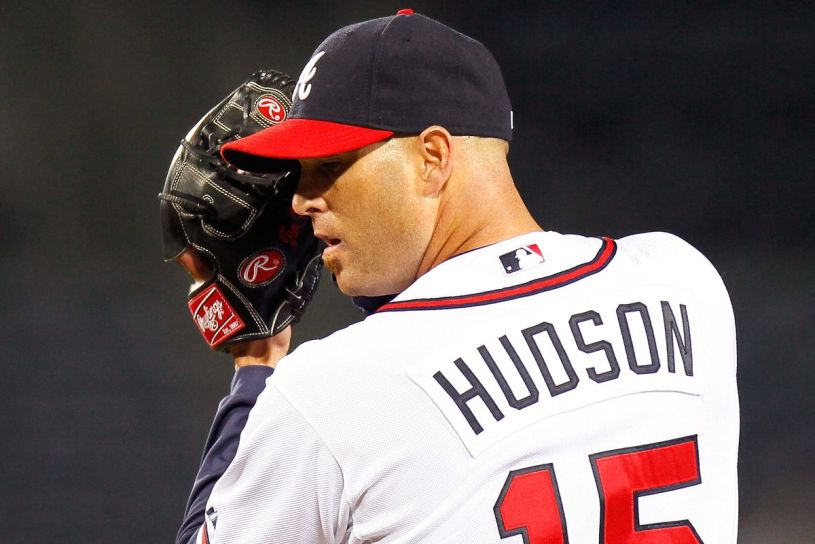
For the first Friday Funday of May 2026, we look to the MLB career of longtime starting pitcher Tim Hudson. A four-time All Star, we gave him our 2010 NL Cy Young nod even though he never won the vote in real life. For a pitcher who finished a 17-season career with a 3.49 ERA, we are surprised he only made four All-Star teams, but we know how that goes with pitchers, in terms of managers picking their own guys, etc. Still, Hudson’s 222 career victories also stands out as an impressive number.
He spent his time in the majors with Oakland (1999-2004), Atlanta (2005-2013), and San Francisco (2014-2015), pitching in the postseason for all three franchises. He actually was selected in the draft by the Athletics twice, in 1994 and 1997. The first time was after his first season of college baseball at Chattahoochee Valley Community College in Alabama (35th round); the second instance came after he had transferred and played at Auburn University (6th round). You could say the A’s really wanted him.
In his rookie season (1999) at age 23, Hudson posted an 11-2 record and a 3.23 ERA for an up-and-coming Oakland team that would make the MLB playoffs four consecutive years (2000-2003) with him at the top of the rotation. His 3.9 WAR a first-year starter was impressive, too, of course, as the A’s posted a winning record for the first time since the 1992 campaign. Oddly, this only got him a mere fifth place in the AL ROTY vote, which doesn’t make a lot of sense to us. We would have placed him second.
Either way, in 2000, he won 20 games and made his first All-Star team as Oakland won the AL West, unexpectedly. Hudson was never a strikeout pitcher, but it is interesting to note his first two years in MLB produced his highest K rates ever (8.7/9IP in 1999 and 7.5/9IP in 2000). His career rate ended up being just 6.0 Ks per 9 IP, so perhaps hitters figured out at that point that his stuff wasn’t that electric. In fact, his 6.9/9IP K rate in 2001 was the third best of his career, showing an odd decline there for Hudson.
After all, he did have a long, successful career without striking out a lot of batters. After finishing second in the AL Cy Young voting for his 20-win effort in 2000, he topped the majors with 35 starts in 2001, winning 18 games and delivering a 3.37 ERA. He kept improving, year by year, with a stellar 2002 season (15-9, 2.98) and his best-ever season in 2003 (16-7, 2.70). In fact, from 1999-2003, Hudson improved his WAR mark every year, peaking with 7.4 WAR in 2003 as the A’s won the AL West yet again.
Yet he finished just fourth in the AL Cy voting. After finishing in the Top 6 vote three times in a four-season span, he would only earn votes one more time in his career (2010). It’s almost as if nothing Hudson did could impress, which is odd, and maybe it is because he was reliable, steady, and strikeout poor. This goes in line, too, with the mere four All-Star nods and the fact he fell off the Cooperstown ballot after just two years (see below). His 57.9 career WAR seems to warrant a bit more love than that, really.
But we digress.
One knock against Hudson early on was his lack of postseason success, as with the A’s, he won just a single postseason game in four Octobers across seven starts. His 1-2 record in the playoffs with Oakland comes with a 3.44 ERA, which is right there with his career mark, but somehow, like his whole team, Hudson just couldn’t “win the big one” as the Athletics lost four consecutive Game 5s in the divisional round of the AL playoffs, multiple times blowing 2-0 series leads (2001, 2003). That ugly label stuck.
In 2004, Hudson “regressed” to 4.3 WAR, putting up a 12-6 record with a 3.53 ERA after starting “just” 27 games, and the Oakland front office decided he was going to be too expensive to keep longterm. Plus, he was heading into his age-29 season, so the Moneyball A’s flipped him to the Atlanta Braves, as Hudson was a Georgia native. That alone says a lot about their respect for him, even if they didn’t want to spend the money to keep him. Oakland’s returns in the trade never amounted to anything, either.
With the Braves, Hudson just kept moving along nicely, for nine seasons, 113 more victories, and a 3.56 ERA. However, this was an era of Atlanta baseball where the team was not as dominant as it had been from 1991 to 2004. He made just three postseason starts for the club, across only two Octobers (2005, 2010), and Hudson was winless in those starts, despite a 3.48 ERA. Thus, the same labels hung around his neck in the Southeast: he can’t win the big one(s). His 2010 season featured an All-Star nod, though.
That was his best year in Atlanta (5.8 WAR) and the third-best season of his career overall: 17-9, 2.83. At age 34, however, it also was the informal end of his prime production, and in his final three campaigns with the Braves, Hudson saw his ERA rise every year until it hit 3.93 in 2013. But he kept posting winning records, every year: in fact, from 1999-2013, he won more games than he lost, every season. This streak of success contributed to his impressive .625 winning percentage accrued over his full career.
Yet all that would end as Hudson was not retained by Atlanta after the 2013 season. His annual salary had been $9M per year from 2010-2013, and he was clearly in decline entering his age-38 season, yet for some reason, the San Francisco Giants threw $23M at him for two years. He ended up posting two straight losing records with them in 2014-2015, with a 3.91 ERA, but San Francisco won the World Series in 2014, getting Hudson a long sought-after ring. Yet still? He was winless in four postseason appearances.
Hudson made the All-Star roster his first year with the Giants, despite finishing with just 1.0 WAR and a 9-13 record to go along with a 3.57 ERA. His tossed 21 October innings and produced a 4.29 ERA with an 0-1 record, so he personally didn’t really win the “big one” as that honor went to one of his rotation mates with San Francisco. Hudson’s final season (2015) produced just 0.5 WAR, an 8-9 record, and a 4.44 ERA; sadly, this was his worst season ever, and at age 39, he decided to retire at that point in time.
It is interesting how his only two losing seasons came at the end of a stellar career, and yet that experience still netted him a World Series championship. Hudson certainly endured his trials and tribulations, like the 2009 season where he was injured and made only seven starts (still posting 0.9 WAR in the process, though). He always seemed to find his way back from the challenges he faced, but the Hall of Fame voters didn’t really value his career: he peaked at 5.2 percent of the vote in 2021, his first on ballot.
He dropped to 3.0 percent in 2022, and that was that. Hudson ranks as the 74th-best starter in MLB history, which isn’t really in Cooperstown territory, but we still feel, maybe a bit subjectively, that more voters could have appreciated his steadiness for what it was over the 17 years of his career. Alas, we estimate he made over $120M total overall, so as the joke goes, he can cry himself to sleep on that huge pile of money—and the World Series ring he earned in 2014. We’d all take that kind of career in a heartbeat, eh?
 Daily McPlay: (mostly) Historical Sports Analysis with TENACITY & VERVE
Timmy was one of my favorites for a long, long time. His consistency was remarkable. He was a staple on my fantasy teams many of those years, so I followed him closely. To me, he is a Hall of Famer. I couldn’t believe the lack of respect he received on those HOF votes. I think part of the problem, on top of the things you already mentioned, was that he was unfairly grouped in, perhaps even overlooked with the other pitchers in his rotations – Barry Zito and Mark Mulder in Oakland, and John Smoltz in Atlanta. For whatever reason, people loved Zito more, for example.
Anyway, great writeup on Huddy!
Thanks,
Reid
LikeLiked by 1 person
Watching him in Oakland was a treat. He and Mulder were traded away after 2004, while Zito was around until 2006 and never traded—despite being the weakest of the three in our opinion. We do think that perception of not winning in October hurt him, but guys have to win from April to September to even get to October, right?! And Timmy was good at that.
LikeLiked by 1 person