
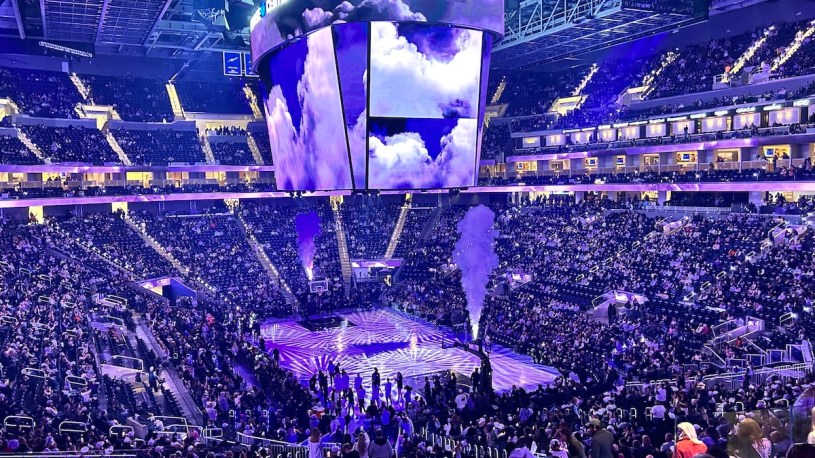
We have taken a lot of weekends “off” in the last few months, but we’re back today with a new Sunday Surmising column on the WNBA, which kicked off its preseason in grand style on Saturday with a slate of exhibition contests on the schedule. So, of course, we went to see the Golden State Valkyries start their second season in the league as they faced off against the Seattle Storm in a game where neither team was playing with anything resembling its full roster of players; the Valkyries won a meaningless tilt.
The scene at Ballhalla—a.k.a., the Chase Center in San Francisco, on the waterfront where the NBA’s Golden State Warriors also play—was pretty fun, once again, and that’s what we want to zoom in on today. Paid attendance was over 18,000 fans for a preseason contest that meant nothing, other than the obvious: the Valkyries are popular in the Bay Area. We didn’t see a lot of empty seats on a night where every fan in attendance got a free 2026 team t-shirt and a violet “victorine” (as we are calling it).
That energy and support is important for a fledgling league that needs its fan base to grow in order to survive and thrive, despite the continued financial backing from the NBA. Coming off a labor dispute in the offseason that threatened to derail the momentum the WNBA has established over the last two seasons, it is a league-wide imperative to continue cultivating a firm presence in the North American sports scene. The Valkyries became the first expansion team in league history to make the postseason last year …
And now two new expansion teams enter the league to attempt the same: the Portland Fire and the Toronto Tempo. Over the next few seasons, three more teams will join the WNBA: Cleveland (2028), Detroit (2029), and Philadelphia (2030). That will bring the league to 18 total teams, and it’s smart to grow incrementally. A long time ago, the league expanded way too quickly, and it lost a lot of credibility when multiple franchised folded into oblivion. The WNBA clearly does not want to make that mistake again.
We hope it works for them: we love the energy at WNBA games, which is much more positive—even if a bit delusional at times, in terms of fan-favorite players who are actually not very valuable parts of the team—atmosphere than at the games of men’s professional sports leagues. It’s also great to see little girls wearing GSV gear and recognizing professional sports as a career option at a young age, too. This nation is, unfortunately, very far behind other global nations in gender equality and social equity.
Locally, we know how bandwagon the Bay Area sports fans are when it comes to the MLB, NBA, NFL, and NHL teams, sadly. Thus, the Valkyries really need a quality second act here, and the team’s recent draft results were not very good. Fortunately, Head Coach Natalie Nakase is as good as it gets, and the team is led by 2025 Most Improved Player Award winner Veronica Burton. The cast of characters around them may revolve, but this core all but guarantees the team will be competitive again. And then …
This: the WNBA is not like those other leagues, in terms of its fan base. We expect the base support for this team to remain consistent, regardless of outcomes on the court. The fans, again, are more compassionate, diverse, empathetic, kind, and … dare we say … loving. That will carry the Valkyries a long way, barring a complete collapse into the basement of the standings for several consecutive years in a row. Ballhalla is here to stay in the greater San Francisco Bay Area, period, despite any perceived setbacks.

